
Pediatric Hematology & Oncology Fellowship: Curriculum & Rotations
The U-M Medical School Department of Pediatrics' Pediatric Hematology & Oncology Fellowship program offers in-depth training in patient care to prepare trainees to develop expertise in the field.
For More Information
Training Schedule
On call, fellows are responsible for the hematology, oncology, and blood and marrow transplant and cellular therapy patients. There is a resident team in house as first call for the hematology/oncology patients. There is an NP or PA in house as first call for the blood and marrow transplant and cellular therapy patients. You take calls from the inpatient teams, parents, our ED and outside EDs. 2 nights per week first call is taken by NP or PA. Holiday coverage is split between all years of fellowship. There are always Attending on for Hematology/Oncology and Blood and Marrow Transplant and Cellular Therapy
Call Schedule
| Year | Total Nights | Weekends (Friday-Sun) |
| 1st Year | ~1-2 calls per week | ~1 per month |
| 2nd Year | ~0-1 call per week | ~4-6 per year |
| 3rd Year | ~01 calls every other week | ~4-6 per year |
Educational Conferences
First year begins with five days of a “Crash Course” taught by faculty. The fellow education series is divided into different topics by month. Fellows have one week of board review, one week of journal club, one week of attending lecture, and one week of “other.” Every 1st Thursday at 12:30 pm is a multi-site immunohematology case presentation/discussion.
- Monday: BMT Sign Out - 8 AM; Hematology Sign Out - 12 PM
- Tuesday: Pediatric Grand Rounds - 8 AM; Pediatric Hematology Oncology Sign Out - 4:30 PM
- Wednesday: Hematology-Oncology Division Meeting/Research Conference - 8:15 AM; Tumor Board - 12 PM
- Friday: BMT Research Conference - 8 AM; Fellow Education Series - 8 AM; Oncology Research Patient Discussion - 3 PM
- Monthly: Leukemia-Lympohma Conference - 2 PM
Year 1
- Oncology: 14 weeks
- Inpatient Blood and Marrow Transplant: 8 weeks
- Hematology: 14 weeks
- Outpatient Clinic: 4 weeks
- Continuity Clinic (General Hematology Oncology): One full day per week regardless of rotation
- Vacation: 4 weeks
- Team is comprised of an attending, a fellow, an APP, a senior resident, 3 senior residents and up to 3 medical students
- Pharmacy and dietitan often round with the team
- Case management and social work are closely involved with the team
- The fellow is responsible for leading the team and inpatient oncology consults
- The census is usually 15-25 patients
- Team is comprised of an attending, 1 NP/PA and a fellow
- Pharmacy and nutrition often round with the team
- Case management, social work and psychology are closely involved with the team
- The fellow is responsible for individual patients, and later in the year often runs the team
- The census is usually 5-10 patients
- Team is comprised of an attending, fellow, and APP. At times, there may also be a 4th year coagulation fellow, residents or medical students.
- Consults most commonly occur in PICU, NICU, PCTU and general floors.
- Common consults include cytopenias, VTE (DVT, stroke, PE), immune deficiency, and HLH
- 7 half-days of different clinics (plus 1 full day of your continuity clinic)
- 1 half-day for research, doctor’s appointments, etc.
- Options include: Long-Term Follow Up Clinic, Phase I Clinic, Neuro-Oncology Clinic, Sickle Cell/Hemoglobinopathies Clinic, Coagulation Clinic, Immunohematology Clinic, Hematopathology, Radiation Oncology and Blood Bank
- You will have the same day of clinic with the same Attendings for all 3 years
- Each patient is assigned a primary attending, primary fellow and primary NP
- During first year you are assigned new oncology patients
- Your Scholarly Oversight Committee will meet with you early in the first year to help you identify potential research mentors based on your interests.
Years 2 & 3
- Second and third year fellows are primarily research fellows with one day of clinic per week
- Your primary research mentor may be part of the Department of Pediatrics or chosen from a group of qualified mentors campus wide
- You are expected to present two research seminars, one at the end of each research year.
- During second and third year you keep your oncology patients and see new hematology patients
- Second and third years may elect to split time between their continuity clinic and another clinic of interest (e.g. neuro-oncology, sickle cell/hemoglobinopathies, coagulation, immunohematology, BMT)
- Second year fellows can do an optional 1-2 weeks of “pre-attending” on the inpatient hematology/oncology service
- Third year fellows do 2-3 weeks of “pre-attending” on the inpatient hematology and/or oncology service
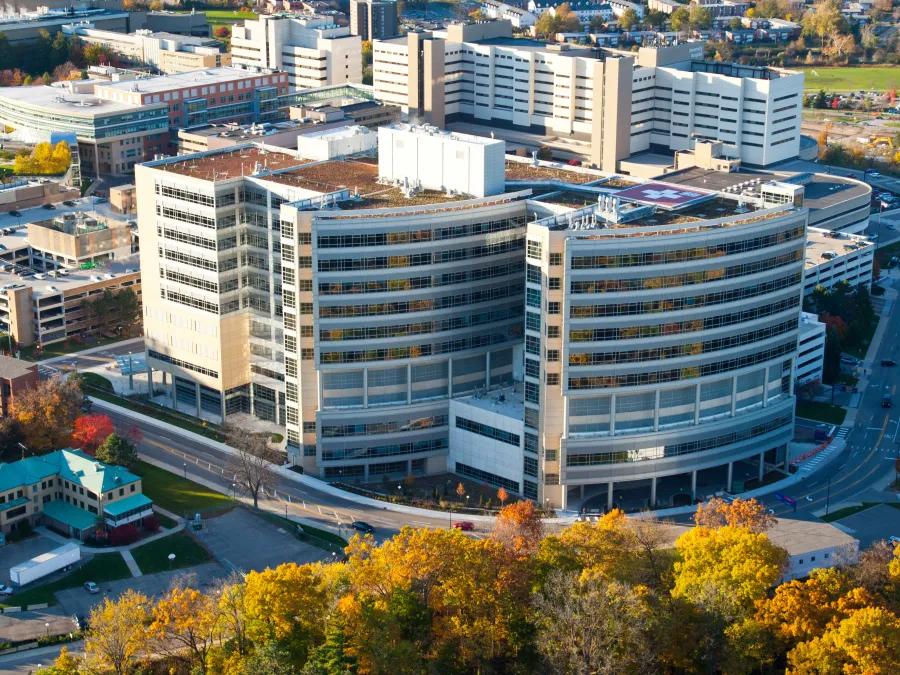
See Where Training Takes Place
Expand your career trajectory in a high-volume academic medical center that also supports and excels in a wide range of basic science, translational and clinical research programs.
