
MD Curriculum Diagrams
MD Curriculum Diagrams
Overviews and examples for you to reference
Diagrams are provided for reference only; curriculum details are subject to change. Content was last reviewed and/or updated in July 2024.
The Michigan Curriculum
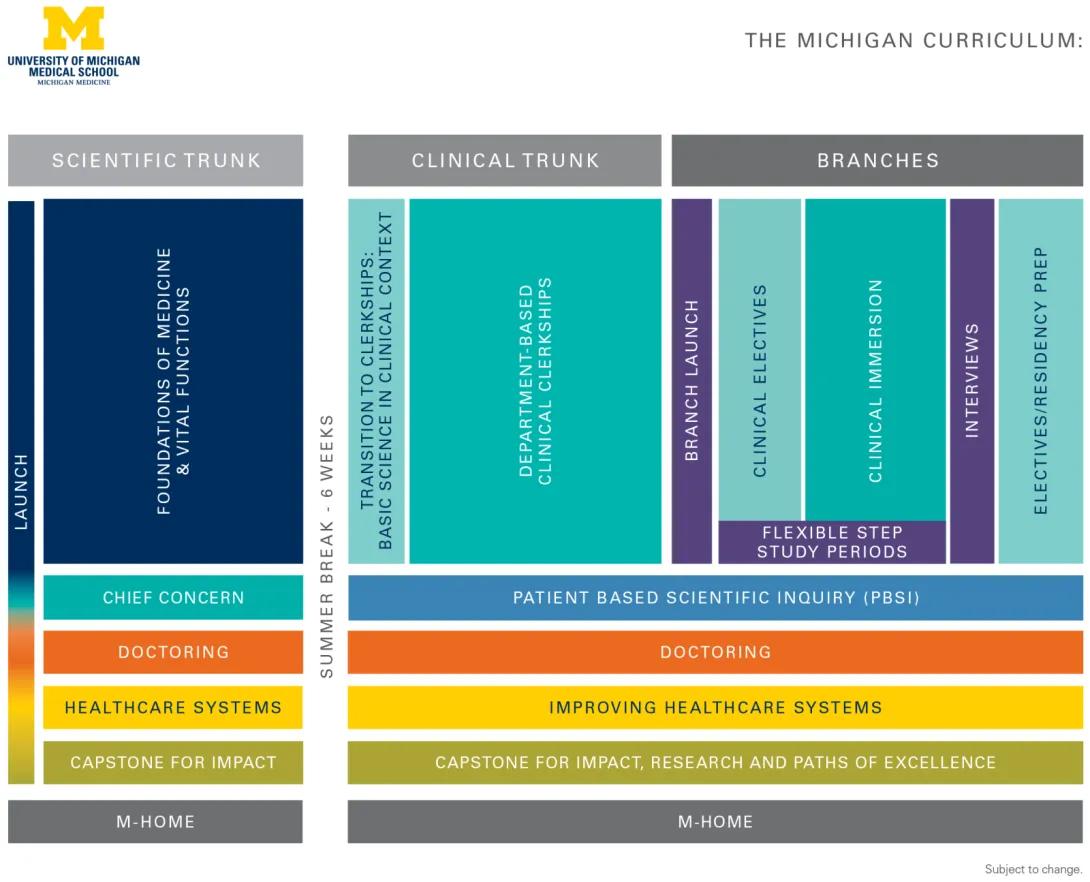
The Michigan Curriculum graphic from the University of Michigan Medical School presents the medical education sequence as a horizontal timeline with three main phases: Scientific Trunk, Clinical Trunk and Branches.
The Scientific Trunk begins with Launch and includes Foundations of Medicine and Vital Functions, followed by Chief Concern, Doctoring, Healthcare Systems, Capstone for Impact, and M-Home. A six-week summer break separates the Scientific Trunk from the Clinical Trunk.
The Clinical Trunk includes Transition to Clerkships: Basic Science in Clinical Context and Department-Based Clinical Clerkships. Longitudinal components during this phase include Patient-Based Scientific Inquiry (PBSI), Doctoring, Improving Healthcare Systems, Capstone for Impact, Research and Paths of Excellence, and M-Home.
The Branches phase begins with Branch Launch and includes Clinical Electives, Clinical Immersion, Flexible Step Study Periods, Interviews, and Electives/Residency Prep. The longitudinal components from the Clinical Trunk continue through the Branches phase.
The graphic uses color-coded blocks and vertical and horizontal labels to show the sequence, duration, and overlap of curriculum components. The curriculum is noted as subject to change.
Scientific Trunk Overview
Scientific Trunk Overview — University of Michigan Medical School
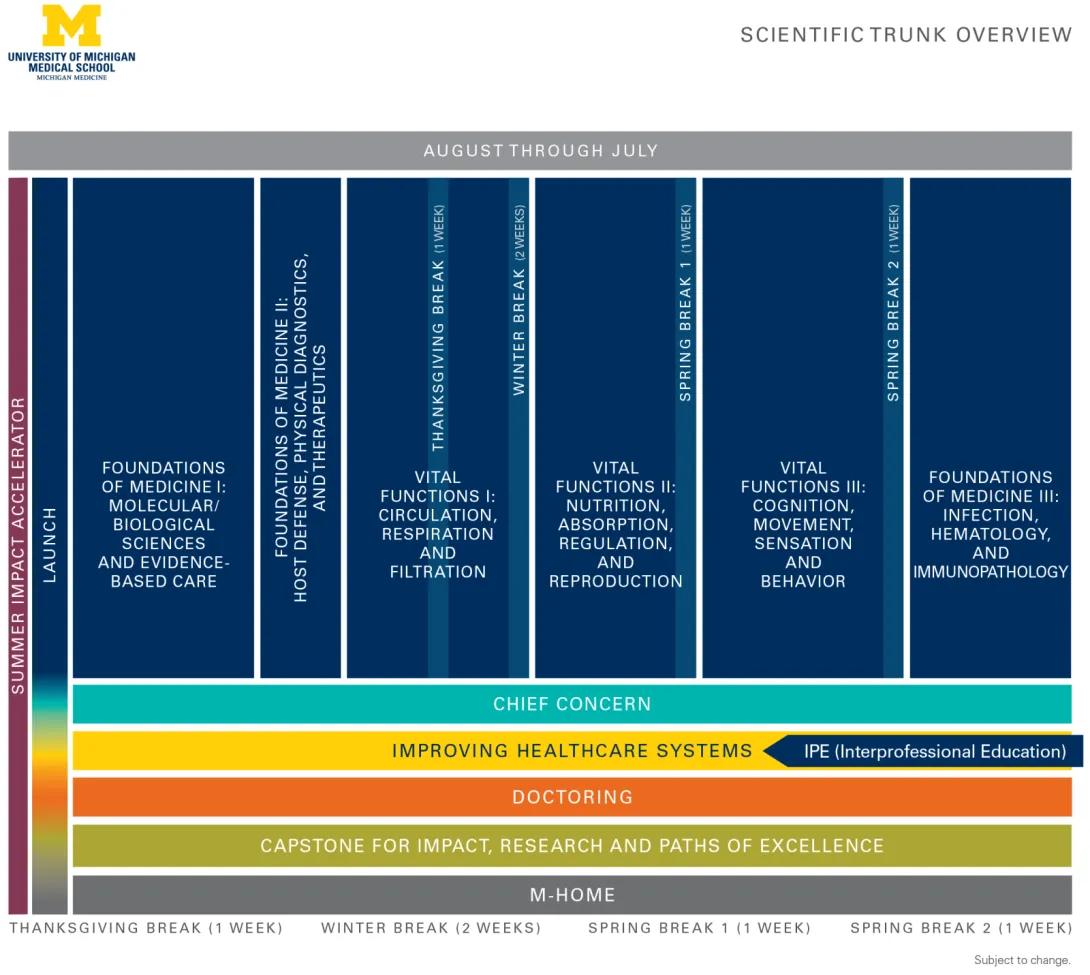
This diagram shows a yearlong curriculum timeline running from August through July. The main content is a series of large vertical blocks (course blocks) arranged left to right, with thin vertical bars marking academic breaks. Along the bottom, several horizontal bands represent longitudinal courses that continue across most or all of the year.
Course blocks (left to right)
Foundations of Medicine I: Molecular/Biological Sciences and Evidence-Based Care.
Foundations of Medicine II: Host Defense, Physical Diagnostics, and Therapeutics.
Vital Functions I: Circulation, Respiration, and Filtration.
Includes Thanksgiving Break (1 week) (shown as a thin vertical break bar).
Vital Functions II: Nutrition, Absorption, Regulation, and Reproduction.
A Winter Break (2 weeks) occurs between Vital Functions I and Vital Functions II (thin vertical break bar).
Includes Spring Break 1 (1 week) (thin vertical break bar).
Vital Functions III: Cognition, Movement, Sensation, and Behavior.
Includes Spring Break 2 (1 week) (thin vertical break bar).
Foundations of Medicine III: Infection, Hematology, and Immunopathology.
Pre-year/launch element
Along the far left edge, the diagram labels a Summer Impact Accelerator with a Launch marker, indicating an introductory/launch component associated with the start of the overall timeline.
Longitudinal threads (horizontal bands across the year)
Chief Concern
Improving Healthcare Systems, which includes IPE (Interprofessional Education)
Doctoring
Capstone for Impact, Research and Paths of Excellence
M‑Home
Breaks summary
Thanksgiving Break: 1 week
Winter Break: 2 weeks
Spring Break 1: 1 week
Spring Break 2: 1 week
The diagram also notes “Subject to change.”
Clinical Trunk Overview
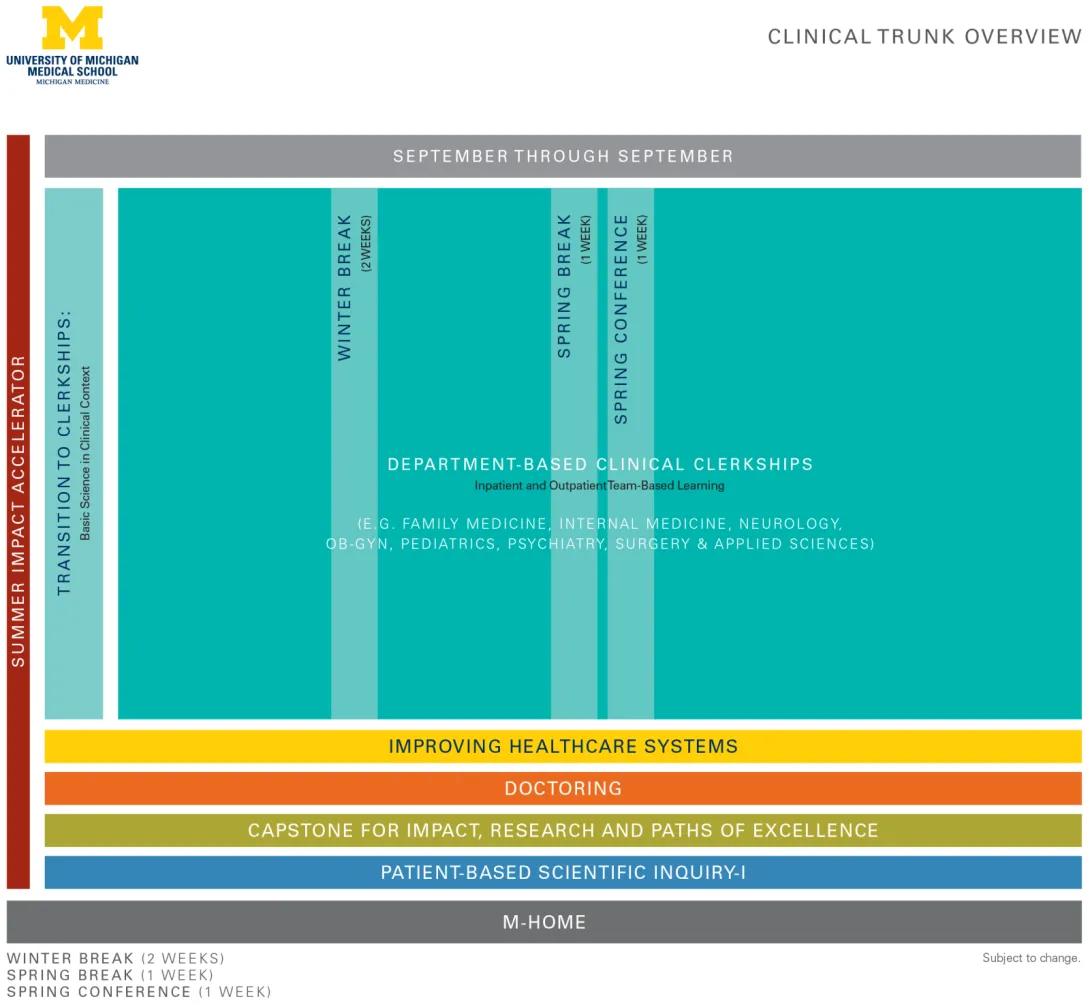
This diagram is titled “Clinical Trunk Overview” from the University of Michigan Medical School. It presents a timeline that spans September through September. The main area is a large block labeled “Department-Based Clinical Clerkships,” described as inpatient and outpatient team-based learning, with examples including family medicine, internal medicine, neurology, OBGYN, pediatrics, psychiatry, surgery and applied sciences.
At the far left, a vertical bar labeled “Summer Impact Accelerator” runs along the full height. Next to it is a shorter vertical block labeled “Transition to Clerkships,” described as basic science and clinical context.
Within the yearlong clerkship timeline, three scheduled time-off or program periods appear as narrow vertical bars: Winter Break (2 weeks), Spring Break (1 week), and Spring Conference (1 week). A small legend at the bottom repeats these durations.
Below the clerkship block are longitudinal strands shown as horizontal bands that extend across the year: Improving Healthcare Systems, Doctoring, Capstone for Impact, Research and Paths of Excellence, Patient-Based Scientific Inquiry I, and M-Home. The diagram includes a note that it is subject to change.
Clinical Trunk Transition: Week Example
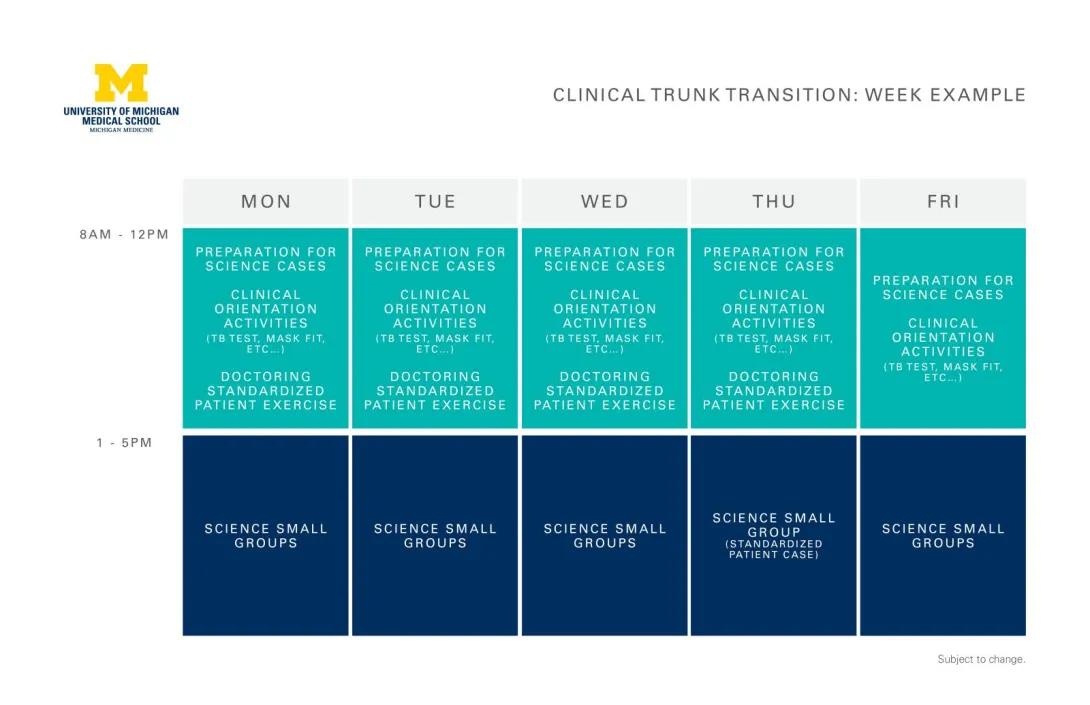
This diagram is titled “Clinical Trunk Transition: Week Example” from the University of Michigan Medical School. It shows a weekly schedule grid with columns labeled Mon, Tue, Wed, Thu, and Fri. Two main time blocks are shown on the left: 8 am to 12 pm and 1 pm to 5 pm. Each day has morning and afternoon activities. The diagram includes a note that it is subject to change.
8 am to 12 pm (Mon to Thu): Preparation for Science Cases; Clinical Orientation Activities (TB test, mask fit, etc.); Doctoring Standardized Patient Exercise.8 am to 12 pm (Fri): Preparation for Science Cases; Clinical Orientation Activities (TB test, mask fit, etc.).
1 pm to 5 pm (Mon to Wed): Science Small Groups.1 pm to 5 pm (Thu): Science Small Groups (Standardized Patient Case).1 pm to 5 pm (Fri): Science Small Groups.
Clinical Trunk Clerkships: Inpatient Pediatrics Week Example
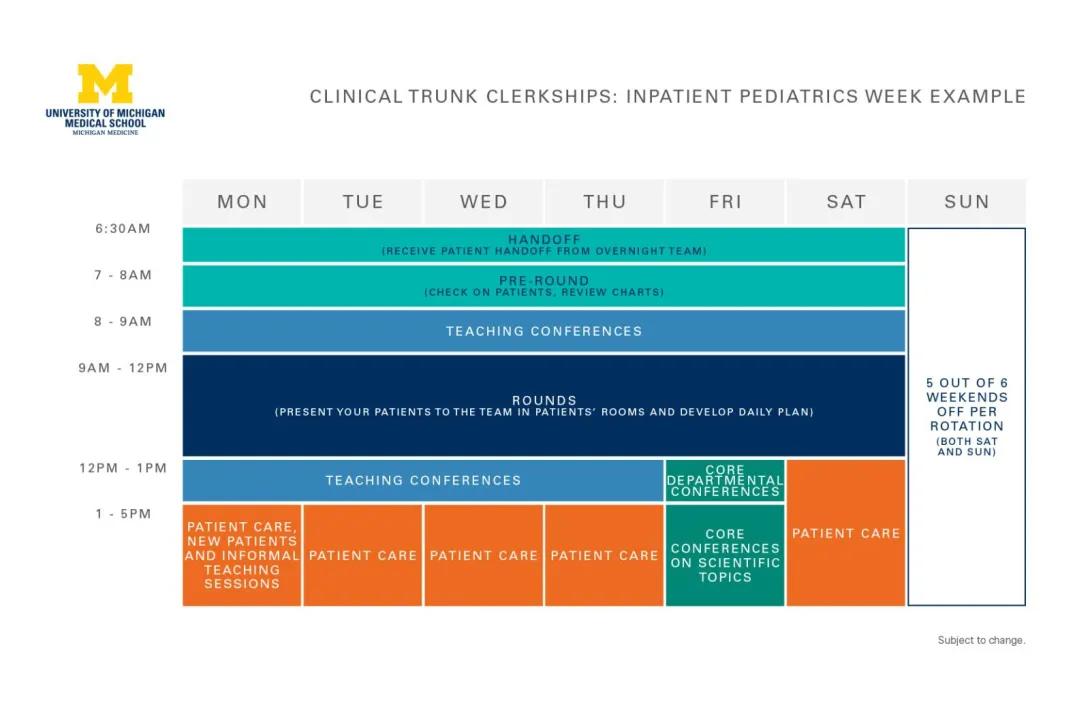
This diagram is titled “Clinical Trunk Clerkships: Inpatient Pediatrics Week Example” from the University of Michigan Medical School. It is a weekly schedule grid with columns labeled Monday through Sunday and times listed down the left side from 6:30 am to 5 pm. Most scheduled blocks run Monday through Saturday, with Sunday shown as a weekend-off note rather than timed blocks. The diagram includes a note that it is subject to change.
A morning block labeled Handoff runs across Monday through Saturday from 6:30 am to 7 am, described as receiving patient handoff from the overnight team. Pre-round runs across Monday through Saturday from 7 am to 8 am, described as checking on patients and reviewing charts. Teaching Conferences runs across Monday through Friday from 8 am to 9 am. Rounds runs across Monday through Friday from 9 am to 12 pm, described as presenting patients to the team in patients’ rooms and developing the daily plan. Teaching Conferences continues Monday through Thursday from 12 pm to 1 pm.
Afternoons vary by day. Monday from 1 pm to 5 pm is labeled Patient Care, New Patients, and Informal Teaching Sessions. Tuesday through Thursday from 1 pm to 5 pm are labeled Patient Care.
Friday afternoon is divided into conference blocks: 12 pm to 1 pm is Core Departmental Conferences, and 1 pm to 5 pm is Core Conferences on Scientific Topics. Saturday from 1 pm to 5 pm is labeled Patient Care.
The Sunday column contains a note stating “5 out of 6 weekends off per rotation (both Sat and Sun).”
Branch Overview
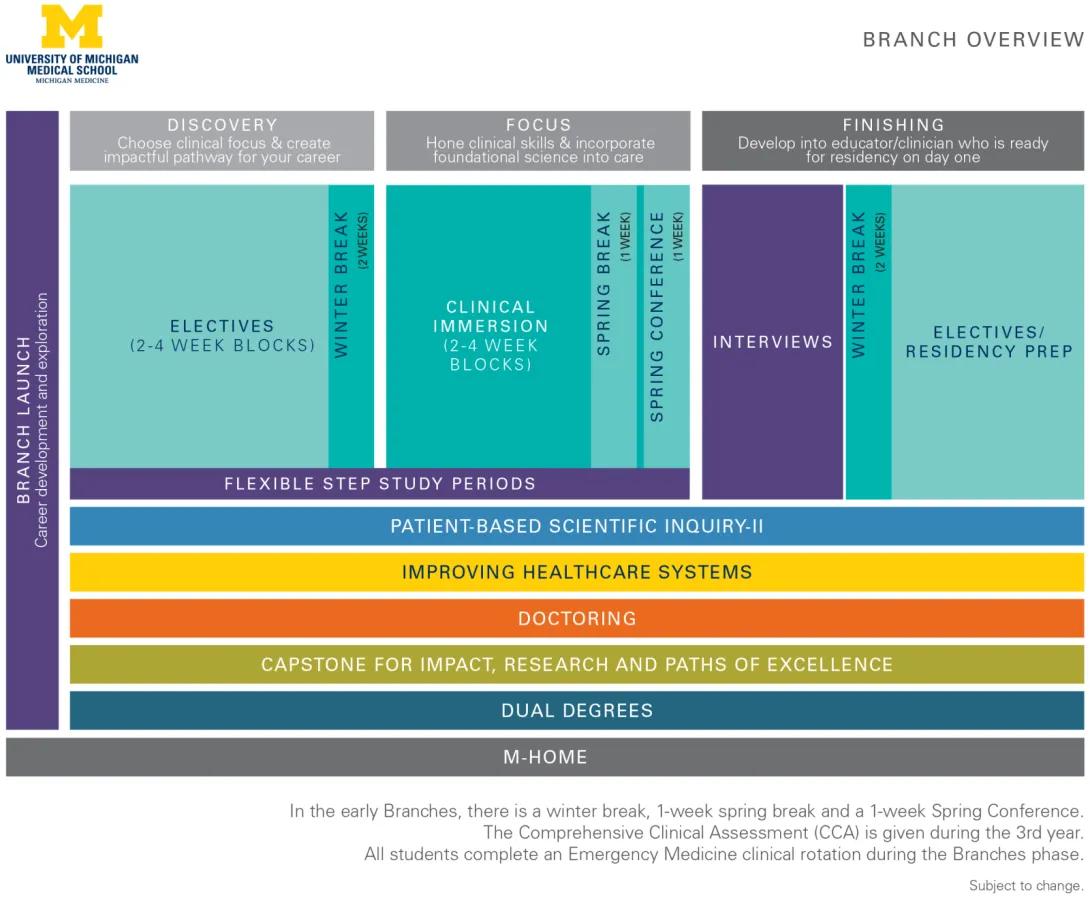
This diagram is titled “Branch Overview” from the University of Michigan Medical School. It presents the Branch phase as a left-to-right timeline divided into three stages: Discovery, Focus, and Finishing. A vertical bar on the far left is labeled “Branch Launch” and notes career development and exploration.
Discovery is shown as a period of electives in 2 to 4 week blocks. A Winter Break of 2 weeks appears within this stage.
Focus is shown as “Clinical Immersion” in 2 to 4 week blocks. During Focus, a Spring Break of 1 week and a Spring Conference of 1 week are shown as separate short blocks.
Finishing is shown as a period for Interviews followed by Electives and Residency Prep. Another Winter Break of 2 weeks appears within Finishing.
A band labeled “Flexible Step Study Periods” runs beneath the Discovery and Focus sections.
Across the bottom of the diagram, several longitudinal elements are shown as horizontal bands spanning the Branch phase: Patient-Based Scientific Inquiry II, Improving Healthcare Systems, Doctoring, Capstone for Impact, Research and Paths of Excellence, Dual Degrees, and M-Home.
Notes at the bottom state that early Branches include a winter break, a 1 week spring break, and a 1 week spring conference; that the Comprehensive Clinical Assessment (CCA) is given during the third year; and that all students complete an Emergency Medicine clinical rotation during the Branches phase. The diagram includes a note that it is subject to change.
