

Pediatric Hospital Medicine Fellowship: Training Opportunities
As a large academic institute, the U-M Medical School Department of Pediatrics' Pediatric Hospital Medicine Fellowship has numerous resources to support its trainees.
Fellows can choose from a number of opportunities that best fit their personal interests and career goals.
For More Information
Research
For fellows interested in strengthening their research skills and knowledge, there are resources to connect you to the research community within U-M Medical School, including our Michigan Institute for Clinical and Health Research (MICHR) and the Child Health Evaluation and Research Center (CHEAR). MICHR is dedicated to enabling and enhancing clinical and translational research at the University of Michigan.
MICHR supports research teams by offering education, funds, and connections. Services include a mentoring academy, awards, certifications, and workshops as well as a Master of Science in Clinical Research.
CHEAR is a large research center based in the Division of Pediatrics that bring together multiple subspecialists and institutes to identify and advance high priority issues in child health. CHEAR offers mentorship, connections to leaders in transformative research, seminars for research methods, and fellowships.
Medical Education
The U-M Medical School has multiple opportunities for further training for those fellows interested in Medical Education. The Medical Education Scholars Program (MESP) is an internationally acclaimed program that develops leaders in medical education by reinforcing skills in teaching and scholarship. Through MESP, scholars receive support on a scholarly project of their choosing as well as a connection to a community of educators within the University of Michigan.
The Community of Medical Educators in Training (CoMET) is similar to MESP but is trainee-designed and trainee-led. CoMET sharpens teaching skills as well as encourages scholarly work in education.
The U-M Medical School also has a state of the art Clinical Simulation Center that fellows can utilize and incorporate into their scholarly activity. The Clinical Simulation center provides an innovative learning environment for all types of learners. We also offers a Master of Health Professions Education.
Quality Improvement & Patient Safety
Fellows interested in refining their Quality Improvement and Patient Safety skills can participate in Lean training or our Patient Safety and Quality Leadership Scholars (PASQUAL) Program. Lean training is offered as a 5-day course that is aimed at teaching the principles, systems, and tools of Lean.
PASQUAL is a more in-depth program that teaches the foundation in principles of quality improvement and patient safety. Through PASQUAL, scholars will develop skills in teaching, leading, and scholarship.
Global Health
The Global REACH (Research, Education, and Collaboration Health) program is ideal for fellows who want to engage in global health activities. Global REACH offers programs and travel awards to allow its trainees to experience medicine all over the world with the goal of advancing healthcare and reducing disparities.
Additionally, Global REACH offers the Global Health Research Certification Program, a program designed to help faculty, fellows, and residents incorporate global health into their research portfolios, creating a foundation for meaningful collaborative relationships and research in the global health setting. (The Pediatric Hospital Medicine Fellowship supports its trainees to engage in programs of interest.)
Healthcare Administration
The U-M Medical School offers additional training in healthcare administration through our Healthcare Administration Scholars Program. This program is a 20 month program aimed at preparing graduates to succeed in a leadership position in their field and allows participants to establish a network for future collaboration.
Healthcare Disparities
The Health and Quality Scholars Program (HEQSP) is a 10-month certificate program designed to support Michigan Medicine house officers in becoming thoughtful, action-driven physicians who are equipped to improve care for all patient populations. Through interactive seminars and a mentored quality improvement (QI) project, participants learn how to deliver compassionate, personalized care while addressing barriers that impact patient outcomes.
This longitudinal program integrates cultural understanding, communication strategies, and systems-based approaches to help clinicians strengthen trust, navigate complex care needs, and work more effectively with patients from all backgrounds. Core topics include social factors that affect health, patient-provider trust, and inclusive care approaches for mental health, substance use, disabilities, language access, and other related issues.
Most sessions are virtual and held in the evening, with three in-person events including an orientation, a mid-point gathering, and a closing celebration. House officers are expected to attend at least 80% of sessions and spend 2–5 hours monthly preparing for or advancing their QI projects. This program aligns with Michigan Medicine’s commitment to delivering high-quality care through a lens of empathy, continuous improvement, and responsiveness to patient needs.
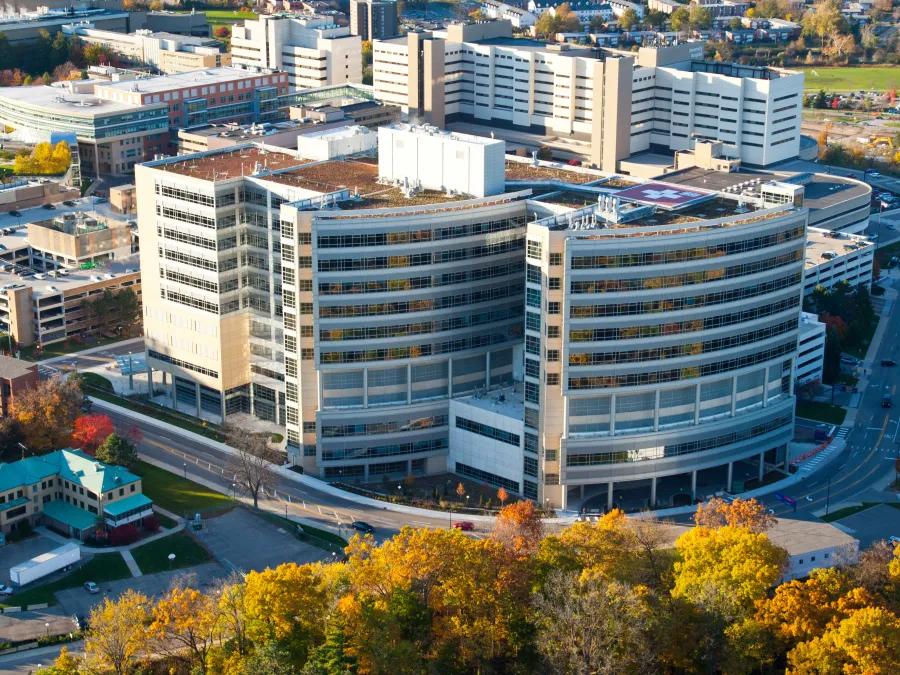
See Where Training Takes Place
Expand your career trajectory in a high-volume academic medical center that also supports and excels in a wide range of basic science, translational and clinical research programs.
