
MD Program Year 1
Scientific Trunk
The science behind the medicine.
The First Step
The Scientific Trunk is your M1 preclinical year, the starting point in a journey of continuous learning. Integrating foundational science and related clinical experiences simulates what you will do throughout doctorhood. Regular practice now cements a valuable lifelong habit while building your knowledge and skill base. Pass/fail grading (including Second Chance quizzing) gives you some breathing room to figure it all out.
The M1 curriculum emphasizes interdisciplinary teamwork, leadership and scientific exploration. It also offers time and support to pursue passions and explore interests beyond medicine. One of my favorite aspects of the curriculum is the patient presentations that not only teach us about illnesses but highlight the social, emotional and financial burdens of disease. These experiences have been invaluable in preparing me to be a compassionate provider during my clinical year."

What are the Main Features of the Scientific Trunk?
- Launch orientation featuring M-Home house sorting and Doctoring small group assignments
- Foundational courses in molecular/biological sciences, evidence-based care, host defense, physical diagnostics and therapeutics, infection, hematology and immunopathology, along with blocks of fused normal/abnormal vital functions
- Pre-recorded asynchronous lectures of science content, increasing student flexibility and accessibility
- In-person sessions focusing on active learning when students interact with the material and faculty facilitator
- Augmented Clinical Reasoning and Shadowing Interprofessional Sessions
- Development of patient care and information management skills throughout the year
- Additional longitudinal elements that start at this stage
Foundations of Medicine Blocks
The Foundations of Medicine courses make up three of the six blocks during the Scientific Trunk and introduce students to:
- Biochemical, cellular and molecular process of the organ systems
- Physical diagnostics and therapeutics
- Immune system and its primary targets
Vital Function Blocks
The three Vital Functions blocks consolidate the foundational material for related organ systems with both normal and abnormal physiology presented at the same time. Combined with related clinical cases, anatomy and histology, this makes for deeply integrated content that reinforces what you learn. Subjects include:
- Circulation, respiration and filtration
- Nutrition, absorption, regulation and reproduction
- Cognition, movement, sensation and behavior
By the end of the Scientific Trunk, you will have gained a foundational skill set that prepares you for expanded clinical time in the Clinical Trunk rotations.
The M1 curriculum integrates basic science and clinical skills from the start. In this video, medical student Mohika breaks down how it all works, from year-round instruction about medical disciplines to dedicated study of organ systems — all with flexibility that focuses on learning (and not just getting a good grade!).
Learning medicine is a lifelong journey; you are never “done”, but continually revisit, refine and expand your knowledge. In the first year you will develop a solid foundation in the basic, clinical and health system sciences that you will subsequently build on during your clinical years."

Scientific Trunk Overview
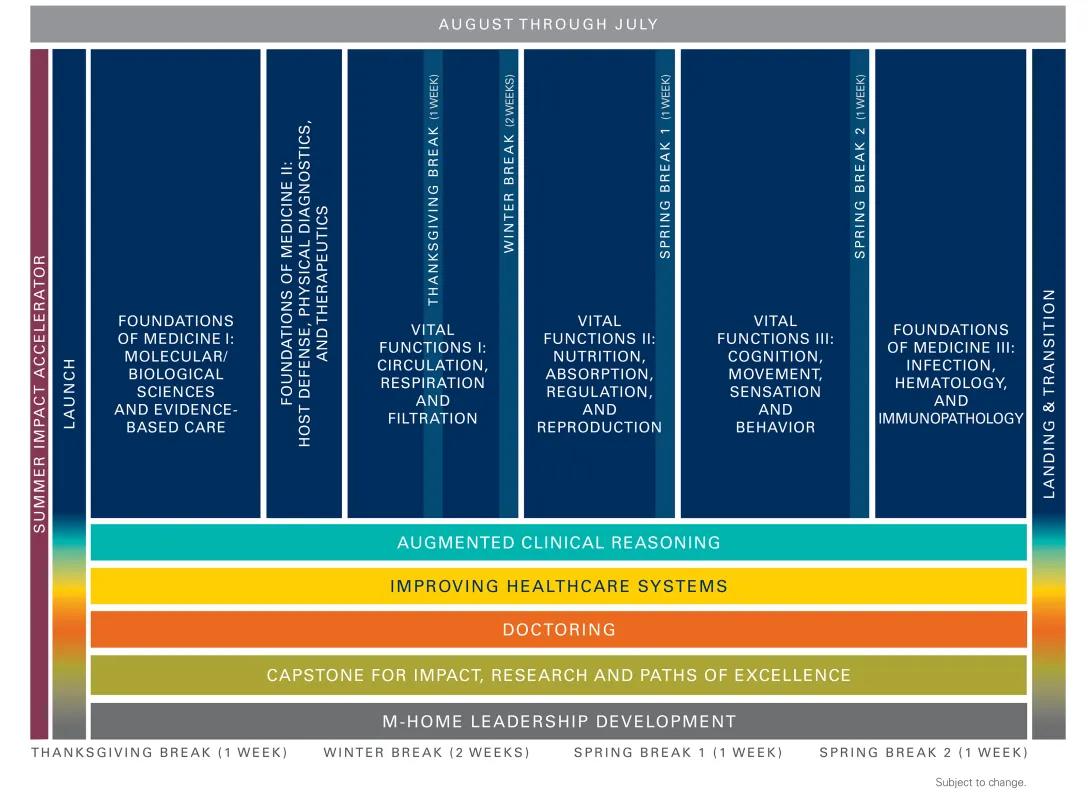
This diagram shows a yearlong curriculum timeline running from August through July. The main content is a series of large vertical course blocks arranged from left to right, with thin vertical bars marking academic breaks. Along the bottom, horizontal bands represent longitudinal courses that continue across most or all of the year.
Course blocks (left to right)
Foundations of Medicine I: Molecular/Biological Sciences and Evidence-Based Care.
Foundations of Medicine II: Host Defense, Physical Diagnostics, and Therapeutics.
Vital Functions I: Circulation, Respiration, and Filtration. Includes Thanksgiving Break (1 week), shown as a thin vertical bar. Followed by Winter Break (2 weeks).
Vital Functions II: Nutrition, Absorption, Regulation, and Reproduction. Followed by Spring Break 1 (1 week).
Vital Functions III: Cognition, Movement, Sensation, and Behavior. Followed by Spring Break 2 (1 week).
Foundations of Medicine III: Infection, Hematology, and Immunopathology.
Launch and transition elements
Along the far-left edge, the diagram labels a Summer Impact Accelerator and Launch, indicating introductory activities at the beginning of the timeline. Along the far right edge, Landing & Transition marks the conclusion of the year.
Longitudinal threads (horizontal bands across the year)
Augmented Clinical Reasoning
Improving Healthcare Systems
Doctoring
Capstone for Impact, Research and Paths of Excellence
M-Home Leadership Development
Breaks summary
Thanksgiving Break: 1 week
Winter Break: 2 weeks
Spring Break 1: 1 week
Spring Break 2: 1 week
The diagram also notes, “Subject to change.”
Scientific Trunk: Fused GI Week Example
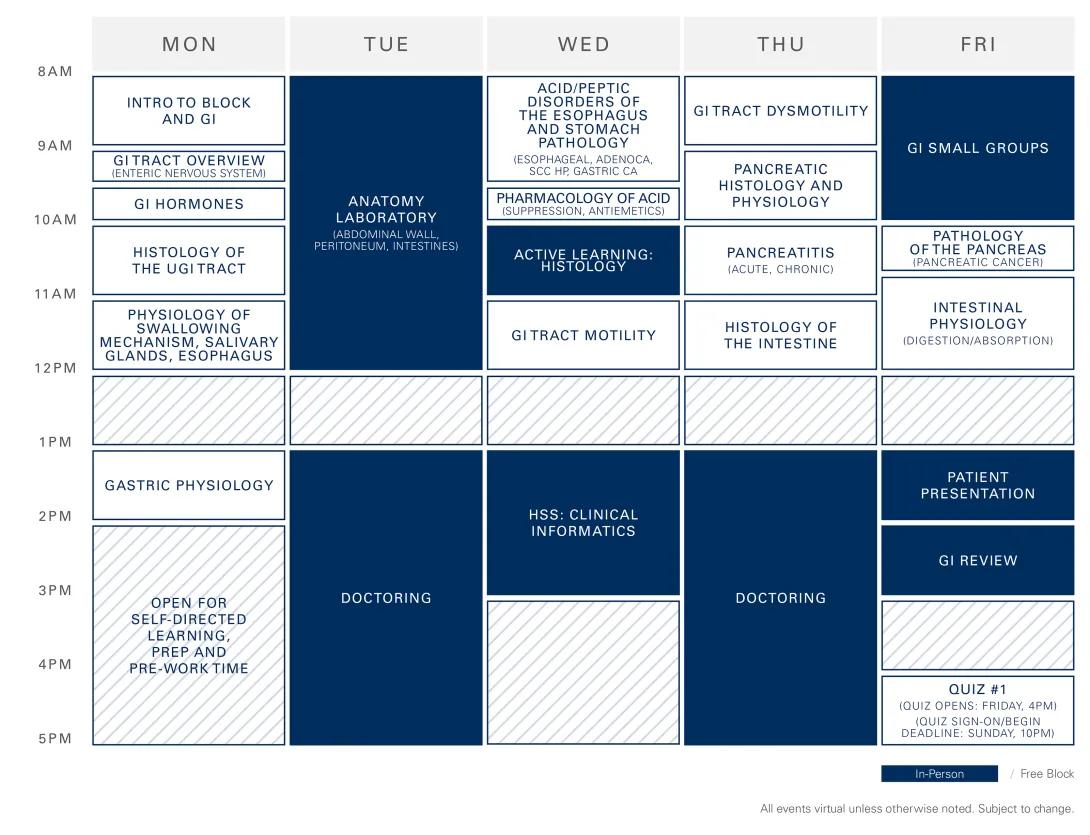
This diagram is a weekly calendar grid titled “Scientific Trunk: Fused GI Week Example” from the University of Michigan Medical School. Columns are labeled Monday through Friday. Times run down the left side from 8 am to 5 pm. Each day contains rectangular blocks indicating scheduled sessions. Dark blue blocks represent in-person sessions, and striped blocks represent free time. A note states that events are virtual unless otherwise noted and that the schedule is subject to change.
Monday: 8 am Intro to Block and GI; 9 am GI Tract Overview (Enteric Nervous System); 9:30 am GI Hormones; 10 am Histology of the Upper GI Tract; 11 am Physiology of Swallowing Mechanism, Salivary Glands, and Esophagus; 12 pm free block; 1 pm Gastric Physiology; 2-5 pm open for self-directed learning, preparation, and pre-work.
Tuesday: 8 am-noon Anatomy Laboratory covering the abdominal wall, peritoneum, and intestines; 12-1 pm free block; 1-5 pm Doctoring.
Wednesday: Morning Acid/Peptic Disorders of the Esophagus and Stomach Pathology, including esophageal adenocarcinoma, squamous cell carcinoma, Helicobacter pylori, and gastric cancer; later morning Pharmacology of Acid, including acid suppression and antiemetics; Active Learning: Histology; and GI Tract Motility. A free block is scheduled from noon-1 pm. The afternoon includes HSS: Clinical Informatics, followed by a free block.
Thursday: Morning GI Tract Dysmotility; Pancreatic Histology and Physiology; Pancreatitis, including acute and chronic forms; and Histology of the Intestine. A free block is scheduled from noon-1 pm, followed by Doctoring from 1-5 pm.
Friday: Morning GI Small Groups; Pathology of the Pancreas, including pancreatic cancer; and Intestinal Physiology, including digestion and absorption. A free block is scheduled from noon-1 pm. The afternoon includes Patient Presentation, GI Review, and another free block. Quiz #1 opens Friday at 4 pm, with the sign-on or begin deadline Sunday at 10 pm.
