Pediatric Cardiology Fellowship Curriculum & Training
The U-M Medical School Department of Pediatrics' Pediatric Cardiology Fellowship has a robust curriculum of didactic and clinically oriented educational conferences as well as routine clinical care and quality improvement conferences.
Fellows are encouraged to attend all conferences when able and are expected to attend the core fellowship curriculum conferences unless urgent clinical duties intercede.
Learn more about the fellowship program by jumping to the sections below:
Educational Conferences
The Pediatric Cardiology Fellowship at the University of Michigan Medical School has a robust curriculum of didactic and clinically oriented educational conferences as well as routine clinical care and quality improvement conferences within the Division of Pediatric Cardiology. The fellows are encouraged to attend all conferences when able and are expected to attend the core fellowship curriculum conferences unless urgent clinical duties intercede.
- Adult Congenital Case Conference (2x a Month): Subspecialty conference led by ACHD faculty and staff, presenting current patients with discussion of diagnostic or therapeutic dilemmas. Held twice monthly.
- Cardiac Catheterization Conferences:
- Cardiac Catheterization Case Review Conference: Faculty and fellows review cases performed during the previous week and scheduled for the upcoming week. Held weekly.
- Catheterization M&M: Monthly morbidity and mortality conference specific to catheterization procedures. Held monthly.
- Cardiac ICU Case Conference (Kulik Conference) (Weekly): A current inpatient on the PCTU service is discussed at length with respect to the differential diagnosis, anatomy, physiology, pre and post-operative management, and surgical options. Once a month, the conference is reserved for QI review of PCTU outcomes. A 2nd year cardiology fellow prepares the case for presentation.
- CHC Research Conference (Monthly): Each conference highlights an ongoing research project in MCHORD (The Michigan Congenital Heart Outcomes Research and Discovery unit), which is the clinical research unit dedicated to the Heart Center faculty, fellows, and staff. The conference highlights current status, results, and future opportunities of the project.
- Echocardiography Conference (4x a Week): Noninvasive imaging faculty review echocardiograms from the prior day with fellows and sonographers; fellows are asked to review the images with faculty guidance.
- Electrophysiology "Office Rounds" (Weekly): Fellows and faculty review ECGs to highlight basic findings as well as interesting tracings; fellows are encouraged to bring their ECG questions.
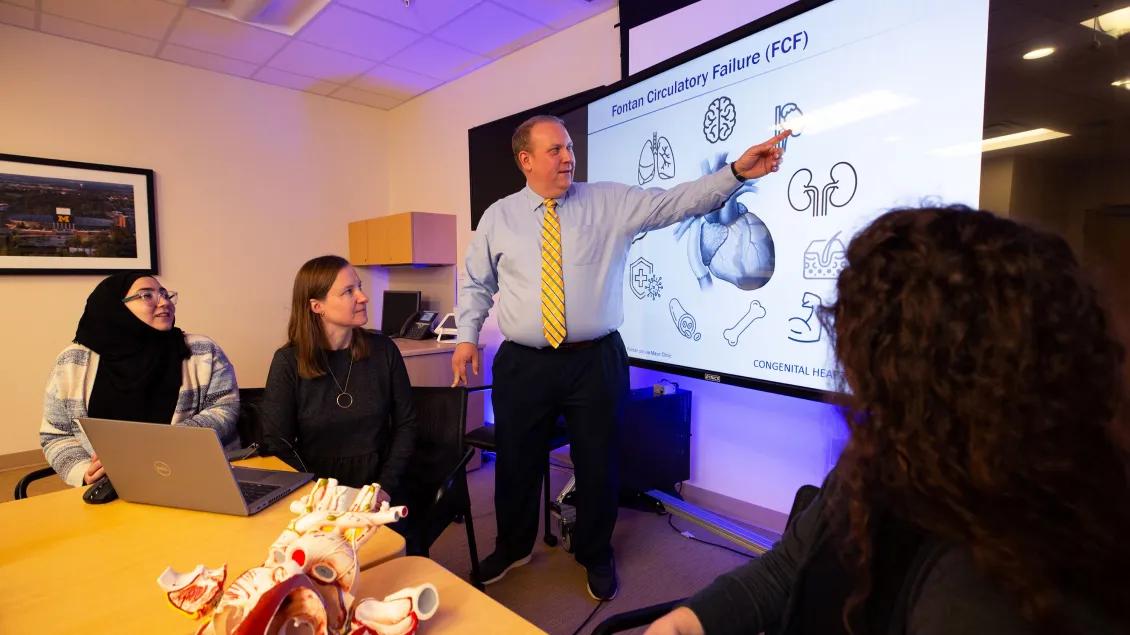
- Fellowship Core Curriculum Conferences (Daily): Didactic lectures that range from core series of lectures in each subspecialty on the science and practice of pediatric cardiology, along with other selected cardiovascular subjects required for all fellows to learn. The presentations given primarily by the cardiology faculty, are designed specifically for the fellows.
- Fellowship Program Meeting (Monthly): Monthly check-in with all fellows, with fellowship director, associate director, and fellowship coordinator. We convey information and discuss any fellowship issues. Held monthly in curriculum slot.
- Fellow Scholarly Oversight Meeting (Monthly): Core clinical research faculty meet with fellows and provide oversight for the fellows’ individual scholarly projects. Fellows give updates and discuss potential pitfalls, while faculty and senior fellows provide assistance. Faculty also provide practical teaching sessions on subjects such as abstract writing and designing a poster for presentation.
- Journal Club (Monthly): The fellows in rotation present and discuss recent (or classic) journal articles, with mentoring from one of the clinical research faculty.
- Medical Cardiology Grand Rounds (Weekly): Division of Cardiology, Department of Internal Medicine conducts an hour conference with presentations by internal or visiting experts on many facets of cardiovascular biology and disease. On occasion, the topic is particularly relevant to Pediatric Cardiology and we will encourage our fellows to attend. Held weekly.
- MRI Conference (2x a Month): Fellows and faculty review and discuss cardiac MRI’s, often with echo/MRI correlation. Held twice monthly in the morning echo conference slot.
- Pathology Conference (Monthly): Review of clinical history, gross and microscopic pathology of patients who have died or received a heart transplant; data presented by a fellow and pathologist, followed by discussion of presentation, treatment and outcome, as well as examination of the pathological specimens.
- Pediatric Cardiology: Cardiac Surgery Conference (Weekly): All patients scheduled for surgery the following week are reviewed and presented; patient histories and data presentation provided by pediatric cardiology fellows and faculty, with active discussion of options and surgical plan involving pediatric cardiology and cardiac surgery fellows and faculty. Held weekly on Wednesdays at 4-5:30 pm.
- Pediatric Grand Rounds (Weekly): Department wide conference on the broad range of pediatric topics presented by internal and external speakers covering biomedical science, clinical problems and disorders, and socioeconomic issues. On occasion, the topic is particularly relevant to Pediatric Cardiology and we will encourage our fellows to attend.
- Peri-operative Performance Rounds (Weekly): Multidisciplinary, quality-improvement focused conference to review all surgical patient outcomes from prior 2 weeks. Congenital Heart Center faculty (including cardiologists and surgeons) present pre-operative planning, intra-operative and post-operative outcomes and compare to program and PC4 benchmarks. Areas for future improvement are discussed.
Clinical Rotations
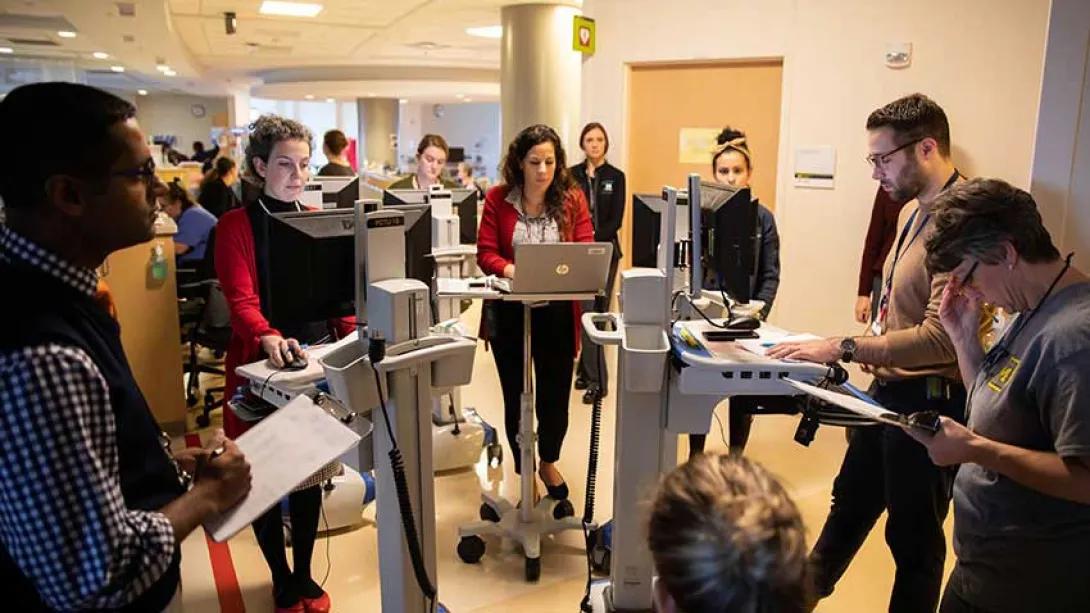
Each year the rotation schedule is designed to provide an equal experience of all fellows on inpatient service, subspecialty rotations and scholarly activity time. Currently the schedule is divided into 12 4-week rotation blocks (with an additional half-block), with some blocks split into 2-week rotations. There are a few general rules:
- The fellow attends a half-day clinic each week throughout th full three-year fellowship, regardless of the rotations.
- First and second year fellows have 4 weeks of scholarly/research time in each of their first 2 years.
- Third year fellows rotate “jeopardy” coverage where they are covering half days in PCTU/cath lab for fellows to attend their continuity clinics. They are also the go-to for urgent coverage needs due to illness/emergency. The remainder of jeopardy time is used for scholarly activity.
- Vacation (4 weeks each year) is scheduled into the first-year schedule. Second and third year fellows schedule their own vacations within their rotations.
Required Rotations
- 6 Inpatient Service weeks
- 8 Consult weeks
- 7 Cardiac Catheterization weeks
- 9 Noninvasive imaging weeks
- 3 Electrophysiology weeks
- 3 Heart Failure/Transplant weeks
- 4 Research/Scholarly activity weeks
- 12 Pediatric Cardiothoracic ICU weeks
- 4 Cardiac Catheterization weeks
- 8 Noninvasive imaging weeks
- 3 Electrophysiology weeks
- 3 Adult Congenital Heart Disease weeks
- 3 Heart Failure/Transplant weeks
- 4 Scholarly activity weeks
- 4 Cardiac Catheterization weeks
- 3 Adult Congenital Heart Disease weeks
- 8 Jeopardy weeks
- 3 Heart Failure/Transplant weeks
Call Schedule
In accordance with our fellowship’s graduated autonomy approach, each fellowship class has a different on-call schedule with different responsibilities appropriate for their level of skill and experience. Within each class, the call is rotated among the fellows in the class (currently 6/year). The call responsibilities of each class year are listed below:
- First year fellows are the “front line” of our division, and take call for the inpatient general cardiology unit, as well as all consults from any inpatient units, NICU, PICU, emergency room, and referring hospitals/cardiologists. They also field phone calls from patients and parents. The first year fellow performs all admissions, whether to the general floor or cardiac ICU, and may go on transport if a physician is needed. Once patients are admitted to the cardiac ICU, the first year fellow hands off care to the second year in the ICU. Coverage is through a night float system for Sunday-Friday, with one 24-hour shift on the weekend. Fellows go home post call after sign out in the morning.
- Second year fellows take call exclusively in the Pediatric Cardiothoracic Intensive Care Unit (PCTU), which is in-house call. The second-year fellows rotate coverage through a night float system for Monday-Friday coverage, with one 24 hour shift on the weekend. During the week, fellows go home post call after signing out in the morning. On weekends, the on-call fellow stays to round on their team before going home by 10 AM. Cardiac surgery nurse practitioners provide assistance to patient care coverage on most night/weekend shifts.
- Third year fellows rotate call as the “backup fellow”. They perform any echocardiograms and catheterizations that happen at night and weekends, and go on any transports that are determined to need a more experienced physician. They also serve as backup to the other 2 fellows on call. In the beginning of the year, they are a welcome resource for the first year fellow with regards to logistical and other more general questions. The third year fellow may also be called in to assist the first or second year as needed for urgent coverage for illness/emergency and in particularly busy or high acuity times. When not called in, the third-year fellow on call is not required to stay in the hospital.
Research Opportunities
Academic development is a cornerstone of our program. Fellows receive strong mentorship and support from the Michigan Congenital Heart Outcomes Research and Discovery (MCHORD) program, which hosts regular research seminars and offers expert assistance with study design, data analysis, regulatory matters, and publication.
Additional research opportunities come through collaborations across campus (including with Biomedical Engineering, Genetics, Public Health, and more) and participation in national research networks (such as PC4, CNOC, NPC-QIC, and the Pediatric Heart Network).
Fellows may pursue basic, translational, clinical, quality improvement, or educational research, with master’s-level training available for those interested in a research-focused pathway.
Advanced Subspecialty Training
Our division offers opportunities for an additional year of advanced training in various subspecialties. We are committed to continuing these advanced fellowships because of the increasing specialization and technical requirements for each sub-discipline, and our commitment to producing fully prepared, independent pediatric cardiologists across the full range of activities of our discipline. It is our intention to consider our own interested categorical fellows for this experience before considering external candidates. Nonetheless, acceptance into our standard 3-year fellowship does not guarantee an advanced 4th year position.
Advanced fellows are hired as U-M Medical School Faculty Lecturers. Funding for our advanced fellowships is sourced by philanthropic support as well as Divisional and Departmental funds, and is assessed each year before the Division of Pediatric Cardiology can determine how many and in which disciplines the advanced positions will be available. Available positions are first offered to interested fellows in the U-M Medical School Pediatric Cardiology fellowship. External applicants will be considered for any remaining positions.
The one exception to the above system is the Adult Congenital Heart Disease (ACHD) advanced fellowship position at Michigan, which is an ACGME-accredited 2-year Fellowship. This fellowship position is filled through the NRMP Match and interested applicants should apply to our ACHD fellowship through the ERAS system.
Our Community