Global Program: International Exchanges
The International Exchanges of the U-M Medical School Department of Ophthalmology & Visual Sciences Jerome Jacobson Global Program at the Kellogg Eye Center offer a dynamic platform for cross-cultural learning, clinical collaboration, and capacity building in global eye care.
Global Partnerships
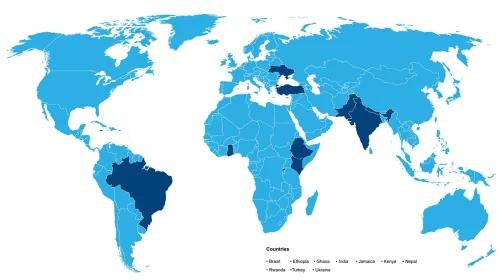
Through partnerships spanning countries such as Brazil, Ethiopia, Ghana, India, Jamaica, Kenya, Taiwan and Vanuatu, participants engage in immersive experiences that strengthen clinical skills, deepen understanding of diverse healthcare systems, and contribute to the program’s mission of addressing avoidable blindness worldwide.
These exchanges foster meaningful relationships between the Michigan Medicine and international eye care communities, empowering trainees and professionals to share knowledge, advance ophthalmic practices, and make a lasting impact on vision health across the globe.
Learn more about our partnerships and current initiatives in the Jerome Jacobson Global Program at the Kellogg Eye Center.
Kellogg has a strong affiliation with institutions in Brazil; the University of São Paulo (USP), Santa Casa de Misericordia in São Paulo, The Federal University of São Paulo, and The Federal University of Minas Gerais in Belo Horizonte.
Our faculty, ophthalmology residents, and medical students have collaborated on research projects and education. Each year we host ophthalmology residents from each institution.
Initiated in 2015, our collaboration with St. Paul’s Hospital Millennium Medical College in Addis Ababa resulted in the graduation of the Medical College's first ophthalmology residency class.
This residency training initiative has been led by Kellogg faculty member Christine Nelson, MD, and is one of a very few in the country. Behind the first graduating class of 6 residents are more than 20 other trainees in various stages of the program. A deep partnership has been formed that includes learner exchange and meaningful research.
A new project is now underway for retinoblastoma screening in Ethiopian children using artificial intelligence technology developed in Ann Arbor.
Kellogg has partnered with the Ghana College of Physicians and Surgeons (GCPS) to launch the first pediatric ophthalmology fellowship program in Ghana. A two-year training curriculum is now in place. Based on standards set by United States Association of University Professors of Ophthalmology Fellowship Compliance Committee and the International Council of Ophthalmology, the fellowship program has been modified for relevance to Ghana. Following on the success of that venture, Kellogg is now developing fellowship programs in other ophthalmic subspecialties.
The Kellogg Eye Center has an exciting collaboration with Aravind Eye Center System in Tamil Nadu, India. Physicians and researchers at Kellogg frequently collaborate with colleagues at Aravind to carry out important clinical and epidemiological research. Each year numerous trainees and faculty from both institutions pay visits to one another, participating in educational exchanges, training experiences, research rotations, and lectureships. Joshua Ehrlich, MD, MPH from Kellogg is a regular faculty discussant in Aravind's webcast glaucoma journal club and led alongside David Musch, PhD, MPH a year-long online research skills-building course for junior faculty at Aravind. The frequent exchange of ideas and people between Kellogg and Aravind has created a strong bond among two world-class eye care institutions.
In 2015, Kellogg initiated a fruitful enterprise in Jamaica. In collaboration with local partners and the University of Michigan Health Services optometry division, we are screening patients and performing eye surgery in an underserved area. Patients are examined in a fully functional “clinic-in-a-container” - a recycled shipping container outfitted in Michigan and shipped, unpacked, and set up in Jamaica.
The Kisii Eye Hospital (KEH) / Innovation Eye Center in Kisii, Kenya has a strong collaboration with the Kellogg Eye Center. Located in southwest Kenya, KEH is one of the only tertiary eye hospitals serving a population of more than 5 million people. Led by Dan Kiage, MD, a glaucoma specialist, KEH has grown rapidly since its founding in 2013, performing thousands of surgeries annually. KEH also serves as a training center for ophthalmologists and allied ophthalmic personnel. Several doctors from KEH have traveled to Kellogg for observerships. Joshua Ehrlich, MD, MPH and Sherry Day, OD, FAAO from the Kellogg Eye Center have spent time in Kenya with Dr. Kiage and his team. The KEH-Kellogg collaboration aims to provide mutually enriching training opportunities and to conduct high-impact clinical and epidemiological research.
The international collaboration is between the University of Michigan (led by Dr. Otana Jakpor, Clinical Assistant Professor of Ophthalmology) and Dhulikhel Hospital in partnership with Kathmandu University in Nepal (led by Dr. Tina Shrestha) to strengthen capacity for eye trauma management.
With a new Trauma and Emergency Center under construction, the facility is expected to attract a growing number of trauma cases, including eye-related injuries. With her research collaborators, Dr. Jakpor plans a project to help the Dhulikhel care teams prepare to meet this growing need through research (developing a database of ocular trauma cases and outcomes); education (engaging U-M residents and faculty to teach ocular trauma management to Dhulikhel colleagues); and prevention (engaging the community service
The international research partnership is between the University of Michigan (led by Prof. Rajesh C. Rao) and Ege University Faculty of Medicine in Turkey to study genetic causes of childhood blindness. The collaboration focuses on using human pluripotent stem cell– derived retinal organoids to model rare developmental eye disorders, particularly microphthalmia, anophthalmia, and coloboma (MAC).
The project centers on investigating mutations in the CENPF gene associated with Strømme Syndrome, a condition linked to severe eye malformations. Patient-derived cells from Turkey will be reprogrammed into induced pluripotent stem cells and developed into retinal organoids. Researchers will analyze disease mechanisms using gene editing (CRISPR/Cas9) and multi-omics approaches, including RNA sequencing and chromatin analysis.
The partnership aims to establish a “bedside-to-bench-to-bedside” research pipeline, combining clinical genetics expertise in Turkey with advanced stem cell and genomic technologies in Michigan. Activities include joint training, researcher exchanges, shared data, and collaborative publications.
Expected outcomes include improved understanding of genetic eye diseases, development of potential therapeutic strategies, joint grant applications, and long-term capacity building in genetic diagnostics and precision medicine. The proposal builds on Prof. Rao’s prior successful international collaborations and aligns with Michigan Medicine’s global health mission
Our Collaborators