
Ophthalmology Residency Curriculum & Clinical Rotations
The U-M Medical School Department of Ophthalmology & Visual Sciences Ophthalmology Residency includes a Comprehensive Ophthalmology clinic and seven subspecialty clinics, each with exceptional depth of experience.
We are the tertiary care center for the State of Michigan and serves as a major referral center for the region. Our patients come from across the country and around the world.
For More Information
The Department is part of Michigan Medicine and shares its mission of excellence in clinical care, research, and education.
Physicians at U-M Health represent virtually every medical specialty and conduct some 1.5 million patient visits each year. The U-M Medical School graduates 170 physicians annually, and, like the larger health system, is consistently ranked as one of the top institutions in the nation.
Didactic Curriculum
Our residents participate in several lecture series throughout all three years of residency. The goals of these lectures are to provide an excellent clinical and surgical foundation as well as aid in preparation for the annual Ophthalmology Knowledge Assessment Program exam. There is protected academic time every Thursday morning from 8:30-9:30am one afternoon Friday per month from 1:00-5:00pm. Please note that ACGME requires a minimum of 360 hours of lecture time from PGY2 through PGY4.
The BCSC Lecture Series mirrors the Basic and Clinical Science course published by the American Academy of Ophthalmology. These lectures provide the foundational clinical and surgical knowledge in ophthalmology and are repeated annually, to maximize repetition and retention.
The OKAP Preparation Course takes place every Spring prior to the Ophthalmology Knowledge Assessment Program exam. These lectures provide high-yield reviews of all topics covered on the exam. Residents and faculty from other Michigan programs are invited to participate.
Imaging Conferences take place on Monday evenings, led by faculty in various specialties. These lectures are an opportunity to learn to interpret all ophthalmic imaging modalities, including OCTs, visual fields, ERGs, ultrasounds, typography, and more.
Grand Rounds
Every Thursday morning residents present and discuss complex cases with the faculty, with case selection rotating among the subspecialties. One session per month is devoted to ethics discussion or a complications conference.
Visiting Professors
Ophthalmologists with expertise in all subspecialties are invited annually with a program structured to introduce residents to diagnostic and therapeutic approaches used at other institutions. Eight visiting professor sessions are scheduled annually on Thursdays, with residents spending the morning learning from the visiting professor.
Ophthalmology Bootcamp
The focus of the yearly ophthalmology bootcamp is on cultivating and developing the skills of the residents in the program. The bootcamp provides room in a hands-on clinical setting to learn practical skills, like how to gown up before surgery, to the finer nuances of the art of ophthalmology, while also giving space for residents to ask questions and hone their skills.
The annual phacoemulsification wet lab is a part of the bootcamp specifically geared toward allowing residents to learn how to perform cataract surgery prior to performing the surgery on patients.
Surgical Curriculum
The primary surgical experience for Kellogg residents begins early, with some starting as soon as their first month of residency. During their PGY1 combined internship, residents learn the fundamentals of assisting in the operating room and practice on surgical simulators, preparing them to excel in their first full ophthalmology year as PGY2’s. They perform numerous extra-ocular procedures and progressively gain experience in intra-ocular surgeries, culminating in their first primary cataract surgery by the end of their PGY2 year. As PGY3's, residents continue to enhance their surgical skills through various oculoplastics, strabismus, and cataract cases.
In their PGY4 year, they serve as the primary surgeon for a significant number of routine and complex cataract surgeries, subspecialty procedures including retina, cornea, and glaucoma, as well as ocular trauma cases.
The surgical faculty at Kellogg foster residents' surgical proficiency by gradually increasing their autonomy. This includes guiding patients through pre-operative decisions, making intra-operative techniques and management choices, and assisting patients in adapting to their post-operative vision. By the end of training, Kellogg residents are confident in all facets of comprehensive ophthalmologic surgical care and are well-prepared for advanced subspecialty training in fellowships.
Residency Tracks
The Pathway for Residents Interested in Medical Education (PRIME) is an optional longitudinal curriculum designed to run parallel to and supplement the ACGME required ophthalmology curriculum while providing residents with additional skills in medical education. Participants in PRIME will work with the Medical Student Education (MSE) team to gain exposure and experience in curriculum design, medical student mentorship, running small group sessions, designing lectures and wet labs, and participating in educational research. By participating in PRIME, residents gain valuable experience that prepares them for future roles as educators in the medical field.
The curriculum includes structured activities such as monthly meetings, lectures, case presentations, and research projects. PRIME benefits residents by equipping them with the tools and experience necessary to excel in both clinical and educational settings, fostering a new generation of medical educators.
The Global Ophthalmology Academic Track (GOAT) pairs residents with Kellogg faculty mentors who are experienced in global health work. Through this one-year program, participants join a cohort of global health-minded trainees who share ideas and learn together. A significant portion of the program involves self-directed learning, allowing participants to customize their educational experiences by selecting which topics interest them most. Many residents supplement this learning with a global health rotation abroad during their research blocks, facilitated through the Jerome Jacobson Global Program at the Kellogg Eye Center. Since many barriers to effective ophthalmology care internationally are driven by factors that transcend boundaries, GOAT participants also engage in local health equity activities (such as volunteering at a free clinic). Over the course of the year, GOAT participants complete an academic project related to global health equity. After participation in GOAT, Kellogg residents will have a strong initial foundation for their future endeavors in global ophthalmology.
Track 1: LENS (Learning Essentials for Navigating Scholarship), the core framework through which residents fulfill the required ACGME research component of ophthalmology residency training at the University of Michigan.
Track 2: OPTICS (Ophthalmology Program Track for Investigative and Clinical Sciences) a research‑heavy track for residents who envision research as a major component of their career, offering expanded protected research time and dedicated funding without pre‑residency research years.
Track 3: StARR BRITE (Stimulating Access to Research in Residency – Blended Research Intensive Training Experiences) is a clinician scientist development track that combines funded pre-residency research experience with during-residency protected research time and dedicated funding. This track is intended for residents who envision the majority of their future career dedicated to research.
Clinical Rotations
Clinical rotations for residents in the ophthalmology residency program are about two months long and include general ophthalmology and all the subspecialties, inpatient consultation, and ophthalmic pathology.
All rotations take place at the Kellogg Eye Center, the UM-Health hospitals, and the Ann Arbor VA Medical Center, which is half a mile from the Eye Center. A typical day begins at 7:30 a.m. in the O.R. or in the clinic and ends with didactic lectures or Journal Club in the evening.
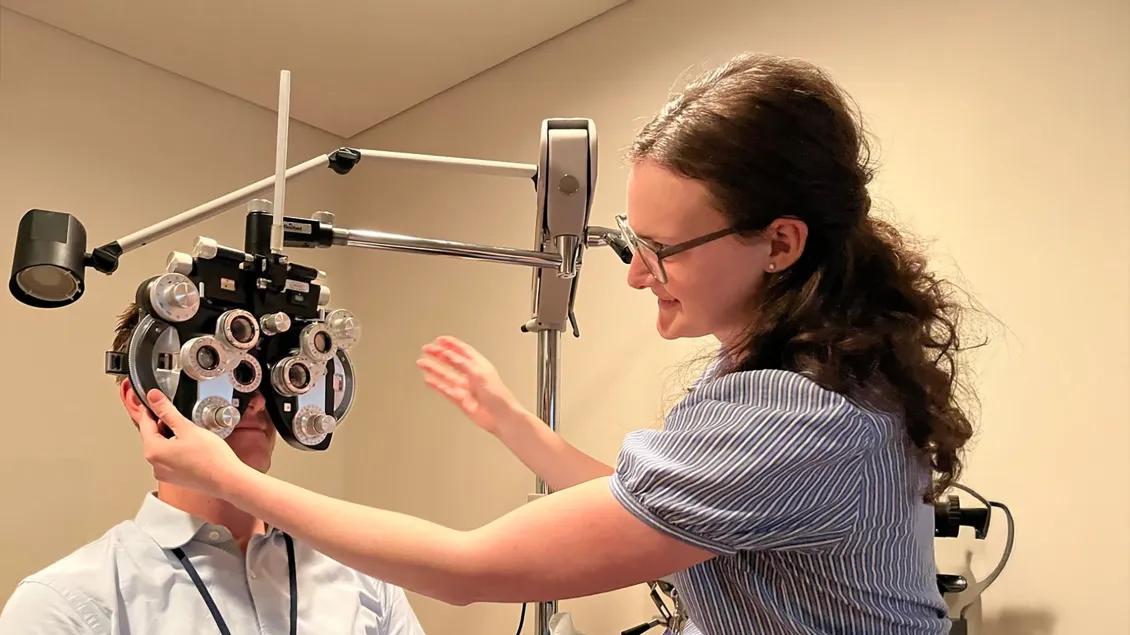
PGY2 year emphasizes refractions, history-taking, detailed observations and descriptions of normal and abnormal states, use of specialized equipment, interpreting visual fields, scans, and films, and developing a reasoned approach to a treatment plan. Residents can expect to participate in pathologic examination of globes, cataract surgery, minor surgical procedures, laser surgery, strabismus surgery, oculoplastics, and enucleations under direct faculty supervision, and to give local anesthesia injections.
Residents assist in eye plastics, cornea, retina, and intraocular cases and become familiar with pre- and postoperative patient care. All residents participate in the Low Vision clinics during their first year and will have assisted in the management of approximately 100 low vision patients over the course of their residency.
Primary call coverage is scheduled based on a night float at-home call system shared by PGY2 and PGY3 residents. Each PGY2 and PGY3 resident completes one 3.5-week, night float period per year where they function as the primary call resident on Sunday through Thursday night.
PGY2 residents on night float have both a PGY3 resident and a PGY4 resident available on call to discuss patients by phone or for whatever type of in-person backup assistance is needed.
In the PGY3 year, residents build their skill levels and perform cataract surgery, repair lacerations and globe ruptures, as well as more complicated strabismus procedures and eye plastic procedures under direct faculty supervision. They perform biopsies, lesion excisions, and laser surgery. It is typical for second-year residents to perform 15-20 cataract extractions.
By the end of residency, each resident will have been first surgeon on approximately 170 - 200 cataract procedures. PGY3 residents should be capable of evaluating any patient and creating a valid treatment plan.
PGY3 residents complete one 3.5-week, night float block per year, during which they function as the primary call resident from Sunday through Thursday night, with a PGY4 surgical resident available for assistance at all times.
By the end of the PGY4 year, each resident will be able to deliver high quality ophthalmic care independently. Each will be able to interpret all tests and studies, make a diagnosis, initiate therapy, and perform a broad range of ophthalmic surgical procedures in both routine and complicated cases.
Residents perform all types of surgical procedures under direct faculty supervision. After they have gained extensive experience with common procedures, training time is devoted to complex clinical and surgical cases with faculty supervision. They are the primary surgeons for all ocular trauma. PGY4 residents also participate in pathologic examination of globes.
Scope of Clinical Practice
The busy comprehensive ophthalmology service triages and treats the full spectrum of ophthalmologic diseases, from routine cataracts to complex ocular trauma. Residents perform routine and complex cataract surgeries, care for patients after open globe injuries, conduct laser and minor eyelid procedures, as well as provide routine eye care and screening.
The cornea & refractive surgery service specializes in corneal and external disease with an emphasis on keratoplasty, including penetrating keratoplasty, lamellar keratoplasty, and endothelial keratoplasty. Residents gain exposure to imaging techniques including anterior segment OCT, corneal tomography, and confocal microscopy. They see a wide variety of pathology including corneal ulcers, corneal dystrophies, complex cataracts, and secondary intraocular lenses, as well as participate in refractive and corneal transplant surgeries.
The glaucoma service treats patients with all types of glaucoma as well as complex anterior segment pathology. Residents learn interpretation of visual fields, OCT, and ultrasound biomicroscopy and become proficient in gonioscopy. Glaucoma surgeries, including tube shunts, minimally invasive glaucoma surgery, and complex anterior segment surgery are the cornerstone of the operative experience.
The neuro-ophthalmology service includes neurologists and ophthalmologists who treat a variety of neuro-ophthalmological diseases including optic neuropathies, idiopathic intracranial hypertension, cranial neuropathies, and optic neuritis. Residents gain exposure both in clinic and consults, where they assist with care of complex neuro-ophthalmology patients. Weekly radiology rounds give residents dedicated teaching in a variety of imaging modalities.
The ocular oncology service sees patients of all ages with a variety of neoplasms. Retinoblastoma care is coordinated with radiology and oncology for intraarterial chemotherapy and other treatments. Residents participate in retinoblastoma care by assisting with exams under anesthesia, which give them exposure to the full range of retinoblastoma presentations. Residents also participate in brachytherapy plaque placement for uveal melanomas and see the full spectrum of ocular and orbital malignancies in clinic
The oculoplastic surgery service service treats children and adults for a variety of conditions including facial trauma, birth defects, skin cancer, ptosis, thyroid eye disease, and orbital tumors. Residents learn basic principles of suturing in addition to complex techniques as they participate in the full range of oculoplastic surgeries.
The pediatric ophthalmology and adult strabismus service treats the full spectrum of pediatric diseases and disorders, as well as adults with strabismus. Given the large geographic area we serve and the tertiary referral nature of our practice, we see a high frequency of unusual cases, such as Duane syndrome, restrictive strabismus, Graves eye disease, neurofibromatosis, complex pediatric cataracts, anterior segment dysgenesis, and craniofacial syndromes. Residents perform strabismus surgery starting their first rotation and become proficient in routine strabismus surgery as well as nasolacrimal duct probing.
The busy retina and uveitis service treats the full spectrum of retinal disorders and diseases including macular degeneration, diabetic retinopathy, sickle cell retinopathy, cystoid macular edema, trauma, and retinal detachment. The uveitis subsection sees patients with complex anterior and posterior uveitis, as well as retinal vasculitis and other inflammatory disorders. The dedicated inherited retinal dystrophy clinic performs ERGs and sees patients with a wide variety of retinal dystrophies. In addition to assisting with routine vitrectomies and lasers, residents gain exposure to more unique procedures including subretinal gene therapy and complex secondary intraocular lenses.
The Ann Arbor VA eye clinic is a busy service, with residents from each PGY1-PGY4 year rotating at a given time. All ophthalmology subspecialties are represented, with Kellogg faculty rotating on different days. Residents have graduated autonomy at the VA starting during the PGY1 year, learning intravitreal injections and YAG lasers. As residents progress, they gain confidence in clinic and learn retina and glaucoma lasers. All residents do their first cataract during the PGY2 year at the VA. We have resident OR five days a week, including routine and complex cataract, cornea, oculoplastic, strabismus, glaucoma, and retina surgery.
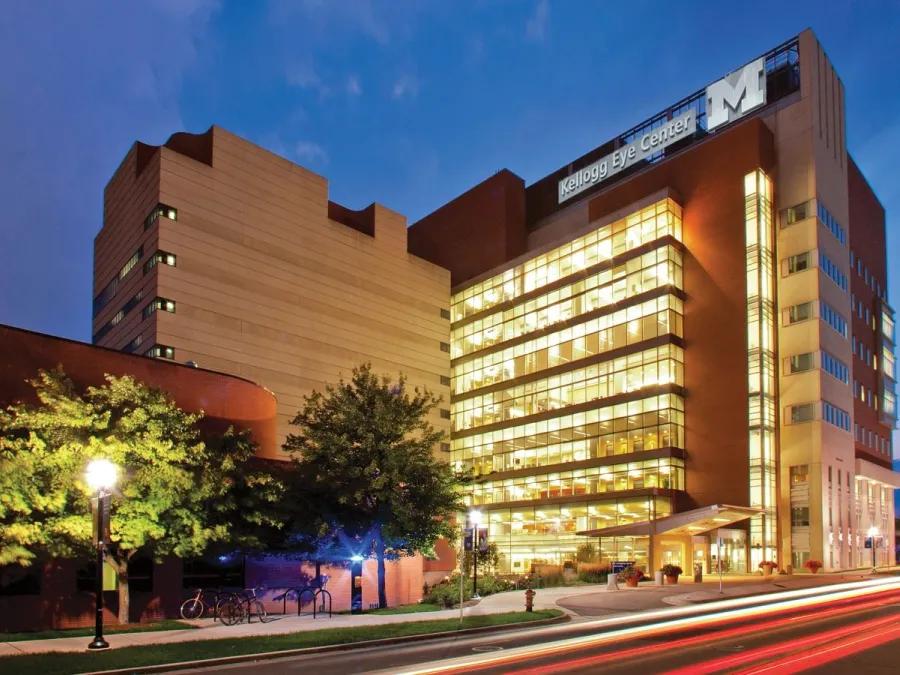
See Where Training Takes Place
Expand your career trajectory in a high-volume academic medical center that also supports and excels in a wide range of basic science, translational and clinic outcomes research programs.
