
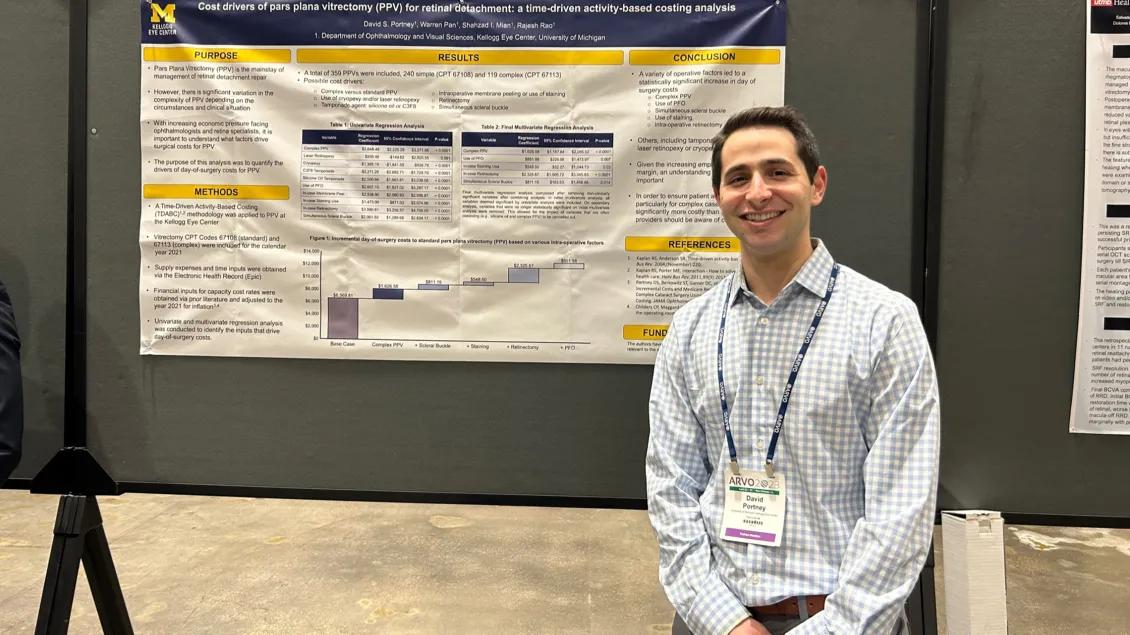
Ophthalmology Resident Research
Research is a vital component of both residency training and current ophthalmology practice at the U-M Medical School Department of Ophthalmology & Visual Sciences Residency program.
At the Kellogg Eye Center, residents are supported with a wide range of opportunities to develop meaningful research projects—highlighted by our unique, dedicated research rotation.
Residents may also choose to pursue projects with an international focus through the Jerome Jacobson Global Program at the Kellogg Eye Center.
By the time they have completed the program, residents will have had opportunities to present or publish their findings. They also will have had the benefit of working directly with world-class vision scientists across Kellogg's research areas.
For More Information
Learn About Our Various Research Training Pathways
LENS (Learning Essentials for Navigating Scholarship) is the core framework through which residents fulfill the required ACGME research component of ophthalmology residency training at the University of Michigan. Early in residency training, residents work closely with faculty mentors to initiate a clinical, translational, basic science, quality improvement, medical education, or global health research project, supported with a dedicated research rotation to provide protected time to advance their work.
Through LENS, residents benefit from extensive mentorship across the Kellogg Eye Center and the broader University of Michigan community, access to internal funding opportunities such as the Michigan Ophthalmology Trainee Career Development Award (MOTCDA), and the ability to pursue global ophthalmology research through established international programs through the Jerome Jacobson Global Program at the Kellogg Eye Center.
LENS supports residents in presenting their work at Kellogg’s annual Research Day and at national meetings, with many projects resulting in peer-reviewed publications, competitive awards, and presentations that support fellowship placement and long-term academic and clinical success.
OPTICS (Ophthalmology Program Track for Investigative and Clinical Sciences) is designed for residents who envision research as a significant component of their future careers but do not wish to pursue pre‑residency research year(s). This track offers a research‑heavy residency experience with expanded, protected research time integrated throughout residency, supported by a defined research budget commensurate with project scope and guided by an identified faculty mentor. It provides a structured pathway for residents to build meaningful, longitudinal research portfolios while maintaining strong clinical training.
Eligibility for this track occurs through a competitive application during the PGY1 (internal medicine) year and includes submission of a research proposal and plan, proposed budget, and mentor letter of support. Residents interested in this pathway are encouraged to begin conversations with prospective mentors early in PGY1 to refine project ideas. Those interested in this track apply as medical students through the standard ophthalmology residency pathway but should indicate in their supplemental SFMatch materials their interest in this track and outline potential research plans in their personal statement and career plans, allowing for intentional alignment of mentorship, resources, and scholarly goals from the start of ophthalmology training.
Applying to Track 2 (OPTICS)
Applicants to the OPTICS track apply through the San Francisco Match to our traditional residency program. Visit our How to Apply page for information on how to apply to the Ophthalmology Residency program. During the application, be sure to include:
Personal Statement & Career Plans
All OPTICS applicants should use their personal statement and career plans in their SFMatch application to articulate their motivation for pursuing a physician‑scientist pathway and describe how they envision integrating research with clinical practice over the course of their career.Letters of Recommendation
At least one recommendation letter submitted to SFMatch should reflect the applicant’s scholarly potential, intellectual independence, and readiness for advanced research training.If accepted to our residency program, candidates will then submit an application for the OPTICS program during their PGY1 year. This ~4 page application includes:
A concise summary of prior research experience and major contributions or findings (≤1 page; figures permitted and counted toward page limit).
Proposed research program during residency, which may be framed as a descriptive narrative or a specific aims‑style page plus abbreviated approach and methods section (≤3 page).
Identification of faculty mentor(s) at University of Michigan for the project, with an ~½ page description of how mentor fits with research project. Mentor(s) are sought out during the early stages of the PGY1 year.
Letter of support from mentor
The residency program has the capacity to accommodate 2 research intensive residents per year (Track 2 OPTICS or Track 3 StARR-BRITE). Thus, the number of residents we accept into the OPTICS program each year depends on the number of residents interested and quality of the candidate’s proposal.
StARR-BRITE (Stimulating Access to Research in Residency – Blended Research Intensive Training Experience) is a clinician-scientist development track designed for residents who intend to have the majority of their future career dedicated to research. StARR‑BRITE offers a structured, research‑intensive pathway that leverages Michigan’s standing as a top‑ranked academic medical center and one of the nation’s leading environments for vision research. Through intentional mentorship, resource support, and extensive protected research time, StARR‑BRITE prepares trainees for independent, federally funded careers in ophthalmology and visual sciences.
Through StARR-BRITE, residents engage in rigorous, longitudinal research training that integrates seamlessly with clinical residency, beginning with pre-residency research and extending through tailored, protected research blocks during residency. The program emphasizes skill development in scientific inquiry, grant writing, leadership, and career planning, while providing access to world-class laboratories, clinical trial infrastructure, data cores, and a large community of funded physician-scientist mentors. Graduates of StARR-BRITE are positioned to compete successfully for NIH career development awards and to emerge as leaders shaping the future of vision science and patient care. Learn more about the StARR-BRITE program and how to apply.
Compare Research Training Pathways
| Feature | Track 1: LENS | Track 2: Optics | Track 3: StARR-BRITE |
| Dedicated research time during residency | Research Rotation | Research Rotation + Longitudinal Protected Time | Research Rotation + Longitudinal Protected Time |
| Research time before residency | No | No | Yes |
| Competitive application required | No | Yes (as a PGY‑1) | Yes (separate SFMatch program) |
| Dedicated research budget | No | Yes, commensurate with research proposal | Yes (most substantial among research tracks) |
| Identified mentor required at entry | No | During PGY1 year | Yes, after interview invitation |
Why Train at Kellogg Eye Center
Supercharge Your Residency: Immerse yourself in eye and vision research as part of your clinical training, transforming clinicians into physician-scientists.
Time That Actually Protects Research: Experience up to 1 year of supported pre-residency research (for StARR-BRITE) followed by integrated research blocks during residency in which you will have research and technician support (for OPTICS and StARR-BRITE), a structure rare among U.S. programs. Those engaged in small research experiences (LENS track) also participate in a dedicated research rotation during residency.
Proven National Impact: Train for success in competitive NIH career-development awards (K12/K08/K23) and accelerate your path toward R-level grants, relying on a department with one of the highest rates of career development awards for new faculty in the country, and one of the highest conversions of career development awards into R01 grants.
A World-Class Environment: Access to Michigan’s world-renowned research infrastructure, clinical resources, and collaborative networks. Michigan’s research enterprise is perennially amongst the top 5 in the country, including more than 100 university-wide cores as well as robust departmental cores.
Mentorship that Matters: Learn from a faculty team of more than 20 physician-scientists and 40 research labs, whose mentorship, funded science, and dedication will guide your growth every step of the way.
Why Kellogg Eye Center Residents Succeed
Strong outcomes at KEC reflect a proven training model built on mentorship, opportunity, and resources that accelerate physician‑scientist careers.
Mentorship: Dedicated guidance from one of the largest pools of nationally recognized physician‑scientists in an ophthalmology department.
Opportunity: Early and sustained access to protected research time, funded national meeting participation, competitive internal awards, and pathways aligned to NIH career‑development mechanisms.
Resources: Unmatched access to Michigan’s research ecosystem—including vision‑specific cores funded through a P30 grant, clinical trial infrastructure, data science and bioinformatics support, and more than 100 university‑wide research cores. The department also houses an active T32 training grant, a K12 clinician-scientist grant, a very active vision research seminar series, and an annual research retreat.
Comparative Outcomes
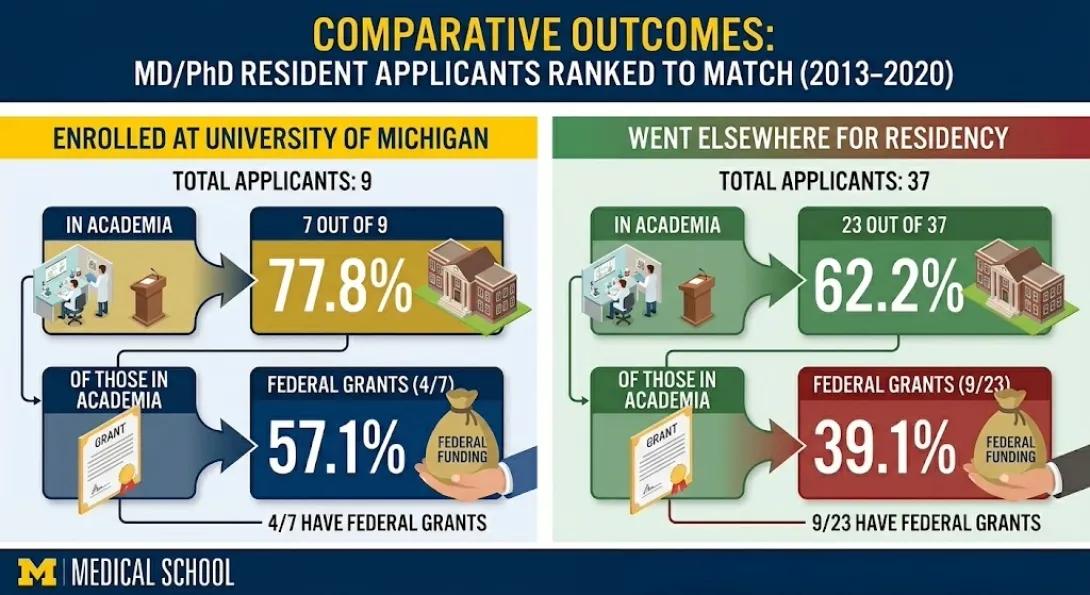
Data reflects completed cohorts from 2013–2020. Outcomes are updated on a five-year cycle to allow sufficient career follow-up.
This comparison highlights career outcomes for MD/PhD graduates who matched into residency, comparing those who trained at the University of Michigan with those who trained elsewhere.
- Among University of Michigan MD/PhD graduates (9 total), 77.8% (7 of 9) went on to careers in academia.
- Of those in academia, 57.1% (4 of 7) secured federal research funding.
- Among MD/PhD graduates from other institutions (37 total), 62.2% (23 of 37) entered academia.
- Of those in academia, 39.1% (9 of 23) received federal grants.
Key takeaway:
University of Michigan MD/PhD graduates were more likely to pursue academic careers and, within academia, were more likely to obtain federal research funding compared to peers from other institutions.
Research Rotation
Working with a faculty advisor, all residents in the LENS track initiate a clinical or scientific research project during the PGY2 year. In the PGY3 year, residents have time to advance that project, thanks to a separate research rotation. OPTICS and StARR-BRITE residents also participate in the LENS research rotation, on top of the dedicated longitudinal protected research time throughout residency.
At the end of the PGY2 and PGY3 year, all residents present their findings at Kellogg’s annual Research Day. OPTICS and StARR-BRITE residents may additionally present their research at the Kellogg Eye Center’s research retreat.
Asad Durrani, MD, talks about the research opportunities available to Kellogg Eye Center residents at home and abroad.
RESEARCH FUNDING MECHANISMS & AWARDS
Michigan Ophthalmology Trainee Career Development Award
The Department of Ophthalmology and Visual Sciences created the Michigan Ophthalmology Trainee Career Development Award (MOTCDA) to provide financial support to residents in the LENS track whose research projects require funding. Those in the OPTICS and StARR-BRITE track have separate dedicated funding determined by the scope of their research.
Research Awards
Each year, trainees may apply for or be nominated for a range of departmental research awards that recognize excellence in scholarly achievement, innovation, and academic impact. These awards honor outstanding research presentations, early research productivity, subspecialty‑focused investigation, and distinguished scholarly work achieved alongside exceptional clinical training.
The George Slocum Award: This award recognizes up to two residents for the most outstanding research study presented at the department's annual Research Day.
The James M. LaBerge Award for Research by a PGY2 Resident: This award recognizes a resident who has participated in research and produced a manuscript during their PGY 2 year of residency. The winner will be able to attend ARVO with expenses covered as per departmental policy.
Howard Prize for Glaucoma Excellence: This prize was established by Dr. Gayle C. Howard of Chula Vista, California. Dr. Howard was mentored by the University of Michigan’s Dr. Paul Lee during her glaucoma fellowship training at Duke University. Given to a medical student, resident or fellow pursuing projects and research in glaucoma in the Department of Ophthalmology and Visual Sciences.
The Aizman Award: Dr. Alex Aizman, an alum of the Kellogg Eye Center Retina Fellowship program, established this award as a way to give back and support University of Michigan’s trainees. Given to a resident for achievement of academic excellence with most significant scholarly work while acquiring the highest distinction in clinical training during residency.
Support for Scholarly Activity at National Meetings
The Department of Ophthalmology and Visual Sciences is strongly committed to supporting resident scholarship and national engagement across all three research tracks, LENS, OPTICS, and StARR‑BRITE. Throughout residency, trainees are eligible for departmental funding to attend approved national and international professional meetings, particularly when presenting original research as first author. This support reflects Michigan’s belief that dissemination of scholarly work is a vital component of research training and career development.
Whether residents are fulfilling core scholarly requirements through LENS, pursuing expanded protected research time through OPTICS, or engaging in intensive clinician‑scientist training through StARR‑BRITE, funded meeting participation allows trainees to share discoveries, gain visibility within the ophthalmology community, and build lasting professional networks. By reducing financial barriers to national engagement, the department ensures residents can fully participate in the academic life of ophthalmology and present their work on prominent national stages.
Kellogg also encourages participation in professional organizations. All PGY4 residents attend the annual meeting of the American Academy of Ophthalmology (AAO) Other residents participate in sub-specialty societies and the state ophthalmologic society, MiSEPS.
