
Launch Committees
Launch Committees are a resource for new faculty members and an opportunity for senior faculty to develop their leadership skills.
Departments that participate in the program “launch” new faculty with the goal of providing structured support and guidance as they begin their careers at the U-M Medical School, School of Dentistry, School of Kinesiology, School of Public Health, or College of Pharmacy.
For more information about this program, please contact us at [email protected].
Program Overview
Launch Committees ensure bi-monthly support by senior faculty and consistent access to department leadership throughout the launchee’s first year. This regularity enables new faculty members’ onboarding to move more quickly and smoothly. New faculty can map out their first few years, discuss teaching strategies, receive advice on setting up a lab, build rapport with their department leadership, and expand their scholarly network. Equity and inclusion concerns can be addressed appropriately.
Each committee convenes for one hour once every other month. If you have someone that supports your calendar, it is expected that you provide that information to aid in the scheduling of meetings. In addition to the bi-monthly committee meetings, members may meet informally with the launchee, as needed.
Nominations
We recommend that nominees meet with their assigned convener prior to the first Launch Committee meeting. At that meeting the two faculty can get to know each other, discuss short and long term goals, as well as coordinate an agenda for the first launch committee meeting.
Additionally, nominees should update their CVs and send it to the committee prior to the first meeting.
Meeting Topics
Each committee focuses on areas essential to the new faculty member’s success. These differ somewhat by field. The discussion and topics should be tailored not only to the field, but also to the new faculty member’s needs. For example, hiring lab personnel may be a central topic over several meetings for one new faculty member while another may not need more than a few minutes on this topic.
Committees should have an explicit conversation about confidentiality of information shared in the meeting and agree to treat all personal information disclosed (whether by the launchee or by others) as confidential.
Program Evaluation
The Launch committee program is evaluated every year, with input gathered via online surveys. Overall, launchees and senior faculty find that the program helps junior faculty navigate the multiple and ever increasing expectations of the first year, and monthly meetings allow for issues to be addressed as they occur.
Department chairs and deans see the program as a valuable recruiting tool, and senior faculty enjoy getting to know their new junior colleagues. These positive evaluations have stimulated expansion of the Medical School program to other Health Sciences schools, which now includes the College of Pharmacy and the Schools of Dentistry and Kinesiology.
Frequently Asked Questions
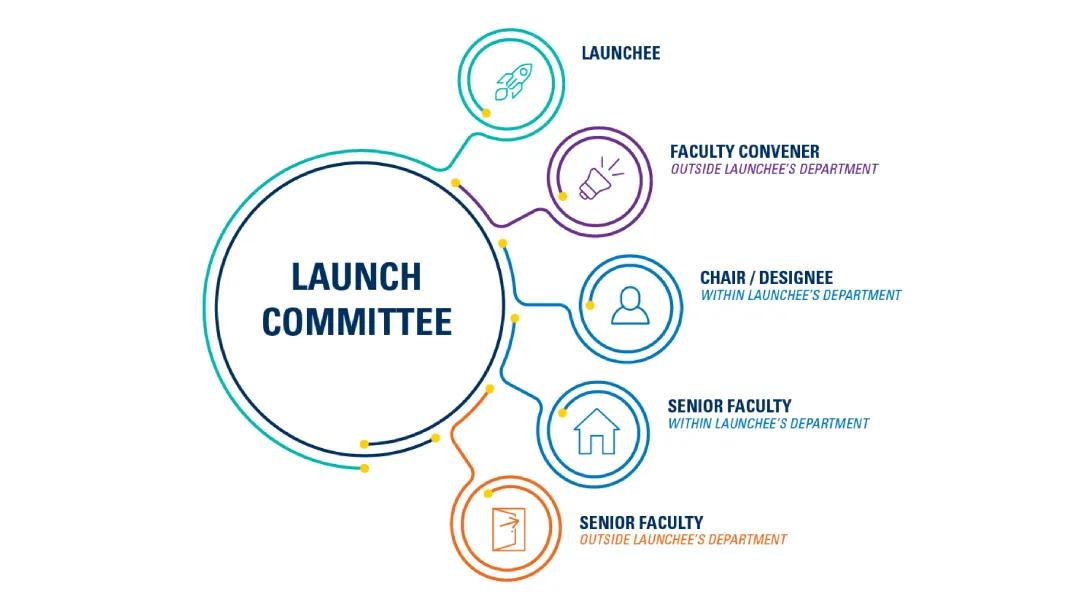
The launchee and four senior faculty: department chair (or designee), senior member of department with related interests, senior member outside department with related interests, and the convener.
When the launchee has an appointment in more than one department, it is sometimes appropriate to add the chair of that department to the committee as well.
The Launch Committee Faculty Convener plays important roles: creating and maintaining a positive and supportive environment for the launchee, managing the discussion so that important topics are covered and multiple perspectives are shared, noting discussion topics and areas to return to at the next meeting, and ensuring that meetings are held bi-monthly.
The Convener is also responsible for organizing meeting times, taking notes, and following up on action items. Because of this special role, the Office of Faculty Development holds Convener orientation sessions that conveners must attend prior to their first launch committee meeting. As a token of appreciation, conveners receive a small (discretionary fund) stipend at the conclusion of the Launch year.
No. The call for Launch Committee nominations goes out to department chairs for all faculty.
No, Launch Committees are not “remedial.” Launch Committees help all faculty be successful in their new role.
Absolutely. New faculty have many questions beyond research: how to plan their first three years, navigate interacting with students and trainees, make sense of teaching evaluations, work with staff, respond to service requests, learn about relevant policies, make connections to faculty and resources across campus, find work/life balance, and connect with community resources.
Not unless you want to. What’s more typical is for committee members to help the launchee identify scholars (UM or elsewhere) who are appropriate for reading draft manuscripts, grant proposals, and so forth.
Committee members sometimes meet (informally) with their launchee after Year 1, but that is by choice. Launch Committees are not expected to meet beyond the first year. However, committees should end by putting a mentoring plan in place.
Their questions are answered quickly and certain problems are avoided. They can map out their first three years, build rapport with senior faculty, expand their scholarly network, feel valued by other faculty, and (STEM fields) have labs built and equipment ordered sooner.
Yes. It is often deeply rewarding for senior faculty to support junior faculty. It provides a fascinating look at other fields, norms, and subject matter. Professional relationships can be deepened and expanded, in and outside the department. Senior faculty can also learn about practices in other departments, e.g. around teaching or service, that might be useful for their own department. Chairs and senior faculty get a better understanding of new faculty needs. Conveners receive a small stipend. We also hear that prospective faculty find Launch Committees an attractive feature of UM.
Launch Committees ensure a structure of regular (bi-monthly) support and consistent access to department leadership throughout the launchee’s first year. This regularity creates an atmosphere and relationship where concerns across many domains are addressed, and questions large and small regarding success as a faculty member are answered.
