
OrganFlow
Automating Organ Offer Evaluation
CFI project lead: Tyler Dann
CFI advisor: Randall Sung, MD, Professor of Surgery
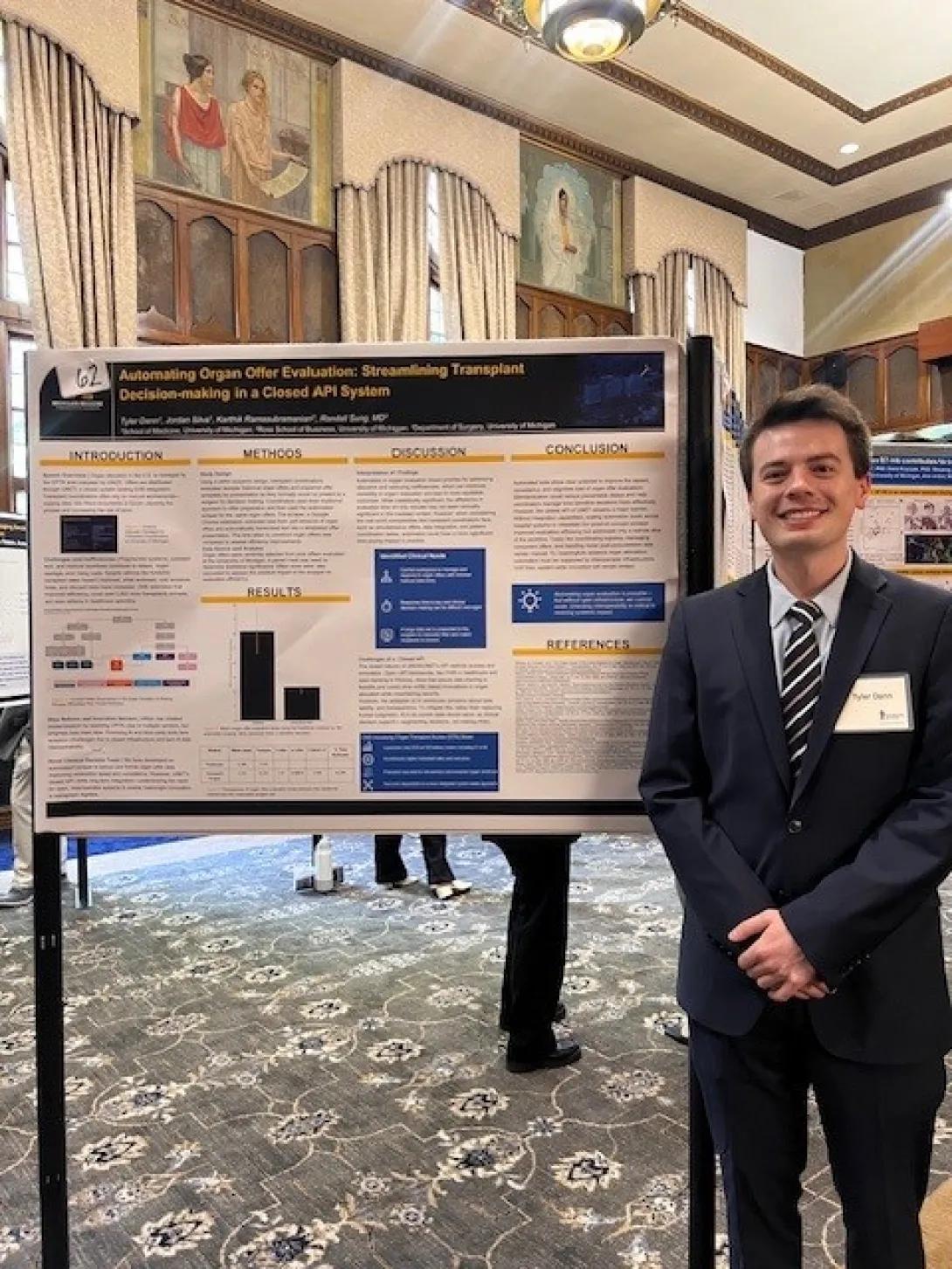
Recent changes to organ allocation in the United States have increased the number of deceased donor offers that transplant centers receive, creating added pressure on transplant coordinators and clinical teams. Because the national UNet system does not allow donor information to flow automatically into hospital systems, coordinators often must manually copy donor data into clinical summaries — a process that is time-consuming, repetitive and vulnerable to transcription errors.
This study evaluated whether automation could make the organ offer review process more efficient. Transplant coordinators reviewed anonymized historical kidney donor offers using two workflows: a standard manual process and an automated tool built as a Google Chrome extension. The tool extracted structured donor information from PDF offer documents and automatically populated a standardized clinical presentation template.
The automated workflow substantially reduced the time needed to prepare donor offer summaries. Manual review took an average of 6.27 minutes per offer, while the automated process took 2.34 minutes — a 62.6% reduction in evaluation time. The improvement was statistically significant and also helped produce more consistent formatting and data extraction.
These findings show that automation can meaningfully reduce coordinator workload and improve efficiency in transplant decision-making. However, the study also highlights a broader infrastructure challenge: because UNet has a closed system architecture, automated tools must rely on workarounds such as document scraping, which can be fragile if document formats change. Modernizing organ allocation technology and enabling secure, interoperable access to donor data could support faster, more reliable, and more data-driven transplant decisions.
Topic area: Technology and Innovation
Q&A with Tyler Dann
In what ways did this project influence your academic or career goals?
This project profoundly shaped my academic and career goals by demonstrating how system-level inefficiencies directly impact patient care and how clinicians can play a critical role in designing solutions. Through developing OrganFlow, I saw firsthand how transplant coordinators were burdened by manual workflows that delayed clinical decision-making and introduced opportunities for error. Building and testing an automated solution showed me that meaningful improvements in efficiency and safety can come not only from new surgical techniques, but also from innovating the infrastructure that supports clinical care.
This experience reinforced my interest in pursuing a career in surgery while integrating clinical practice with technology development and health systems innovation. It highlighted the importance of physician-led innovation, particularly in transplantation, where time-sensitive decisions depend on accurate and efficient information flow. Moving forward, I hope to continue developing tools that improve clinical workflows, reduce cognitive burden, and enhance patient outcomes, while contributing to broader efforts to modernize health care infrastructure.
What challenges did you face during your CFI project, and how did you address them?
One of the primary challenges I faced during my CFI project was working within the limitations of a closed, proprietary system. Because the UNOS UNet platform does not provide an open API, it was not possible to directly integrate OrganFlow with the source data. Instead, I had to design the tool to extract information from exported PDF documents. This made the system inherently fragile — when UNOS updated the formatting of their offer templates, even slightly, it disrupted the scraper’s ability to reliably identify and extract key data fields. To address this, I developed more flexible parsing logic and implemented safeguards to detect missing or misaligned fields. This experience highlighted both the technical challenges of working around closed systems and the importance of building resilient solutions.
Another major challenge was designing a study that accurately simulated the real-world organ evaluation workflow. Because organ offer evaluation is highly time-sensitive and occurs in a dynamic clinical environment, it was difficult to recreate those conditions in a controlled setting. As this was my first time independently designing an experiment, I worked closely with transplant coordinators and mentors to ensure the simulation reflected realistic workflows. Their feedback helped refine the study design, select representative cases, and identify meaningful outcome measures such as evaluation time and consistency.
I also faced the challenge of bridging the gap between technical development and clinical application. Learning to translate clinical needs into functional software required me to develop new skills in programming, iterative testing and user-centered design. I addressed this by maintaining close communication with end users, incorporating their feedback and continuously refining the tool.
Overall, these challenges taught me how to navigate technical constraints, design rigorous experiments and collaborate across disciplines. More importantly, they reinforced the importance of adaptability, persistence and user-centered thinking when developing solutions intended to improve clinical care
What skills did you develop while working on your project, and how might these skills benefit your future career?
Working on OrganFlow allowed me to develop a broad set of technical, analytical and leadership skills that will directly benefit my future career as a surgeon and clinical innovator. One of the most important skills I developed was critical thinking and problem solving. I learned how to identify inefficiencies in a complex clinical workflow, break them down into discrete components and design a practical solution. This required creativity and systems-level thinking, as many of the barriers were not purely technical but rooted in existing infrastructure and workflow design.
I also developed technical skills, including coding, software development and iterative debugging. Because I had limited prior programming experience, I had to teach myself new technical concepts and tools independently. This experience strengthened my ability to quickly acquire concrete, practical skills and apply them to real-world problems — an ability that will be essential as medicine continues to evolve alongside technology.
In addition, I gained experience in study design, data analysis and scientific communication. Designing and executing a formal evaluation of the tool taught me how to develop a research question, create a study protocol and interpret results in a meaningful clinical context. I also developed leadership and collaboration skills by working closely with transplant coordinators, clinicians and mentors, learning how to incorporate feedback and guide a project from concept to implementation.
Other important skills I developed included resilience, adaptability and user-centered design — learning to iterate in response to setbacks and to design solutions around the needs of the people who use them. These skills will benefit my future career by enabling me to approach clinical challenges with an innovative mindset, contribute to research and systems improvement and ultimately help develop solutions that improve patient care and clinical efficiency.
What was the most rewarding aspect of your CFI project, and why was it meaningful to you?
The most rewarding aspect of my CFI project was learning how to take a complex, real-world clinical problem and transform it into a tangible, testable solution. Early on, I recognized that transplant coordinators were burdened by a manual and inefficient workflow, but initially I did not know how to meaningfully address it. Through this project, I learned how to break down the problem, assemble a team with complementary expertise and develop a practical tool designed around the needs of its users.
What made this especially meaningful was seeing the project evolve from an abstract idea into something functional that we could rigorously evaluate. Building OrganFlow and testing it in a simulated clinical workflow demonstrated that it could significantly reduce evaluation time, validating that the solution had real potential to improve efficiency. This experience showed me that innovation in medicine is not limited to theoretical ideas — it can result in concrete tools that directly improve how care is delivered.
On a personal level, the project was rewarding because it taught me that I am capable of identifying problems, teaching myself the necessary skills and leading a project from concept to execution. It strengthened my confidence in my ability to contribute not only as a clinician, but also as a problem solver and innovator. Most importantly, it reinforced my desire to pursue a career where I can continue improving health care systems and developing solutions that enhance patient care.
If you could repeat your CFI project, what would you change to improve the outcomes or process?
If I were to repeat my CFI project, I would focus on expanding both the technical and clinical scope to strengthen the tool and its evaluation. One of the first changes I would make would be to involve more collaborators with software development experience earlier in the process. While I was able to teach myself the technical skills needed to build a proof-of-concept scraper, having additional team members with formal programming expertise would have allowed us to develop a more robust, scalable and resilient solution, particularly in adapting to changes in document formatting.
I would also recruit a larger and more diverse group of transplant coordinators to participate in the evaluation. Including coordinators from multiple institutions would improve the generalizability of our findings and provide insight into variations in workflow across transplant centers. Expanding collaboration to external hospitals could also create opportunities to pilot the tool in real-world clinical settings and gather more meaningful user feedback.
Additionally, I would incorporate more comprehensive outcome measures beyond evaluation time, such as perceived cognitive workload, usability and error rates. These metrics would provide a more complete understanding of the tool’s impact on workflow and clinical decision-making.
Finally, I would build on this foundation by taking the next step toward predictive modeling. Automating data extraction creates opportunities to develop tools that not only streamline workflows but also help clinicians interpret donor data and assess organ suitability more efficiently. Integrating forecasting or decision-support models could further enhance transplant evaluation and improve utilization.
Overall, these changes would strengthen the technical rigor, clinical relevance and long-term impact of the project while moving it closer to real-world implementation.
What advice would you offer to future students starting a CFI project, based on your experience?
My biggest advice to future students starting a CFI project is to choose a problem you genuinely care about and stay creative in how you approach it. Many of the most impactful projects come from noticing small but meaningful inefficiencies in real workflows and asking, “Why is this done this way, and what could be better?”
Start early and give yourself time to iterate. The first version of your idea will rarely be the final one, and progress often comes from repeated cycles of building, testing and refining. Break the problem into smaller, approachable pieces — identify one clear bottleneck you can measure and design a solution around that. A focused, well-executed project is usually stronger than an overly ambitious one that becomes difficult to complete.
Use resources and ask for help sooner than you think you need it. Lean on mentors, faculty and end users; the people closest to the workflow will tell you what matters most and what success should look like. Share your work frequently, even when it’s incomplete, and actively seek feedback — early input can save you weeks of going down the wrong path.
Finally, treat the process as a learning opportunity. You don’t need to start as an expert. Be willing to teach yourself concrete skills, stay persistent through setbacks and keep the project grounded in real clinical needs. If you do that, you’ll end up with something meaningful — whether it’s a finished tool, a strong study, or a clearer understanding of how innovation can improve patient care.
