Otolaryngology-Head & Neck Surgery Research

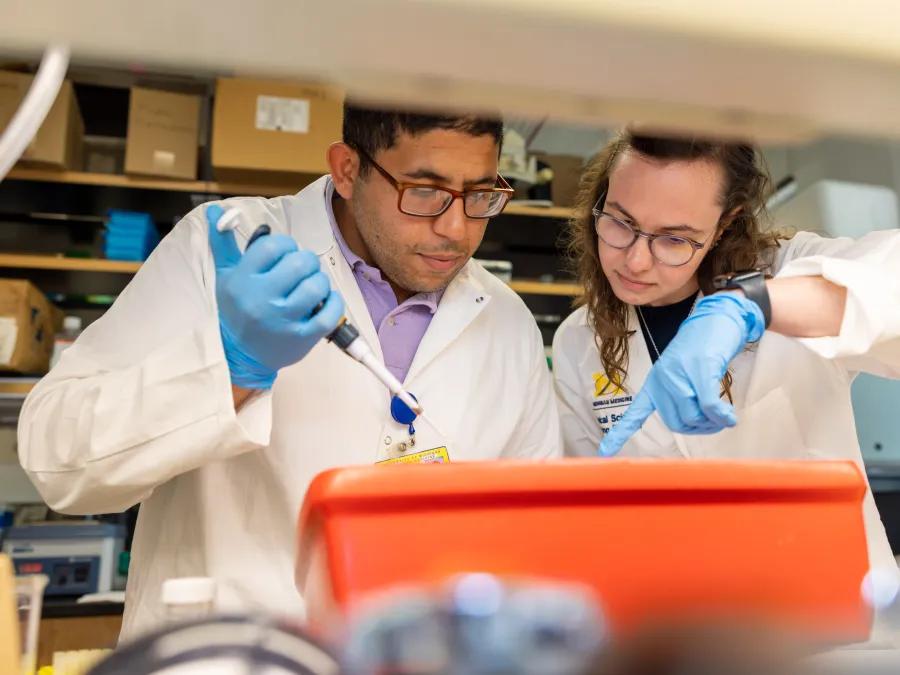
a female scientist working in a lab

Leading Innovation in Michigan’s #1 ENT Program

Our dedicated researchers are shaping the future of ear, nose and throat science, treatment and care.

Discovery & Innovation for Better Outcomes

By exploring a wide range of basic science, translational and clinical outcomes in our robust research programs, our faculty, staff and students are committed to advancing the field through discovery and innovation. Their findings are published and presented throughout the country and around the world.

Experts across departments collaborate here in state-of-the-art facilities and programs focused on basic, clinical, behavioral, population and translational research in our key research areas.

The Michigan Otolaryngology Research Education (MORE) program provides the research education necessary to enable participating residents and medical students to develop successful careers as clinician-scientists and play key roles in the translation of research advances into evidence-based, state-of-the-art health care for patients. The program takes advantage of the infrastructure of one of the nation’s pre-eminent research institutions and a longstanding departmental commitment to research excellence to create the next generation of clinician-scientists.

Our Research Areas
Head and Neck Cancer Research

This program is committed to eradicating head and neck cancer through multidisciplinary studies that include basic, clinical, behavioral, population and translational research.

Kresge Hearing Research Institute

Our Kresge Hearing Research Institute houses a diverse group of scientists and physicians working on basic science and clinical aspects of hearing and balance disorders.

Vestibular & Audiology Research

The Neurovestibular Lab's research focuses on the mechanisms underlying vestibular function and dysfunction across the age span.

Resident Research Opportunities

Our residents have been remarkably successful in competing for extramural grants and have had impressive research productivity. Residents have opportunities to engage in mentored research training throughout the residency period.

Learn More About Resident Research

Featured News & Stories

See all news
same man singing sitting on left in exam room as man standing singing on right
Health Lab

After near-fatal car crash, singer regains voice at U-M Vocal Health Center

Patient regains singing voice after near-death car crash at U-M Vocal Health Center.
Dr. Michael J. Brenner
Points of Blue

Michael J. Brenner, MD, FACS: Advancing Interprofessional Approaches to Medical Education

Michael J. Brenner, MD, FACS, is an Associate Professor of Otolaryngology–Head and Neck Surgery at the Medical School. His interest in medical education comes from a desire to apply rigor and evidence-informed strategies to real-world patient care. In this spotlight, he discusses his approach to teaching, his goals for the future of health professions education, and the experiences that continue to shape his work.
Decorative graphic with a headshot photos of Clarissa Hoffman, Ziad Jowhar, Jasdeep Kler, Jared Martin and Prishae Wilson
Department News

Introducing Our 2026 Incoming Residency Class

Meet the newest residents to join our program.
Health Lab Podcast in brackets with a background with a dark blue translucent layers over cells
Health Lab Podcast

Ragweed Pollen Shows Negative Effect of Quality of Life for Some

Ragweed pollen levels correlated with worse chronic rhinosinusitis symptoms.
image of an outside green field during summer with blue skies
Health Lab

Pollen exposure linked to worse quality of life for chronic sinus infection sufferers

The results of a Michigan Medicine pilot study suggest long term exposure to higher pollen levels leads to worse symptoms and quality of life for patients with chronic rhinosinusitis.
lungs in blue and yellow spots floating
Health Lab

'Molecular glue' stabilizes protein that inhibits development of non-small cell lung cancer

University of Michigan researchers found a new protein target PP2A and developed a drug to treat non-small cell lung cancers that have KRAS mutations.