
Professor Harry Lee Thompson Mobley, Ph.D., Frederick G. Novy Distinguished University Professor of Microbiology and Immunology at the University of Michigan Medical School, is internationally renowned for his research on urinary tract infections (UTI), a disease that affects over 400 million patients a year in the world.
After forty years of pioneering research on bacterial infections, and mentoring over 85 trainees, professor Mobley leaves a remarkable legacy, not only advancing science and the understanding of bacterial infections, but also touching the lives of many colleagues, mentees and students. Professor Mobley is retiring from M&I, effective September 30, 2024.
Mobley’s scientific excellence spans different fields, from microbiology to biochemistry and bacterial genetics, molecular pathogenesis, and vaccine development.
Mobley grew up a soccer player, won his home (Kentucky) State Championship, and went to college to keep playing soccer —and then study. Seeking soccer and warm weather, he went to Emory University in Atlanta, GA, where he was a four-year starter on the soccer team but also learned a lot of science. There, Mobley took a microbiology course that was decisive in finding his professional path. He particularly recalls a class visit to the nearby Center for Disease Control (CDC), which was immediately adjacent to campus, that made a huge impression on him.
As a graduate student at the University of Louisville Medical School, KY, he joined the lab of Ronald J. Doyle, Ph.D., who gave him his first exposure to lab work. “He was a terrific mentor who taught me everything about lab work, and I learned a lot of microbiology then,” Mobley said. He became interested in molecule transport, and how bacteria take up the nutrients they need from a host cell. This topic took him to work with Barry Rosen, Ph.D., an expert in this field at the University of Maryland School of Medicine. Mobley then expanded his knowledge of microbiology to include biochemistry.
At that time, recombinant DNA technology was just being developed, opening up an entire field of research. Mobley spent a year in James Kaper’s lab where he learned these novel molecular techniques. None of these had been applied to study urinary tract infections, and with his solid and broad background training, Mobley seized the opportunity to tackle this uncharted territory.
His research career launched at the University of Maryland with a study of weekly urine samples from 50 patients with long-term catheter-associated urinary tract infections, revealing that E. coli and Proteus mirabilis were the most frequent bacterial species causing these infections. His results also informed on the role of Proteus mirabilis in the formation of bladder stones. Later, he investigated how Helicobacter pylori causes stomach ulcers. For the following 15 years, the lab also studied Helicobacter pylori, a novel research area that had much international interest and exposure.
The Mobley lab has published over 300 peer-reviewed articles, 49 book chapters, and five books, cited in the literature over 45,000 times. During his career, Mobley delivered more than 250 scientific presentations in 21 countries.
Mobley’s scientific excellence has been recognized with prestigious fellowships. He is a Fellow in the American Academy of Microbiology and a Fellow in the American Association for the Advancement of Science.
Research Highlights
For Mobley, a particularly exciting moment of his scientific career was a first-of-its-kind study that investigated which bacterial genes were turned on or repressed during an infection. E. coli, the most common bacteria in UTI, has about 5,000 genes but their expression had never been studied globally during an infection. For this work, the team had to stabilize the bacteria in the urine within 10 minutes of collection from women attending the University Health Service with symptoms of UTI, and they managed to collect excellent data about E.coli gene activation and noted an extraordinarily rapid bacterial growth rate. These pioneering results guided many subsequent research projects.
Among its many discoveries, the Mobley lab also developed a vaccine that proved effective against UTI in mice. Regretfully, this breakthrough was not brought to human clinical trials.
More recently, Mobley has investigated the processes involved in bacterial infections from bladder to kidney into the bloodstream. The lab expanded its collaboration with colleagues from other labs and the consortium identified which genes, shared among five related Gram-negative bacterial species, contribute to bloodstream infections. This project used data from 1,000 mice and was very labor intensive. The results point to potential target areas for treatment, and will be published in PLoS Pathogens in the coming weeks.
“Piece by piece, we gained a better understanding of the processes by which bacteria lead to a disease,”—Harry L.T. Mobley, Ph.D.
Since 1986, research in the Mobley Lab has been continuously supported by grants from the National Institutes of Health. “It’s a great job if you can get the grants,” he said, “and we were able to because of all the talented people who worked in the lab.”
Mobley was invited by the Australian Society for Microbiology to give a lecture tour across Australia. “I remember I took 17 flights in 21 days!” He was also a distinguished lecturer of the American Society for Microbiology. He enjoyed that role and meeting undergraduate students in institutions that might not have had a high scientific profile. “The students were so enthusiastic but did not necessarily have the exposure to high level science. These students had poster sessions and it was rewarding to give them comments. It was great to meet people and travel within the US,” he said.
M&I flourished under Mobley’s leadership
In 2004, Mobley became the Chair of the Department of Microbiology and Immunology (M&I) at the University of Michigan, after a 20-year career at the University of Maryland where he had been Assistant Professor (1984–1989), then promoted to Associate Professor in 1989, and to Professor in 1995. When Mobley moved his lab to Michigan, four of his lab members accompanied him to Michigan, including his current lab manager, Stephanie Himpsl. “We hired three moving vans, two for the lab, one for the household, and off we came,” he recalls.
Under Mobley’s leadership, M&I more than doubled its number of faculty, from 13 primary faculty to a total of 27, with more women faculty members than men. “Indeed, we were the only M&I department in the country to have more women than men on the faculty,” he said. “It was very helpful to have the support of the administration to make attractive offers.”
Mobley is also grateful for the Endowment for the Basic Sciences (EBS) that gathers the U-M departmental chairs of the basic sciences departments. Mobley explained that the EBS pooled resources, fueled cooperation, and created a very supportive network.
With these faculty hires and departmental growth, M&I moved up from 34th rank in NIH funding to eighth place.
Mobley stepped down from his role as departmental chair in 2019.
Mobley, the colleague and mentor
Mobley mentored 34 graduate students (30 Ph.D. and 4 M.S.), 38 postdoctoral fellows, and six research track faculty. “The majority of my trainees are now in science related fields, and this gives me great joy,“ he said. “We always had a lot of celebrations in the lab and everyone brought their family!”
“Our motto for the lab was ‘moving on up’ to the next step, and we celebrated each step!”
Mobley was recognized for his outstanding mentorship with the University of Maryland Mentorship Award, and with the inaugural University of Michigan Postdoctoral Mentoring Award. “I really cherish these recognitions,” he said. Mobley particularly enjoyed adapting his mentoring style to each one of his mentees. “Hearing what their concerns were, celebrating their successes and giving advice beyond laboratory techniques to include career advice was a lot of fun.” Mobley had an open-door policy and invited everyone to come in to talk if they had some issue.
Former lab members also commented on Mobley’s ability to have everyone, no matter how scientifically knowledgeable they might have been, take a turn presenting their work during the lab meetings.
Mobley recommends “to try to do something everyday, move things forward a little bit, and don’t be daunted by things that don’t work. It’s why we call it ‘re-search,’ because we have to do it again and again.” He also suggests taking advantage of the university career resources like OGPS, and to build a professional network. “Don’t hesitate to call up other scientists who do techniques that interest you,” he said.
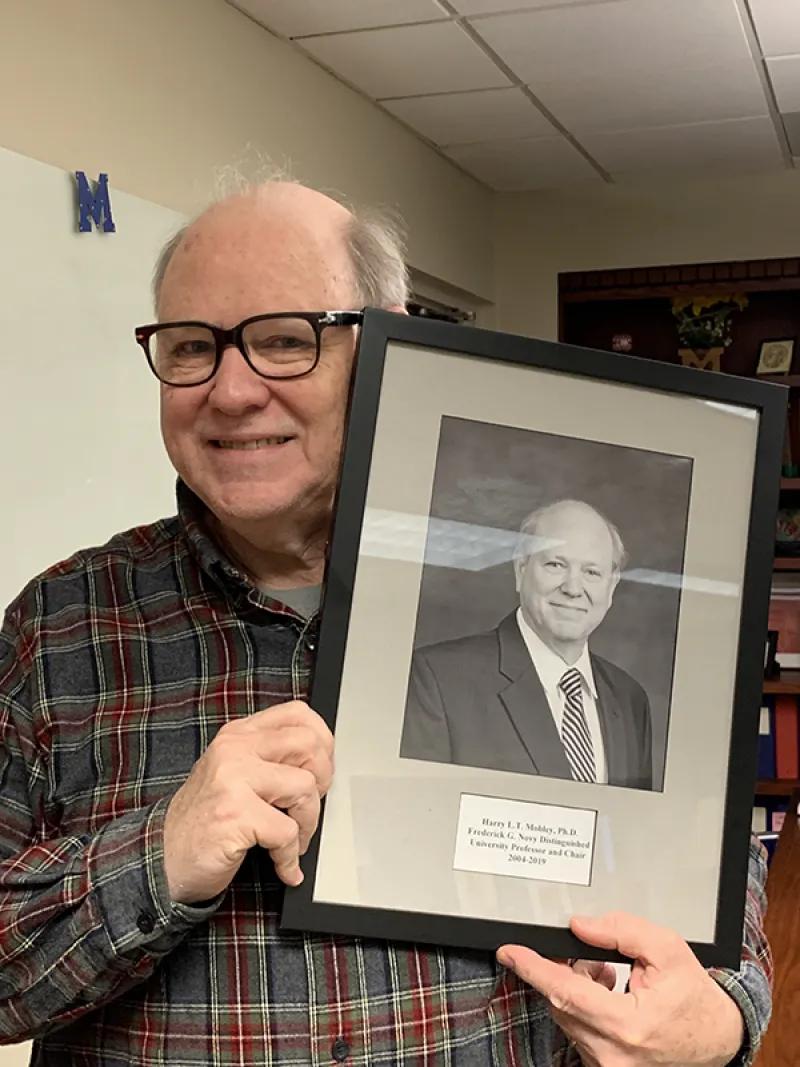
Outside the lab and in retirement
As a renowned microbiologist, Mobley has presented his research all over the world, giving him the opportunity to add sightseeing to his science. And, as a landscape photographer, he delighted in his extensive travels that included visits to Victoria Falls, the Sydney Opera House, Vienna, and the Great Wall of China, among many locales. One of his pieces of advice to trainees is to “ask to present your work at international meetings and extend your stay to visit local sites.”
Mobley is also a woodworker and he looks forward to more time in his shop, making tables and toys for his four grandchildren. He and his wife Natalie will also extensively visit them in St Louis and in the Denver area, and plan on taking them to soccer games!
“Dear Harry,
Now that I have been in the role of chair for nearly 5 years, I am even more amazed that you were able to manage the department for 15 years, all while keeping your science at the highest possible level. You have brought tremendous distinction to the University of Michigan and continued the legacy of pioneering bacteriology research here. Thank you for all your wisdom and advice and friendship over the years. You recruited an amazing group of faculty and trainees and made us a top 10 department. Thanks for everything you have done for Michigan! What a legacy!”—Beth Moore, Ph.D., Nancy Walls Professor of Microbiology and Immunology, Chair, Department of Microbiology and Immunology
Dr. Moore established the Harry L. T. Mobley Lectureship, and M&I is proud to honor his legacy with this prestigious lecture. James Kaper, Ph.D., James and Carolyn Frenkil Distinguished Dean's Professor, University of Maryland, who initiated Mobley to recombinant DNA technology, delivered the inaugural lecture on September 21, 2023.
The Mobley lab will continue its research at U-M M&I under the joint leadership of Melanie Pearson, Ph.D., Research Associate Professor, and Mark Anderson, Ph.D., Research Assistant Professor. “It’s time for the next generation to take on the challenges!” said Mobley.
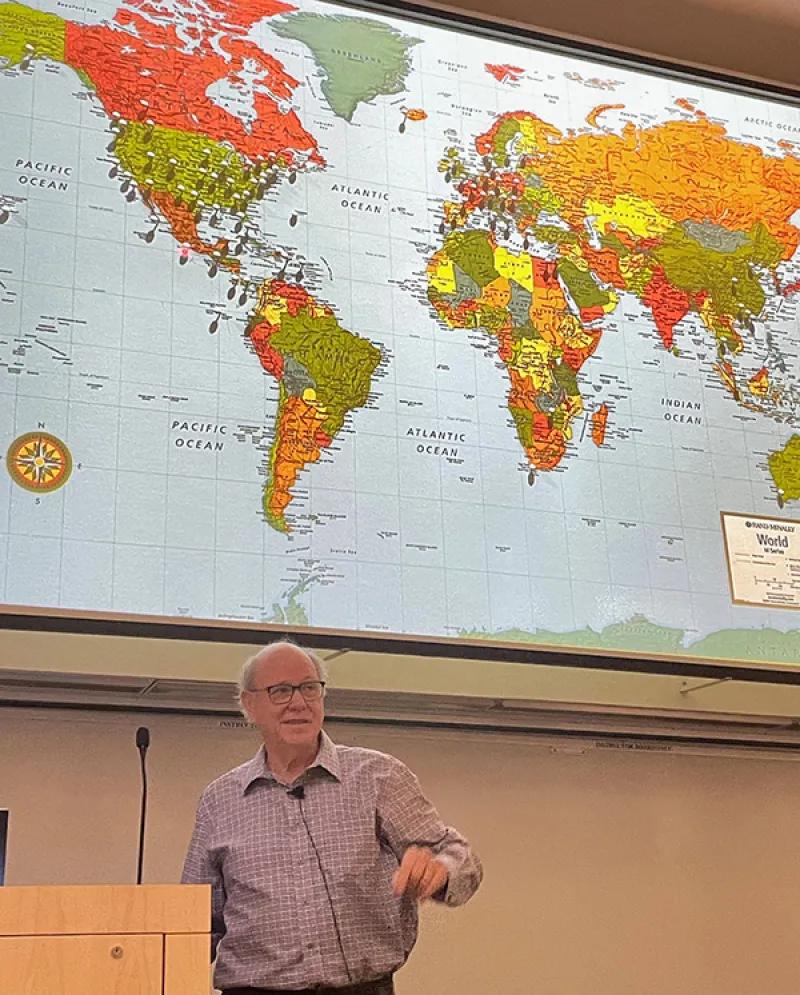
Professor Mobley lectures about his scientific lectures that took him around the world, August 2024
Featured News & Stories
FDA-approved drug offers hope for patients with polycythemia vera, a rare bone marrow disorder
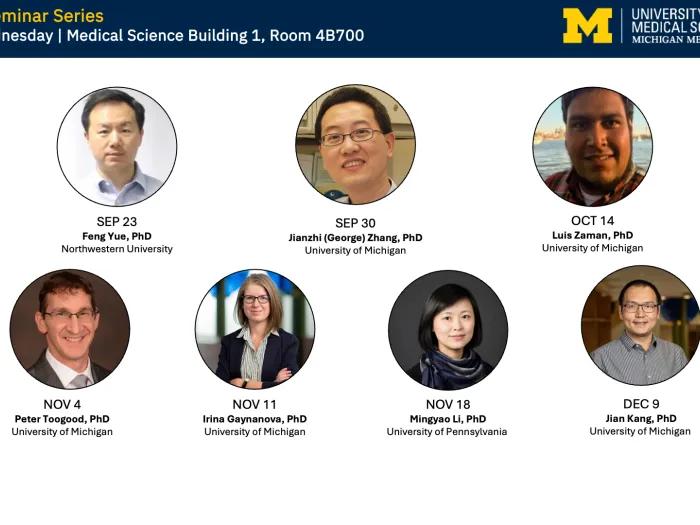
Announcing CCMB/DCMB Fall 2026 Seminar Series

Pediatric patient treated for rare kidney cancer
Jacob Mack: Helping Trainees Take the Next Step

AI, Well-Being and the Human Connection

