
Matthias Truttmann PhD

Associate Professor
Email:
[email protected]
Available to mentor
Matthias Truttmann PhD
Associate Professor
Manage Your Profile
Qualifications
-
Post Doctoral Research FellowBoston Children's Hospital, Biochemistry / Molecular Biology / Cell Biology, Boston, United States
2016 - 2018
-
Post Doctoral Research FellowWhitehead Institute for Biomedical Research, Biochemistry / Molecular Biology / Cell Biology, Cambridge, United States
2013 - 2016
-
Post Doctoral Research FellowMassachusetts Institute of Technology, MIT Learning and Teaching Lab, Cambridge, United States
2015 - 2015
-
Post Doctoral Research FellowUniversity of Basel, Biozentrum, Infection Biology / Systems Biology, Basel, Switzerland
2011 - 2011
Center Memberships
-
Center MemberSamuel and Jean Frankel Cardiovascular Center
-
Center MemberAI and Digital Health Innovation
-
Center MemberFrankel Institute for Heart and Brain Health
Research Overview
Post-translational regulation of chaperone function in aging and aging-associated diseases
Protein AMPylation in the context of protein aggregation, protein folding and protein quality control
Genetically encoded, protein aggregation-associated diseases
De novo generation of camelid nanobodies
Recent Publications
-
Porter CM, Tabler S, Choi S, Truttmann MC. Scientific Reports, 2024 Dec 1; 14 (1):Journal ArticleTSWIFT, a novel method for iterative staining of embedded and mounted human brain sections
DOI:10.1038/s41598-024-63152-2 PMID: 38830987 -
Hernandez-Lima MA, Champion M, Mattiola Z, Truttmann MC. Frontiers in Molecular Neuroscience, 2022 Nov 24; 15:Journal ArticleThe AMPylase FIC-1 modulates TGF-β signaling in Caenorhabditis elegans
DOI:10.3389/fnmol.2022.912734 -
Urban ND, Cavataio JP, Berry Y, Vang B, Maddali A, Sukpraphrute RJ, Schnell S, Truttmann MC. Experimental Gerontology, 2021 Dec 1; 156:Journal ArticleExplaining inter-lab variance in C. elegans N2 lifespan: Making a case for standardized reporting to enhance reproducibility
DOI:10.1016/j.exger.2021.111622 PMID: 34793939 -
McCaul N, Porter CM, Becker A, Tang CHA, Wijne C, Chatterjee B, Bousbaine D, Bilate A, Hu CCA, Ploegh H, Truttmann MC. Journal of Biological Chemistry, 2021 Sep 1; 297 (3):Journal ArticleDeletion of mFICD AMPylase alters cytokine secretion and affects visual short-term learning in vivo
DOI:10.1016/j.jbc.2021.100991 PMID: 34419450 -
Chatterjee BK, Truttmann MC. Open Biology, 2021 May 1; 11 (5):Journal ArticleFic and non-Fic AMPylases: Protein AMPylation in metazoans
DOI:10.1098/rsob.210009 PMID: 33947243 -
Nitika , Porter CM, Truman AW, Truttmann MC. Journal of Biological Chemistry, 2020 Jul 31; 295 (31): 10689 - 10708.Journal ArticlePost-translational modifications of Hsp70 family proteins: Expanding the chaperone code
DOI:10.1074/jbc.REV120.011666 PMID: 32518165 -
Van Pelt KM, Deng Y, Nesvizhskii AI, Paulson HL, Costa MDC, Truttmann MC. 2026 Aug 10;PreprintFicd loss rescues motor impairments and reverses oligodendrocyte maturation deficits in a mouse model of spinocerebellar ataxia type 3.
DOI:10.64898/2026.08.07.743629 PMID: 42845343 -
Casselman TJ, Huffaker AW, Mitchell KC, Schnarrs JE, Ni S, Skinner ME, Truttmann MC. Current Protocols, 2026 Jul 1; 6 (7):Journal ArticleHigh-Throughput Isolation of Nanomouse-Derived VHH Domains: A Practical Guide from Immunization to Nanobody Expression
DOI:10.1002/cpz1.70432 PMID: 42479849
Featured News & Stories

Health Lab
The scent of death?
New research work discovers that the presence of dead members of C. elegans has profound behavioral and physiological effects, leading the worms to more quickly reproduce and shorten their lifespans.
Research News
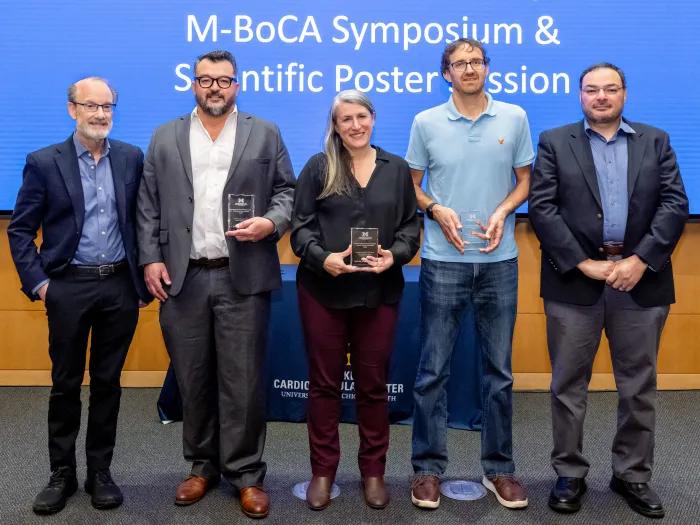
Innovative Multidisciplinary Research Pilot Award FY 25 Recipients
The Stanley and Judith Frankel Institute for Heart and Brain Health and the Michigan-Biology of Cardiac Aging (M-BoCA) program of the Frankel Cardiovascular Center, are delighted to announce the recipients of this year's Innovative Multidisciplinary Research Pilot Award.
