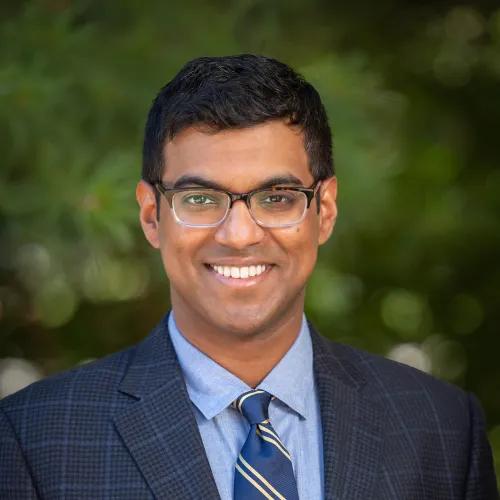
Jacob R Joseph, MD
Neurosurgery
1500 E. Medical Center Drive, TC3470
Ann Arbor, MI 48109-5338
Manage Your Profile
About
Dr. Jacob R. Joseph is a neurosurgeon specializing in the treatment and management of traumatic brain and spine injuries. He grew up in Plano, Texas and attended the University of Texas at Austin, where he graduated with Highest Honors. He then earned his Doctor of Medicine from Baylor College of Medicine in Houston, Texas. He went on to complete a seven-year residency in Neurological Surgery at the University of Michigan. Dr. Joseph then accepted an additional fellowship in Neurotrauma and Complex Spine Surgery at the University of Pittsburgh under the tutelage of Dr. David Okonkwo and Dr. Adam Kanter.
Dr. Joseph’s clinical interests are in the treatment of complex spinal disorders including scoliosis, spinal deformity, and revision spine surgery. His surgical expertise is in complex spinal reconstruction procedures, minimally invasive spine surgery, and motion preservation surgery, including cervical artificial disc placement, lumbar artificial disc placement, and lumbar facet replacement (TOPS system). He is involved in device development to bring new technologies to patients in order to achieve better long-term outcomes.
He is also dedicated to the prevention, diagnosis, and treatment of traumatic brain injury (TBI), concussion, and spinal cord injury. His research focuses on understanding the biomechanics of traumatic brain injury in sports, diagnosing concussion using novel biomarkers and imaging techniques, and developing new therapeutics for victims of TBI and spinal cord injury. Dr. Joseph serves as an Unaffiliated Neurotrauma Consultant for the National Football League and is committed to the prevention of brain and spine injuries in athletes.
Dr. Joseph has extensively published in peer-reviewed journals and has written multiple books chapters on spinal disorders as well as TBI. He is an active member of the Congress of Neurological Surgeons, American Association of Neurological Surgeons, AANS/CNS Section on Disorders of the Spine and Peripheral Nerves, and AANS/CNS Section on Neurotrauma and Critical Care. At the University of Michigan, he is a member of the UM Concussion Center, UM Injury Prevention Center, and UM Center for Integrative Research in Critical Care (MCIRCC).
Qualifications
-
FellowshipUniversity of Pittsburgh Medical Center, Neurosurgery, Pittsburgh, United States
2019 - 2020
Postdoctoral Fellowship
-
ResidencyUniversity of Michigan Medical School, Neurosurgery, Ann Arbor, United States
2012 - 2019
Residency
-
Chief ResidentUniversity of Michigan Medical School, Neurosurgery, Ann Arbor, United States
2018 - 2019
Chief Resident
-
MDBaylor College of Medicine, 1 Baylor Plaza, Houston, Texas, 77030, United States
2008 - 2012
-
BA, Biology with Highest HonorsThe University of Texas at Austin, Austin, United States
2005 - 2008
Center Memberships
-
Center MemberWeil Institute for Critical Care Research
Research Overview
My current research portfolio focuses on the treatment of traumatic brain injury, as well as the management of patients with complex spinal disorders. Much of my traumatic brain injury research has focused on sports-related concussion and mild traumatic brain injury. I am also part of a national consortium of sports neurosurgery physicians within which we are seeking to answer questions of best practices in this unique patient population. My research within spine surgery has focused on improving postoperative pain, resident education techniques, and using new methods both pre-operatively and intra-operatively to improve patient outcomes. I have also participated in surgical innovation research, looking to create devices and other technologies that improve patient care.
Recent Publications
-
Roberts NB, Xie T, Falk H, Bapuraj J, Demski D, Gherasim C, Fung CM, Haas NL, Kocher KE, Seagly KS, Medlin RP, Kallabat A, Askar A, Joseph J, Schipper MJ, Korley FK. Annals of Emergency Medicine, 2026 May 1; 87 (5): 640 - 649.Journal ArticleGlial Fibrillary Acidic Protein and Ubiquitin C-Terminal Hydrolase L1 for Acute Traumatic Intracranial Lesions: The PIONEER Diagnostic Accuracy Study
DOI:10.1016/j.annemergmed.2025.09.012 PMID: 41071136 -
Albdewi MJ, Joshi RS, Harake ES, Linzey J, Zaki M, Arhewoh R, Szerlip N, Cloney MB, Saadeh YS, Joseph JR, Kazemi NJ. World Neurosurgery, 2026 Apr 1; 208:Journal ArticleCharacterizing the Incidence and Management of Rotator Cuff Injuries in Patients with Postoperative C5 Palsy Following Cervical Spine Surgery
DOI:10.1016/j.wneu.2026.124843 PMID: 41654218 -
Zuckerman SL, White M, Rigney GH, Jo J, Bailes JE, Bonfield CM, Cantu RC, Chan PCH, Cordover AM, Coric D, Feuer H, Gardocki RJ, Hecht AC, Hsu WK, Joseph JR, Lehman RA, Levi AD, Liew SM, Louie PK, Ludwig SC, Maroon J, Miele VJ, Mullin J, Nemani VM, Phillips FM, Qureshi S, Riew KD, Rogers MA, Sasso RC, Smith GA, Turner JD, Vaccaro AR, Watkins RG, Theodore N, Okonkwo DO, Sills AK, Davis GA. Spine, 2026 Jan 1; 51 (1): 16 - 24.Journal ArticleReturn-to-Sport Recommendations in Athletes Requiring Cervical Spine Surgery
DOI:10.1097/BRS.0000000000005464 PMID: 40838273 -
Zuckerman SL, Jo J, Rigney GH, Bailes JE, Bonfield CM, Cantu RC, Chan PCH, Cordover AM, Coric D, Feuer H, Gardocki RJ, Hecht AC, Hsu WK, Joseph JR, Lehman RA, Levi AD, Liew SM, Louie PK, Ludwig SC, Maroon J, Miele VJ, Mullin J, Nemani VM, Phillips FM, Qureshi S, Riew KD, Rogers MA, Sasso RC, Smith GA, Turner JD, Vaccaro AR, Watkins RG, Theodore N, Okonkwo DO, Sills AK, Davis GA. Neurosurgery, 2025 Dec 1; 97 (6): 1345 - 1356.Journal ArticleReturn-to-Sport Recommendations for Athletes With Congenital Cervical Spine Pathology: A Modified Delphi Consensus Survey of Expert Opinion
DOI:10.1227/neu.0000000000003576 PMID: 40576340 -
Albdewi M, Zaki MM, Fearer K, Joshi RS, Joseph JR, Patel RD, Kashlan O. Cureus, 2025 Mar; 17 (3): e81429Journal ArticleDoes Perioperative Subcutaneous Heparin or Intravenous Tranexamic Acid Affect the Rate of Vascular Complications in Anterior Lumbar Interbody Fusion Procedures?
DOI:10.7759/cureus.81429 PMID: PMC12037197 -
Joshi RS, Harake ES, Jiang C, Haselhuhn JJ, Linzey JR, Jones JC, Zaki MM, Odland K, Wilseck Z, Joseph JR, Polly DW, Hollon TC, Park P. Neurosurgical Focus, 2025 Jan 1; 58 (6):Journal ArticleValidation of a novel artificial intelligence model (SpinePose) to automatically and accurately predict spinopelvic parameters using scoliosis radiographs in an external cohort
DOI:10.3171/2025.3.FOCUS2574 PMID: 40450875 -
Johnson PL, Dualeh SHA, Ward AL, Jean RA, Aubry ST, Chapman AJ, Curtiss WJ, Joseph JR, Scott JW, Hemmila MR. Journal of Trauma and Acute Care Surgery, 2024 Oct 1; 97 (4): 590 - 603.Journal ArticleAssociation of timing and agent for venous thromboembolism prophylaxis in patients with severe traumatic brain injury on venous thromboembolism events, mortality, neurosurgical intervention, and discharge disposition
DOI:10.1097/TA.0000000000004383 PMID: 38745357 -
Joseph J. 2024 Aug 6;PresentationCranial Trauma
Featured News & Stories
Spinal implant eliminates patient’s 'all-consuming' pain without need for a fusion