Joshi J Alumkal, MD

Manage Your Profile
About
Dr. Alumkal graduated summa cum laude from the University of Texas with a B.A. in Biology. Then, he received his medical degree from Baylor College of Medicine. He completed an internship, residency, and chief residency at UT Southwestern Medical Center. After completing a clinical fellowship in medical oncology at Johns Hopkins University, Dr. Alumkal completed a post-doctoral fellowship focused on cancer epigenetics in the Jim Herman Laboratory at Johns Hopkins. Dr. Alumkal joined the Knight Cancer Institute Prostate Cancer Research Program at Oregon Health and Science University (OHSU) in 2007 and became the co-Leader of the Program in 2013. In 2014, Dr. Alumkal was honored with the Richard T. Jones New Investigator Award for exceptional promise early in a career in biomedical research in Oregon. He was also named the inaugural holder of the Wayne D. Kuni and Joan E. Kuni Endowed Chair for Prostate Cancer Research at OHSU in 2017.
In 2019, Dr. Alumkal re-located to the University of Michigan to lead the Genitourinary Medical Oncology Section in the Division of Hematology-
Oncology and the Rogel Cancer Center, where he is a Professor of Internal Medicine. He was named a Rogel Cancer Center Rogel Scholar in 2019 and was elected to the American Society for Clinical Investigation that same year. Since 2020, he has been a Co-Leader of the Translational and Clinical Research Program in the Rogel Cancer Center. In 2021, Dr. Alumkal was named the inaugural Wicha Family Professor of Oncology at the University of Michigan.
The Alumkal Laboratory’s main emphasis is to understand how tumors change and adapt in response to treatment. The most important goals of Dr. Alumkal’s studies are to identify therapies that effectively target and interdict lethal prostate cancer progression in the laboratory and to conduct innovative clinical trials designed to validate the molecular and clinical effectiveness of novel therapeutic agents.
Center Memberships
-
Center MemberMM-PKUHSC Joint Institute
-
Center MemberCenter for Cell Plasticity and Organ Design
-
Center MemberRogel Cancer Center
-
Center MemberAI and Digital Health Innovation
Recent Publications
-
Bottomly D, Suciu CG, Cordier B, Evans N, Poire A, Zheng C, Deininger M, Zang X, Witkiewicz A, Knudsen E, Boutros PC, Soragni A, Vlashi E, Lin C, Tran P, Chan KS, Alumkal J, Willey C, Liu T, Liu S, Goodrich DW, Druker B, Dong J, Hollingsworth M, Singh P, Koong A, Gan B, Roth J, Bivona T, Sandulache V, Myers J, Tyner JW, Hutson A, McWeeney SK. Scientific Data, 2026 Dec 1; 13 (1):Journal ArticleBiomedical Data Manifest: A lightweight data documentation mapping to increase transparency for AI/ML
DOI:10.1038/s41597-026-06670-0 PMID: 41673000 -
Nguyen CB, Tsung I, Lee JK, Pasquina LW, Kasputis A, Lovett JL, Graf RP, Redmond A, Cackowski FC, Heath EI, Smith DC, Alumkal JJ, Morgan TM, Reichert ZR. JCO Precis Oncol, 2026 Sep; 10 (9): e2501218Journal ArticleProspective Evaluation of Circulating Tumor DNA in Metastatic Hormone-Sensitive Prostate Cancer.
DOI:10.1200/PO-25-01218 PMID: 42715508 -
Alumkal JJ, Ellis L. Clin Cancer Res, 2026 Aug 14;Journal ArticleEZH2 Inhibition and Myeloid Risk: A Feature of On-Target Biology.
DOI:10.1158/1078-0432.CCR-26-2216 PMID: 42599162 -
Storck WK, Flores D, Kumaraswamy A, Duan Z, Chakraborty S, Zhang C, Rodansky E, Khokhani D, Swaim OA, Bedi K, Cavalcante RG, Chen C, Zhao F, Hu Y-M, Xia Z, Rebernick RJ, Cieslik M, Mannan R, Mahapatra S, Chinnaiyan AM, Udager AM, Kuleape JA, Alumkal CR, Beck HN, Nelson PS, Morrissey C, Haffner MC, Ellis L, Wang Y, Yates JA, Alumkal JJ. JCI Insight, 2026 Aug 11;Journal ArticleCombined BET bromodomain and DNMT inhibition targets critical survival pathways in transdifferentiated prostate cancer.
DOI:10.1172/jci.insight.207543 PMID: 42579341 -
Alumkal J. 2026 Aug 31;PresentationTreatment of APMR Harboring Neuroendocrine Histology
-
Takayesu JSK, Xie T, Aldous J, Nasser B, Alumkal JJ, Dess RT, Reichert ZR, Schipper MJ, Spratt D, Suresh K, Jackson WC. Int J Radiat Oncol Biol Phys, 2026 Jul 19;Journal ArticleADT combinations with radiation for prostate cancer: A systematic review and meta-analysis.
DOI:10.1016/j.ijrobp.2026.06.3095 PMID: 42472616 -
Alumkal J. 2026 Aug 31;PresentationNavigating a Career In Academia and Translational Research
-
Alumkal J. 2026 Aug 31;PresentationNavigating a Career In Academia and Translational Research
Featured News & Stories
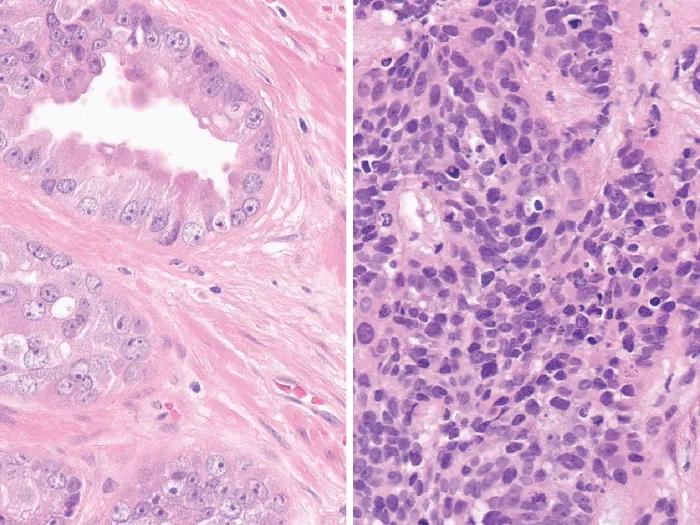
New drug combination may help treat advanced prostate cancer
Study sheds light on why some prostate tumors are resistant to treatment