
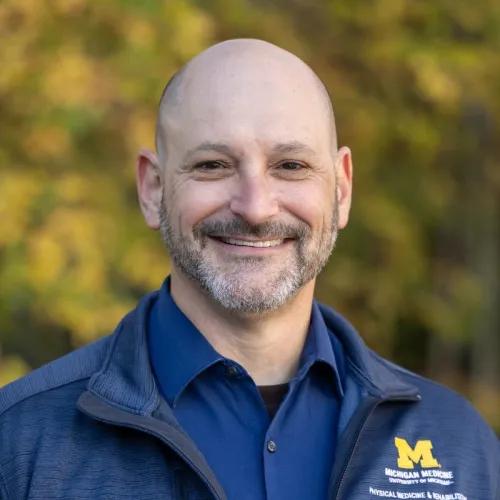
Jonathan Lifshitz, PhD
Physical Medicine & Rehabilitation
2800 Plymouth Road; NCRC 22-1064
Ann Arbor, MI 48109
Manage Your Profile
About
Creative Original - Neuroscientist, Inventor, Story Teller, Analogist, Mentor, Justice Warrior
Jonathan Lifshitz, PhD, leads the Neurotrauma & Social Impact research team as a joint venture between the University of Michigan Concussion Center, Michigan Medicine Physical Medicine & Rehabilitation, and VA Ann Arbor Healthcare System. He is appointed as a Michigan Impact Professor, a tenured Professor, and VA Research Health Scientist.
Research projects focus on investigative, restorative, and regenerative treatments for traumatic brain injury as it develops into chronic neurodegenerative disease. We investigate domestic violence, child abuse, gender imbalance, marital norms, and Veteran mental health, with focus on inflammation and circuit reorganization to detect and intervene. The goal is to train generations of investigators to apply rigorous data to work for social impact, including health and medical outcomes.
Dr. Lifshitz earned a Bachelors in Neuroscience from UCLA, a PhD in Neuroscience from University of Pennsylvania, and completed fellowships at UPenn and VCU. He leads local, state, and federal funded projects, including ones on cognitive rehabilitation, cardiovascular risk factors, vital imaging, neuroinflammation, and TBI during pregnancy. Currently, he is the scientific director for regional and national consortia to understand TBI arising from domestic violence. He serves on shared governance bodies at his institutions, chaired statewide councils, and serves on national and international professional societies. He reviews grants for national institutes.
He has led an academic research lab for two decades, primarily involving animal models of human disease. He has trained scientists at all levels and backgrounds to achieve their individual professional goals.
Links
Michigan Medicine Concussion Center linkedin Google Scholar
Qualifications
-
Post-Doctoral FellowshipVirginia Commonwealth University, Department of Anatomy & Neurobiology, Richmond, United States
2004 - 2006
Postdoctoral Fellowship
-
Post-Doctoral FellowshipUniversity of Pennsylvania, Department of Neurosurgery, Philadelphia, United States
2002 - 2004
Postdoctoral Fellowship
-
Visiting Scholar & ResearcherLund University, Laboratory for Experimental Brain Research, Wallenberg Neuroscience Center, Lund, Sweden
1998 - 1998
Other
-
Ph.D., NeuroscienceUniversity of Pennsylvania, Philadelphia, United States
1995 - 2002
-
B.S., NeuroscienceUniversity of California, Los Angeles, Los Angeles, United States
1991 - 1995
Center Memberships
-
Center MemberCenter for History, Humanities, Arts, Social Sciences and Ethics in Medicine
-
Center MemberInstitute for Healthcare Policy and Innovation
Research Overview
Dr. Lifshitz’s research has focused on cutting-edge research topics that advance the field — including mitochondria involvement in neuropathology, amygdala-dependent affective behavior, sensory sensitivity, objective signs of TBI, neuroinflammation, cognitive rehabilitation and peripheral inflammation. More than 100 peer-reviewed publications represent a body of work that includes basic mechanism, translational investigation, health care data analysis, and topics of social impact related to health care disparities. [PubMed Bibliography] [Google Scholar]
Major contributions to science include:
- Defined the Fencing Response as a TBI indicator, which is recognized through social media as a positive sign of concussion.
- Identification of rod microglia in neurodegenerative disease, with projects to develop molecular tools to interrogate, isolate and intervene.
- Defined post-traumatic sleep as an indicator of brain injury progression.
- Leading translational and community efforts regarding TBI in domestic violence.
- Investigating the consequences of TBI during pregnancy with a focus on transgenerational effects on neurodevelopment.
- Employing miniature microscopes (miniscopes) to understand post-injury pharmacokinetics, vascular dysfunction, and pathodynamics.
- Investigating novel spatial navigation as cognitive rehabilitation for TBI in the laboratory and clinic.
Recent Publications
-
Lujan BE, Giordano KR, Gonzalez-Ricon RJ, Giblin OC, Manriquez M, Qiu S, Antonson AM, Lifshitz J. Pregnancy (Hoboken), 2026 Sep; 2 (5): e70434Journal ArticleDecoding neurodevelopment risks of exposures to intoxication, infection, and trauma during pregnancy.
DOI:10.1002/pmf2.70434 PMID: PMC13501107 -
Mastroeni DF, Nolz J, Zhang Y, Griffiths DR, Louangprasert KA, Emerson H, Karamanova N, Law LM, Park J, Migrino RQ, Lifshitz J. Neurosci Lett, 2026 Aug 27; 886: 138711Journal ArticleMicrotubule and cytoskeletal destabilization gene expression in the brain vasculature after experimental diffuse traumatic brain injury: Implications for neurodegenerative disease later in life.
DOI:10.1016/j.neulet.2026.138711 PMID: 42660275 -
Marshall RA, Swanson PV, Michaels BL, Stenger KM, Corwin D, Lifshitz J, Eckner JT, Hunt NR, McDavid B, Rogers A, Cicero MX. Prehosp Emerg Care, 2026 Jun 8; 1 - 17.Journal ArticleThe Feasibility and Acceptability of Mobilizing Community Paramedics to Provide the Standard of Care for Pediatric Concussion: Mobile Integrated Health Programing for Pediatric Patients.
DOI:10.1080/10903127.2026.2680993 PMID: 42257458 -
Lifshitz J. 2026 Mar 30;PresentationIntimate Partner-Inflicted Brain Injury & Criminal Justice
-
Lugo A, Stewart AR, Lifshitz J, Rowe RK. 2026 Mar 5;DatasetModeling Spatial Neurodegeneration in Male C57BL/6 Mice Following Single and Repetitive Midline Fluid Percussion Injury
DOI:10.34945/F51S4B -
Lugo A, Stewart AR, Lifshitz J, Rowe RK. 2026 Mar 5;DatasetModeling Spatial Neurodegeneration in Male C57BL/6 Mice Following Single and Repetitive Midline Fluid Percussion Injury
DOI:10.34945/F51S4B -
Stewart CJ, Philipson EB, Caspell JR, Gorman K, Marshall RA, Lifshitz J. Peerj, 2026 Jan 1; 14: 1 - 18.Journal ArticleObservable signs of concussion in professional slap fighting using established video review protocols for professional sports: frequency, predictors, and implications for public concussion recognition awareness
DOI:10.7717/peerj.21623 -
Challapalli M, Warburton A, Nosova K, Bina R, Lifshitz J, Katz D. 2025 Nov 22; Research Square,PreprintOptimal Timing of Prophylactic Anticoagulation in Traumatic Brain Injury: A Target Trial Emulation
DOI:10.21203/rs.3.rs-7904113/v1
Featured News & Stories

