U-M Medical School faculty awarded $1.1 million AMA grant to develop precision education tools
Matthew Caldwell, M.D., will lead the Department of Anesthesiology’s efforts to develop analytic and coaching tools for residents
Author |
ANN ARBOR, Mich. - The American Medical Association announced today the award of a $1.1 million grant to Matthew Caldwell, M.D., Clinical Associate Professor of Anesthesiology at the University of Michigan Medical School, through its ChangeMedEd Initiative.
Caldwell’s proposal, “PACE: Precision Analytics for Coaching Effectiveness,” was selected from a field of nearly 200 applicants for the AMA’s Transforming Lifelong Learning Through Precision Education Grant Program. PACE is led by Caldwell, Norah Naughton, M.D., the Georgine M Steude Professor of Anesthesiology Education, and Lara Zisblatt, Ed.D., Clinical Assistant Professor of Anesthesiology.
“We’re incredibly excited for the opportunity to launch the full vision of PACE with this support from the AMA,” Caldwell said.
“By harnessing data across dozens of training programs, our goal is to give residents real agency over their learning — helping them identify strengths, fill experience gaps and, ultimately, become more adaptable, reflective and confident physicians.”
PACE will use electronic health record data from the Multicenter Perioperative Outcomes Group (MPOG) registry to create interactive education dashboards for anesthesiology residents that track progress and provide precision automated nudges. In addition, in-person coaching based upon the dashboards will be implemented at 10 selected PACE sites.
Drawing high-quality, validated data from 36 anesthesiology training programs, this tool will provide “real-time, scalable, education-focused analytics.”
PACE’s dashboard will contextualize residents’ clinical experiences, prompting them to debrief after a rare incident, for example, or seek supplemental education opportunities due to their individual clinical exposure relative to local or national benchmarks. PACE aims to create master adaptive learners — and potentially provide a roadmap for other specialties hoping to develop precision-education coaching tools.
“As the coordinating center for MPOG, we are excited to support Dr. Caldwell and his national network of PACE collaborators in this innovative application of EHR data and rigorous analytics,” stated Sachin Kheterpal, M.D., M.B.A., the Robert B Sweet Professor and Chair of the U-M Department of Anesthesiology and Executive Director of MPOG.
The project began with funding from a Michigan Medicine GME Innovation Grant before expanding through a grant from the Foundation for Anesthesia Education and Research.
Precision education refers to the use of technology and analytics to create personalized tools that increase agency for learners. The AMA has committed to supporting precision education with this four-year, $12 million grant program.
“We are delighted that once again the University of Michigan Health is a recipient of one of the American Medical Association’s medical education grants,” said Louito Edje, M.D., MHPE, FAAFP, Senior Associate Dean of Medical Education at the University of Michigan Medical School.
“We look forward to supporting Dr. Caldwell’s bold innovation as he leads change in precision education.”
In This Story
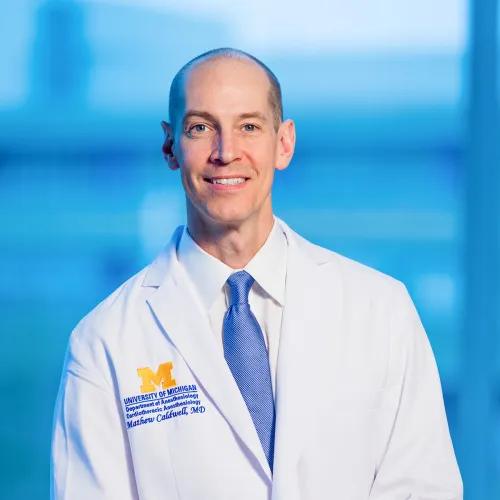
Matthew Caldwell, MD
Clinical Associate Professor
Featured News & Stories
Teaching Ultrasound at the Bedside

Hear From the RISE Curriculum Director: October 2026

Jacob Mack: Helping Trainees Take the Next Step

Psychedelics and anesthetics create mirror image patterns in the brain
From the Executive Director’s Desk: September 2026