Clinical trial opens to study groundbreaking 3D printed device for babies with rare respiratory disease
Michigan Medicine and Materialise launch research study for first-of-its-kind bioresorbable implant intended to help children with severe tracheobronchomalacia
9:00 AM
Author |
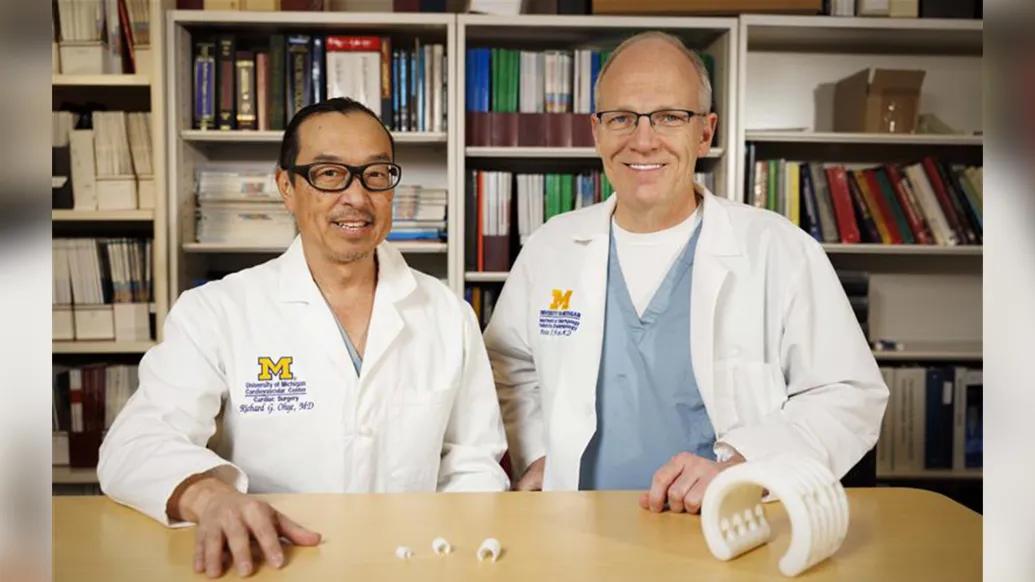
ANN ARBOR, Mich. – A new clinical trial will allow researchers to study 3D-printed bioresorbable devices aimed at treating children with rare and life-threatening airway condition tracheobronchomalacia.
The trial, launched by Michigan Medicine and Materialise, marks a crucial step towards full Food and Drug Administration (FDA) approval for the innovative devices designed to support the airways of infants with the severest forms of the disease.
Tracheobronchomalacia causes the airway to collapse, making breathing difficult and, in severe cases, can be fatal. Currently, infants with this condition often rely on ventilators to survive.
For more than a decade, University of Michigan Health teams have been obtaining expanded access approval from the FDA on a case-by-case basis to use a first-of-its-kind 3D-printed bioresorbable airway splint to treat these children under emergency and compassionate use. But the groundbreaking treatment is currently accessible to only a limited number of patients.
Now, researchers at Michigan Medicine and 3D printing manufacturing company Materialise are paving the way for broader use of the device through a clinical trial to test its safety and efficacy. The trial opened in January, with the first patients now being enrolled.
“We have established a process that allows us to offer the customized airway splint as a last resort treatment for certain children with no other options but we need more research to make it available on a wider scale,” said trial principal investigator Richard Ohye, M.D., a pediatric heart surgeon at U-M Health C.S. Mott Children’s Hospital, who leads surgical implantation of the device.
Research teams plan to enroll 35 infants in the eight-year study from Mott, as well as four other children’s hospitals across the country, with devices produced by Materialise.
Tracheobronchomalacia, caused when cartilage in the trachea or mainstem bronchi develops abnormally, varies in severity. For most children, symptoms are mild and subsist by age three once the tracheal cartilage has had time to grow stronger.
But Mott otolaryngology surgeon Glenn Green, M.D., said he was frustrated by the lack of options for other children with the severest forms of the condition who faced poor outcomes.
“We needed a revolutionary innovation to give these babies a chance to survive,” Green said.
More than a decade ago, he worked with former U-M professor of biomedical engineering Scott Hollister, Ph.D., to develop a biodegradable scaffolding, which could be designed and manufactured into a tracheal splint customized to the individual patient.
The University of Michigan-developed device is attached to the outer side of the trachea or mainstem bronchi to hold the airway open and prevent collapse and was the first 3D implant made for kids, designed to grow along with the patient, and eventually be safely resorbed into the body.
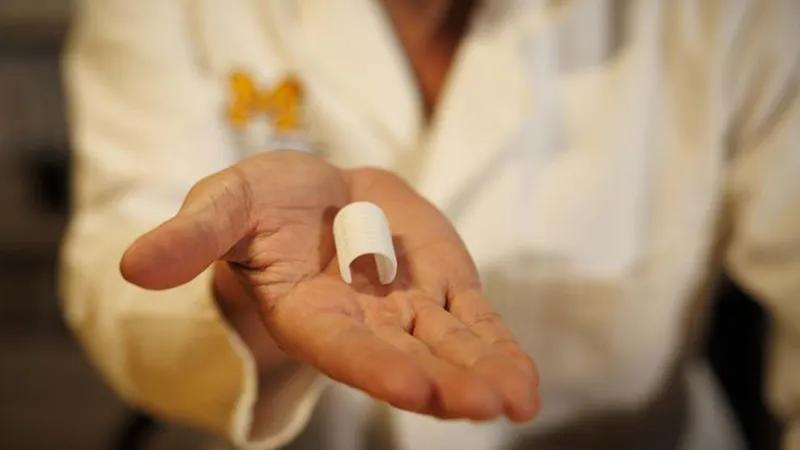
In 2012, the tracheal splint was used for the first time to save the life of a three-month old with a dire case of tracheobronchomalacia and the successful outcome was outlined in a New England Journal of Medicine report. With assistance from the Michigan Institute for Clinical and Health Research (MICHR), Green and colleagues were able to obtain emergency approval to use the bioresorbable scaffolding through working with the FDA, Institutional Review Board and hospital administration. It’s since been used in more than 40 children at Mott.
MICHR, Michigan Medicine and Materialise have worked together to obtain approval for the 3D printed bioresorbable devices to be utilized in a clinical trial. The trial is the next step towards FDA approval to treat children with the life-threatening condition.
Throughout the trial, the devices will be printed by Materialise, a large Belgium-based 3D-printing company that has pioneered numerous groundbreaking medical 3D printing applications. With over three decades of experience in developing medical solutions, Materialise operates manufacturing facilities for these bioresorbable splints in Ann Arbor. The company produces 280,000 personalized 3D-printed instruments and implants per year, including 160,000 for the U.S. market.
“The advent of technologies such as 3D printing and advanced visualization techniques has transformed patient-specific care,” said Colleen Wivell, Director of Clinical Engineering at Materialise. “Surgeons increasingly adopt 3D printing as part of their surgical workflow to bring personalized care to patients, improving healthcare and reducing costs overall. We’re so pleased to support this life-saving treatment and look forward to continuing to impact these children and their families.”
Additional contributions: Andrea Les, Ph.D., research program manager for pediatric cardiology, and Jeanne Wright, director of the MICHR IND/IDE Investigator Assistance Program (MIAP), made essential contributions to the airway splint program over the last decade, including protocol development, expertise in regulatory compliance, and support for expanded access use of the airway splint device. Their expertise and dedication has been crucial to the success of this work.
Disclosures: Green and Hollister developed the device at the University of Michigan, which licensed the intellectual property to Materialise.
About Michigan Medicine and University of Michigan Health
At Michigan Medicine, we advance health to serve Michigan and the world. We pursue excellence every day in our top rated hospitals, clinics and home care operations, as well as educate the next generation of physicians, health professionals and scientists in our U-M Medical School.
Michigan Medicine includes the highly regarded U-M Medical School and University of Michigan Health, which includes C.S. Mott Children’s Hospital, Von Voigtlander Women’s Hospital, University Hospital, the Frankel Cardiovascular Center, Rogel Cancer Center, U-M Health West and Sparrow Health System. The U-M Medical School is one of the nation's biomedical research powerhouses, with total research funding of more than $500 million.
More information is available at www.michiganmedicine.org
About Materialise
Materialise incorporates more than three decades of 3D printing experience into a range of software solutions and 3D printing services that empower sustainable 3D printing applications. Our open, secure and flexible end-to-end solutions enable industrial manufacturing and mass personalization in various industries — including healthcare, automotive, aerospace, eyewear, art and design, wearables and consumer goods. Headquartered in Belgium and with branches worldwide, Materialise combines the largest group of software developers in the industry with one of the world’s largest and most complete 3D printing facilities.
In This Story

Richard G Ohye
Professor

Glenn Edward Green, MD
Clinical Professor
Featured News & Stories

Intuition pushed mom to keep checking for breast cancer

Connecting Genetics, Discovery and Patient Care: Dr. Santhi Ganesh on the Future of Vascular Genetic Medicine

Continuing the legacy of a doctor’s doctor

Human Rabies Exposures Growing Across the Country

New Certificate in Global Health Program welcomes first cohort of residents, fellows