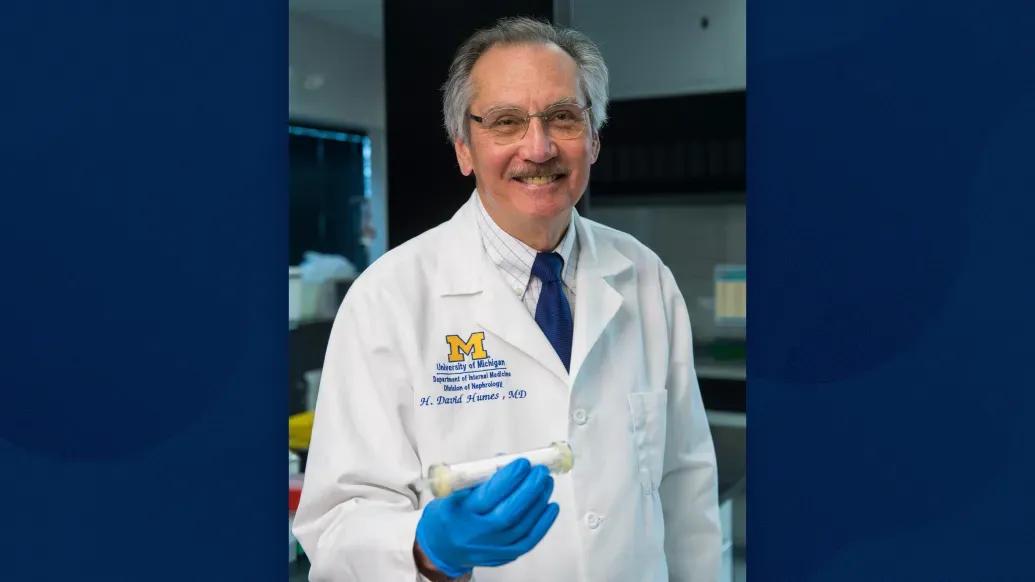
H. David Humes, MD, named 2026 Distinguished University Innovator of the Year
The award is the highest honor for U-M faculty members who have developed transformative ideas, processes or technologies and shepherded them to market for broad societal impact
Author |
This article originally appeared in The University Record on Aug. 12, 2026
Sepsis is a life-threatening medical emergency that is brought on by the body’s extreme response to an infection. And for patients with severe sepsis that is complicated by acute kidney injury and multiorgan failure, mortality remains extraordinarily high even under the best care available.
The conventional approach to treating sepsis focuses on targeting the bacteria responsible, but H. David Humes, MD, identified a different culprit. In severe sepsis, the immune system becomes dangerously overactivated, with white blood cells flooding the body and attacking its own organs; the bacteria, in a sense, are only the trigger.
This understanding from Humes, a nephrologist and professor emeritus of internal medicine at U-M, led to the development of the Selective Cytopheretic Device, the first and only FDA-approved therapy specifically for children with acute kidney injury and sepsis or a sepsis-like condition.
“Our technology focuses not on treating the bacteria, but on treating this dysregulated immunologic system that is overreacting and destroying tissues within the body. That’s the breakthrough,” Humes said. “However, the breakthrough would not have happened without the commercialization support we received at the University of Michigan.”
Humes’ device acts on that insight, drawing a patient’s blood through a specially designed filter outside the body that captures and quiets the overactive immune cells driving the damage. After early clinical trials in adults were derailed by a nationwide drug shortage, Humes pivoted and secured funding to test the device in children. Two pediatric trials produced a 50% reduction in mortality compared to standard care, with no device-related serious adverse events.
“These are not modest gains,” said Lenar Yessayan, MD, professor of medicine and director of the Acute Dialysis Program at Michigan Medicine. “These are outcomes that fundamentally alter the natural history of a disease long defined by high mortality and incomplete recovery.”
In recognition of the impact of this work, Humes is being awarded this year’s Distinguished University Innovator of the Year. The award is the highest honor for U-M faculty members who have developed transformative ideas, processes or technologies and shepherded them to market for broad societal impact. It was established in 2007 and is supported by endowments from the Office of the Vice President for Research and the Stephen and Rosamund Forrest Family Foundation.
“Dr. Humes exemplifies what it means to be a physician-innovator,” said Kelly Sexton, associate vice president for research-innovation partnerships and economic impact. “He identified a clinical problem that had seen little progress for decades, and he kept working until he had a solution, one that has now received FDA approval and is improving outcomes for critically ill children. That kind of vision, persistence and real-world impact is exactly what this award was created to recognize.”
OVPR selected this year’s recipient based on the recommendation of a faculty selection committee that reviews a pool of nominees. Humes will receive the award Sept. 24 at the annual Celebrate Invention event.
From approval to impact
In February 2024, the FDA approved Humes’ device under a Humanitarian Device Exemption, now commercialized as QUELimmune by SeaStar Medical, for children with acute kidney injury and sepsis in the ICU.
SeaStar, a publicly traded company on the NASDAQ, projects that more than 30 centers will be utilizing its technology by the end of 2026. Additionally, SeaStar’s QUELimmune was awarded the National Kidney Foundation’s Corporate Innovator Award in 2025.
The FDA has since granted the device six Breakthrough Device designations across additional indications. An ongoing multicenter trial in adult patients is expected to be completed in late 2026, with interim data already showing potential clinical benefit. FDA submission may follow as early as 2027, potentially opening up a therapy to patients that previously had seen little advancement in care.
Innovation without borders
Humes is now extending his work globally. A new philanthropic initiative pairs his device with low-cost dialysis technologies developed, in part, by an Ann Arbor-based research and development company Innovative BioTherapies, including systems designed to operate without electricity, to expand access to critical care in low- and middle-income countries.
The program, structured as an interdisciplinary initiative with U-M as a central partner, targets pediatric sepsis, malaria and maternal sepsis in underserved regions.
Humes holds more than 70 issued or pending patents, has published nearly 250 scientific articles and book chapters and previously chaired U-M’s Department of Internal Medicine. The development of the Selective Cytopheretic Device was supported by more than $30 million in grant funding and over $100 million in private equity investment.
“Despite some of the challenges along the way, this journey has been incredibly exciting,” Humes said. “Identifying a problem and achieving a solution to solve it is why many of us enter academic medicine. The impact we’re seeing from this technology is a prime example of how medicine can be translated into a product that serves the public good.”
U-M and Humes have a financial interest in SeaStar Medical and Innovative BioTherapies.
In This Story
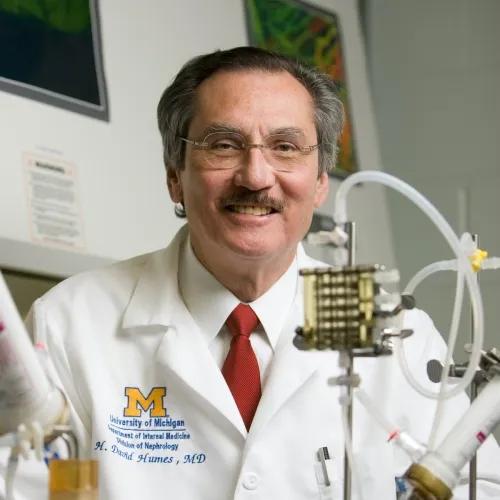
H D Humes
Professor Emeritus/a

Lenar Yessayan, MD
Clinical Professor
Featured News & Stories
First national survey by U-M clinician-researchers finds nearly all family medicine residencies teach menopause care
Comprehensive DNA sequencing reveals hidden drivers of cancer
Noah Carey, MD/MPH student: Connecting medicine, public health and purpose

Regents approve Urology acting chairs, Cell and Developmental Biology interim chair
Keith E. Cook, PhD, MS, appointed Chair of Biomedical Engineering