Why aren’t more older adults getting flu or COVID-19 shots?
A poll suggests a need for more communication about vaccines’ power to reduce risk of severe illness in people over 50
6:00 AM
Author |

This winter’s brutal flu season isn’t over, and COVID-19 cases have risen recently too.
But a new poll taken in recent weeks shows that vaccination against both viruses lags among people 50 and over, and the national survey reveals key reasons why.
In all, the University of Michigan National Poll on Healthy Aging shows, 42% of people over 50 haven’t gotten either flu or COVID-19 vaccines in the past six months, though 29% have gotten both and 27% have gotten just the updated flu shot.
The poll also asked about COVID-19 vaccination since it became available in 2021: 49% of people over 50 said it’s been more than a year since their last dose, and 15% said they’ve never received it.
The leading reason people over 50 gave for not getting updated vaccines?
They didn’t think they needed them.
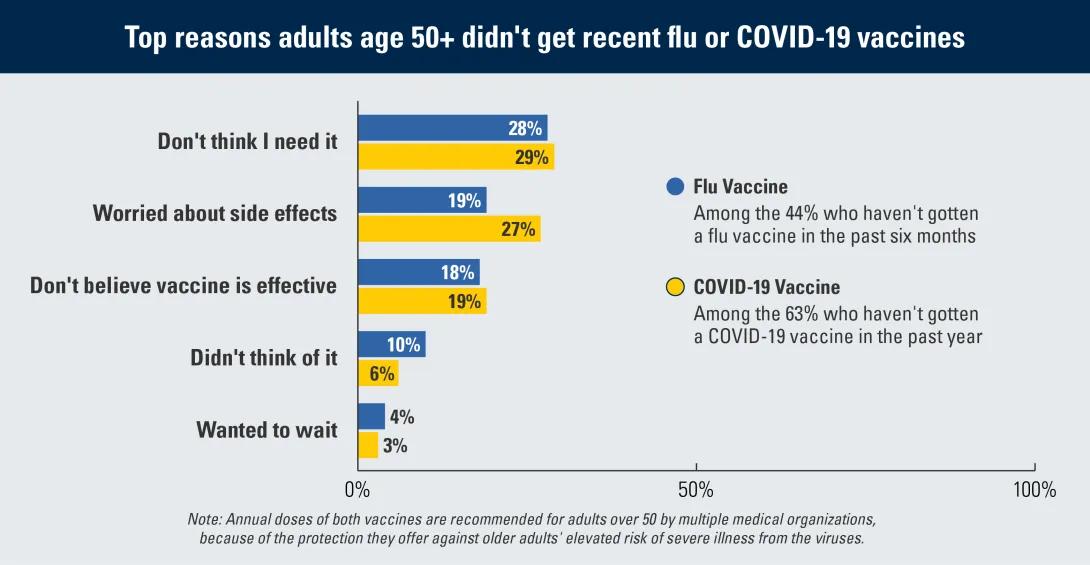
In all, 28% of people over 50 who didn’t get a flu vaccine in the past six months, and 29% of those who didn’t get a COVID-19 vaccine in the past year or ever, gave this as the main reason.
That’s despite clear evidence showing that staying up to date on both vaccines reduces the risk of serious illness and death in older adults, whose immune systems need regular “reminders” with updated vaccines tailored to recent mutations in the viruses.
Coming in second among reasons for not getting vaccinated recently were worries about the vaccines’ side effects (19% for flu and 27% for COVID-19), followed by a belief that the vaccines aren’t effective (18% and 19%, respectively).
Far fewer (10% for flu and 6% for COVID-19, respectively) said they just didn’t think of it. A few (4% and 3%) wanted to wait, and from 1% to 4% cited time, cost, insurance, availability or eligibility concerns.
The findings could help health care providers and public health agencies communicate better with middle-aged and older adults about the health benefits of annual vaccination and address any concerns, misinformation, or barriers.
The poll is based at the U-M Institute for Healthcare Policy and Innovation and supported by Michigan Medicine, U-M's academic medical center.
From late December 2025 to mid-January 2026, the poll team asked 2,964 United States adults age 50 and over if they’d gotten a flu vaccine dose in the last six months, and when their most recent COVID-19 vaccination was.
Then, the team asked those who hadn’t sought vaccination recently their main reason why.
“The evidence is clear: these viruses can lead to serious illness, hospitalization, and death. That risk increases with age and underlying health conditions, and vaccination reduces that risk,” said Jeffrey Kullgren, M.D., M.P.H., M.S., the poll’s director, an Associate Professor of Internal Medicine at the U-M Medical School and a primary care physician at the VA Ann Arbor Healthcare System.
“These findings suggest that we must do a much better job helping people in their 50s and up understand that they will benefit from getting these updated vaccines each year, that the vaccine side effects are mild and short-lived, and that even if they later get infected and develop symptoms, vaccination means they won’t get as sick,” he added.
Emphasizing individual impacts is important, he noted. Experts and news stories often discuss vaccine effectiveness in percentages based on how well the vaccine reduces the risk of hospitalization or death in a population.
That’s different from what an individual might care most about: whether it will keep them from getting sick at all, or seriously ill, Kullgren says.
Even when a vaccine isn’t a perfect match for the virus strains that are circulating, a recent dose still nudges the immune system to be ready to fight off the virus in general, and can help reduce the severity and duration of symptoms, he notes.
No impact from changed recommendation for COVID-19 shot
Last spring, leaders at the United States Food and Drug Administration signaled a change in the agency’s recommendation about which adults should receive the COVID-19 vaccination.
This was followed by an official change in the FDA approval and the recommendation from the Centers for Disease Control and Prevention in late summer.
But the poll suggests this change didn’t play a major role in older adults’ decision-making.
Less than 1% of respondents who chose not to get vaccinated against COVID-19 in the last year said their main reason was they thought they weren’t eligible.
And in fact, the federal change only affects some of those who were polled: Those who are aged 50 to 64 without any chronic health condition that raises COVID-19 risk.
These findings suggest that we must do a much better job helping people in their 50s and up understand that they will benefit from getting these updated vaccines each year, that the vaccine side effects are mild and short-lived, and that even if they later get infected and develop symptoms, vaccination means they won’t get as sick."
-Jeffrey Kullgren, M.D., M.P.H., M.S.
COVID-19 vaccination is still recommended for most older adults, including two doses a year for everyone over age 65 and anyone with a compromised immune system, and one dose a year for those under 65 who have underlying health conditions that put them at higher risk of severe COVID-19.
Many people ages 50 to 64 have at least one of those qualifying conditions, which include diabetes, asthma, obesity, high blood pressure, current or previous smoking, and physical inactivity.
The CDC didn’t change its recommendation that everyone over the age of 6 months should get an annual flu vaccination.
And major medical societies and insurance companies announced that they would continue recommending or covering both vaccines for all children over 6 months and all adults, regardless of health status.
Differences in vaccination uptake
In addition to revealing reasons older adults didn’t get updated vaccines, the new poll data show some key differences in vaccination among different groups of people 50 and over.
The oldest adults (age 75 and over)– those with the highest risk of hospitalization and death from both viruses – had the highest rates of updated vaccination.
In all, 46% of those age 75 and up said they had gotten a COVID-19 vaccine in the last six months, compared with 37% of those age 65 to 74 and 20% of those age 50 to 64.
Flu vaccination was even higher in all age groups, with 76% of those in the oldest age bracket having gotten the latest flu shot, compared with 64% of those age 65 to 74 and 42% of those in their 50s and early 60s.
"This gap between flu and COVID-19 vaccination represents an opportunity to connect the dots for older patients: both of these viruses can put them at risk, both of them mutate rapidly, and both vaccines should be an annual tradition, even if they don’t get them at the same time,” said Kullgren.
He also points to the poll’s positive finding that adults 50 and over who report having at least one chronic health condition were much more likely to have gotten flu and COVID-19 shots recently than those without a chronic condition.
But even among those with chronic health conditions, 39% said they hadn’t had either vaccine in the last six months, though this rate was much lower than the 59% of those without chronic conditions who said so.
The poll also suggests a need for focus on those who have never gotten vaccinated against COVID-19, as they grow older and their risk of severe outcomes rises.
In all, 20% of those age 50 to 64 said they had never gotten a COVID-19 vaccine, along with 12% of those age 65 to 75 and 7% of those age 75 and up.
There’s also an income gap, with 19% of all those with household incomes under $60,000 saying they’ve never had a COVID-19 shot, compared with 12% of those with incomes over $60,000.
Not too late to vaccinate, including second doses of COVID-19 vaccine
Kullgren notes that it’s not too late in the current respiratory virus season for anyone to get a flu or COVID-19 vaccine if they haven’t already done so.
It’s also almost time for second doses of the COVID-19 vaccine for those over 65 or with moderately to severely compromised immune systems who got this year’s version soon after it arrived in early September.
They're recommended to get another dose starting six months after receiving the first.
So, if someone received their first dose in the first week of September, for instance, they can receive a second dose starting the first week in February.
See the detailed adult vaccine schedule and the page about COVID-19 vaccines for immunocompromised people.
About the poll
The poll findings come from a nationally representative survey conducted by NORC at the University of Chicago for IHPI and administered online and via phone from December 29, 2025 to January 13, 2026 among 2,964 U.S. adults ages 50 to 98. The sample was weighted to reflect the national population.
Read past National Poll on Healthy Aging reports and Michigan findings, and learn about the poll methodology.
Sign up for Health Lab newsletters today. Get medical tips from top experts and learn about new scientific discoveries every week.
Sign up for the Health Lab Podcast. Add us wherever you listen to your favorite shows.

Health Lab
Explore thousands of health news & research stories by visiting the Health Lab homepage for more.
Media Contact

Public Relations
Department of Communication at Michigan Medicine
In This Story

Jeffrey Todd Kullgren, MD, MS, MPH
Professor
Related

Despite policy confusion, vaccines for flu, COVID still strongly recommended

Investing in COVID-19 vaccination more than paid off for U.S.
Stay Informed
Want top health & research news weekly? Sign up for Health Lab’s newsletters today!
Featured News & Stories

Comprehensive DNA sequencing reveals hidden drivers of cancer

Many older adults make Medicare decisions quickly and most don’t change plans, poll finds

‘Molecular glue’ stabilizes protein that inhibits development of non-small cell lung cancer and uterine cancer
What’s the latest on 7-OH and kratom availability and addiction care?

Depression in OBGYN residents needs more attention, study suggests