Solving a sticky, life threatening problem
Candida auris is an emerging fungal threat—and its unique way of sticking to surfaces may underlie its virulence
5:00 AM
Author |
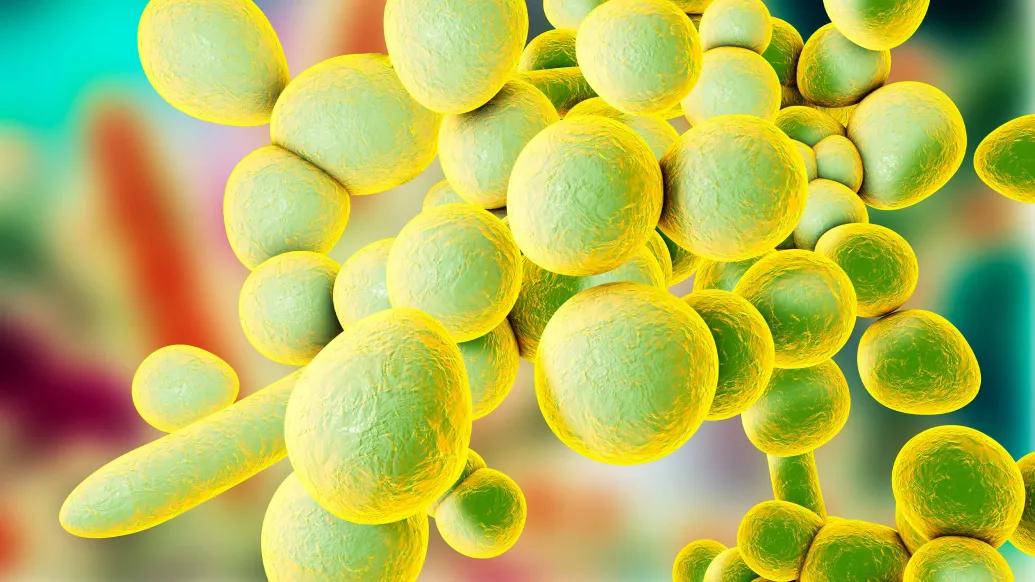
In 2009, a mysterious fungus emerged seemingly from out of thin air, targeting the most vulnerable.
It sounds like Hollywood, but the fungus in question poses a very real threat.
Scientists are scrambling to figure out what makes the life threatening fungus Candida auris tick—and why even the best infection control protocols in hospitals and other care settings often fail to get rid of it.
Researchers at Michigan Medicine have zeroed in on C. auris’ uncanny ability to stick to everything from skin to catheters and made a startling discovery.
The investigative team, led by Teresa O’Meara, Ph.D., of the U-M Medical School Department of Microbiology and Immunology and her graduate student Darian Santana, has discovered that C. auris is unlike any other known fungus in that it employs a type of protein, called an adhesin, that acts very similar to those used by oceanic organisms, such as barnacles and mollusks.
Their original hypothesis was that C. auris would use an adhesin from the families of sticky proteins used by other fungi like C. albicans.
However, when they checked the usual suspects, namely proteins from the highly conserved ALS and IFF/HYR families, they came up mostly short, except for one protein, IFF4109, with a partial affect.
They then pivoted to a different screening method to systematically break the genome of C. auris and see which mutant lost its ability to stick to 96-well plastic plates—leading to the discovery of a new adhesin they named Surface Colonization Factor (SCF1).
“The new adhesin is only present in C. auris so we don’t know where it came from evolutionarily. It doesn’t look like it came from any other organisms by sequence similarity,” said O’Meara.
The bonds formed by Scf1, they revealed, are cation-pi bonds, which are among the strongest non-covalent chemical bonds in nature.
Said O’Meara, “Much of the literature about this type of bond in nature comes from people trying to bioengineer glue that adheres underwater. Hence, they’ve looked to nature for inspiration.”
Furthermore, the team discovered that SCF1 was associated with increased colonization and an enhanced ability to cause disease. Using mouse models, they demonstrated that a loss of both SCF1 and IFF4109 diminished the ability of a strain of C. auris to colonize skin and an in-dwelling catheter.
What’s more, strains designed to over express SCF1 saw enhanced virulence and more fungal lesions.
“We don’t know why this adhesin is required to cause disease,” said O’Meara.
“It could be that they’re required to attached to blood vessels, or maybe they change the host-receptor interactions which has been true for the related fungus Candida albicans, but we don’t know in this case.”
O’Meara and her team plan to investigate the link between SCF1 and virulence in the hopes of exploiting it for a more effective anti-fungal therapy, as many strains of C. auris are resistant to current medications.
The adhesin may also provide a clue about where C. auris came from, says O’Meara, with its barnacle-like adhesive properties suggesting an oceanic origin.
“Unlike SARS-CoV2, which emerged in one place, C. auris suddenly appeared in 5 distinct locations around the world. There’s some selective pressure in the world that changed that allowed C. auris to go from not a threat at all to colonizing people.”
Additional authors include Darian J. Santana, Juliet A. E. Anku, Guolei Zhao, Robert Zarnowski, Chad J. Johnson, Haley Hautau, Noelle D. Visser, Ashraf S. Ibrahim, David Andes , Jeniel E. Nett , and Shakti Singh
Paper cited: “A Candida auris-specific adhesin, SCF1, governs surface association, colonization, and virulence,” Science, DOI: 10.1126/science.adf8972, https://www.science.org/doi/10.1126/science.adf8972

Health Lab
Explore thousands of health news & research stories by visiting the Health Lab homepage for more.
Media Contact

Public Relations
Department of Communication at Michigan Medicine
Stay Informed
Want top health & research news weekly? Sign up for Health Lab’s newsletters today!
Featured News & Stories

Human Rabies Exposures Growing Across the Country
Comprehensive DNA sequencing reveals hidden drivers of cancer

Many older adults make Medicare decisions quickly and most don’t change plans, poll finds

4 in 5 parents say having a baby is too expensive
‘Molecular glue’ stabilizes protein that inhibits development of non-small cell lung cancer and uterine cancer