Alexa Canady reflects, shares advice after trailblazing neurosurgery career
The first African American female neurosurgeon celebrates her 50th anniversary as a U-M Medical School alum
12:05 PM
Author |
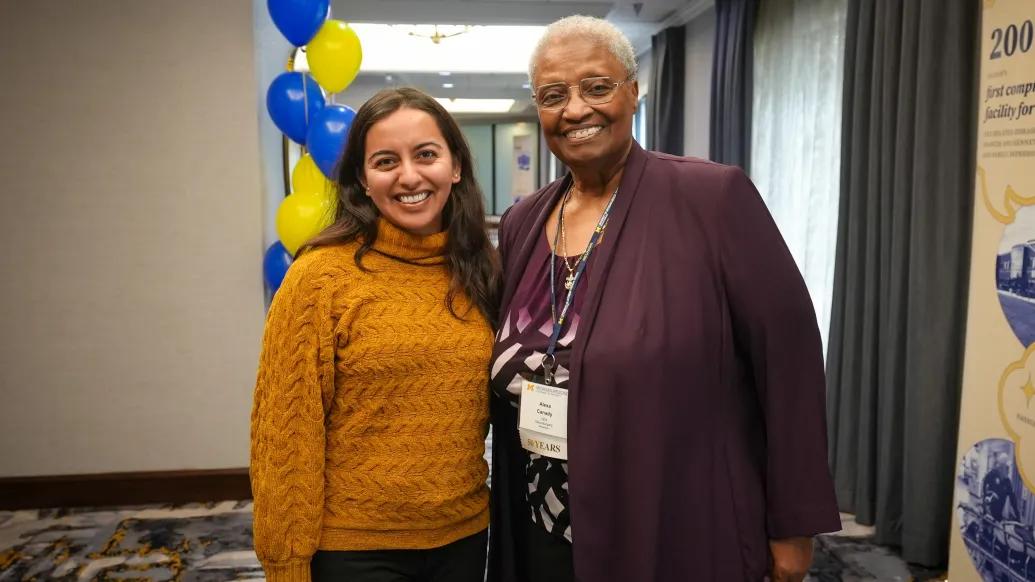
Alexa Canady, M.D., is well known for being the first Black woman to be board-certified in neurosurgery in the United States.
She also graduated from the University of Michigan Medical School in 1975, where she recently returned for her 50th reunion.
Canady’s connections to the University of Michigan extend beyond the Medical School, though: Canady graduated with a degree in Zoology from U-M in 1971, and her brothers, niece and nephew have all attended U-M as well.
“Families have a school,” Canady said. “And for us, the school is Michigan, and it’s been a good place.”
Now retired, Canady served as the chief of neurosurgery at Children’s Hospital of Michigan for 18 years — during which time she held a professorship at Wayne State University. Canady also worked part-time at Pensacola Sacred Heart Hospital until 2012.
Here, Canady discusses her time in Ann Arbor and her career in neurosurgery, which future physicians can take inspiration from.
What attracted you to pediatric neurosurgery specifically?
I realized that the thing I most enjoyed was working with the children and the spectrum of diseases that they had.
The atmosphere in a children's hospital is very different than in a regular hospital; it's much more collaborative work.
People work together and expect to work together and want to work together.
I mean, they've already made the decision that they're going to do pediatric medicine. In most places, that means you’re going to make less money. So, you're committed to the field then, right?
And who doesn't want to get paid to play with kids? During your job, you can stop during rounds and have a quick little video game with patients.
These are good things and make joy in your day.
You were a trailblazer in your specialty. What advice would you have for today's students who are underrepresented in their specialty, or in medicine more generally?
Well, I think whether you're underrepresented or not is not the issue.
The issue is, do you want it bad enough? And if you want it bad enough, you have to have a battle plan.
There were no women yet when I was looking. So, in my medical school days, I spent all my time that I had free hanging with the neurosurgeons.
By the time I was a senior, when I went to their conferences, they called on me like they called on residents to answer questions.
I made myself, as much as I could, a person who was present, who showed that I knew things, who showed that I could fit in.
Most surgical programs only take one or two people a year. And if you get someone who doesn’t fit in, it doesn’t work.
Your first degree from U-M was a B.S. in zoology. What made you pursue that avenue?
Nothing. My zoology degree is a miasma.
I was originally a math major, and I hadalways wanted to be a mathematician my whole life. I got into a number theory course and I realized that this was really not the thing I wanted to be doing the rest of my life.
I was kind of lost. In fact, I was a great deal lost.
I actually went on academic probation for six months because I didn't go to class. During that time, my father used to come and have dinner with me once a week during the summer when I was trying to get back on track.
I think that helped stabilize me because after that, things went fine.
I decided at that point to get out of math, obviously. When I looked through the book of course requirements, it turned out that all the courses I'd taken for math worked for a degree in zoology.
It was clear to me that that was the degree I could get without having to stay longer.
So that's the kind of zoologist I am; do not ask me any questions about any animals at all if they're not, you know, human.
How did you find your way into medicine after that?
Early college is about finding your niche. I found mine more dramatically than others it seems.
I felt that because of my skill set — I'm pretty good with words, pretty good with logic and thinking — that my choices were going to be probably medicine or law.
Law bothered me a little bit, because law is about winning and losing and not right and wrong.
So, that summer, my older brother, who was also at Michigan, heard about a health science program for minorities that would pay you $400 a month, which in those times was a lot of money. My rent was like $60.
I ended up in the laboratory of a guy who was also a geneticist and ran the genetics clinic.
I got to go to the genetics clinic and from there I fell in love with medicine.
What from your childhood, if anything, inspired your decision to get into medicine?
If I had to pick something, it would probably be Ben Casey.
He and Dr. Kildare were on [television]. Kildare was the handsome guy who played by the rules, but Ben Casey was the opposite. He was smart and was always fighting for what he thought was right, and I really liked that.
Sign up for Health Lab newsletters today. Get medical tips from top experts and learn about new scientific discoveries every week.
Sign up for the Health Lab Podcast. Add us wherever you listen to your favorite shows.

Health Lab
Explore thousands of health news & research stories by visiting the Health Lab homepage for more.
Media Contact

Public Relations
Department of Communication at Michigan Medicine
Stay Informed
Want top health & research news weekly? Sign up for Health Lab’s newsletters today!
Featured News & Stories
Learning Together: Making Space for Growth at Work
Education Community Kickoff Sparks New Connections and Opportunities for Michigan Medicine Educators

Depression in OBGYN residents needs more attention, study suggests
Teaching Ultrasound at the Bedside
Dr. Adam Rodman to deliver Woolliscroft Endowed Lecture on November 17