4 steps to take before using pre-owned children's equipment
Many parents opt for used baby and kid gear, such as cribs and highchairs, but may not always ensure they meet safety standards
10:21 AM
Author |

Cribs, strollers and other infant and child equipment can be expensive and many families agree that it’s wasteful to buy these items new when they’re needed for such a short time.
But while half of parents in a national poll say they have used pre-owned equipment for babies and young children, two in three acknowledge that it’s difficult to always know whether it’s safe.
“Used child essentials are often more cost-effective, environmentally friendly and convenient,” said Sarah Clark, M.P.H., co-director of the University of Michigan Health C.S. Mott Children’s Hospital National Poll on Children’s Health.
“However, many parents in our poll weren’t completely confident they could identify safety concerns, such as unsafe wear and tear, recalls or hygiene issues.”
Half of parents say they are only comfortable using used infant and child equipment from family or close friends while a little less than half are also OK with items bought at resale shops and yard sales.
Parents most commonly used pre-owned cribs and highchairs, followed by outdoor play structures, strollers, playpens and bath seats, and are least likely to report using second hand infant car seats or booster seats.
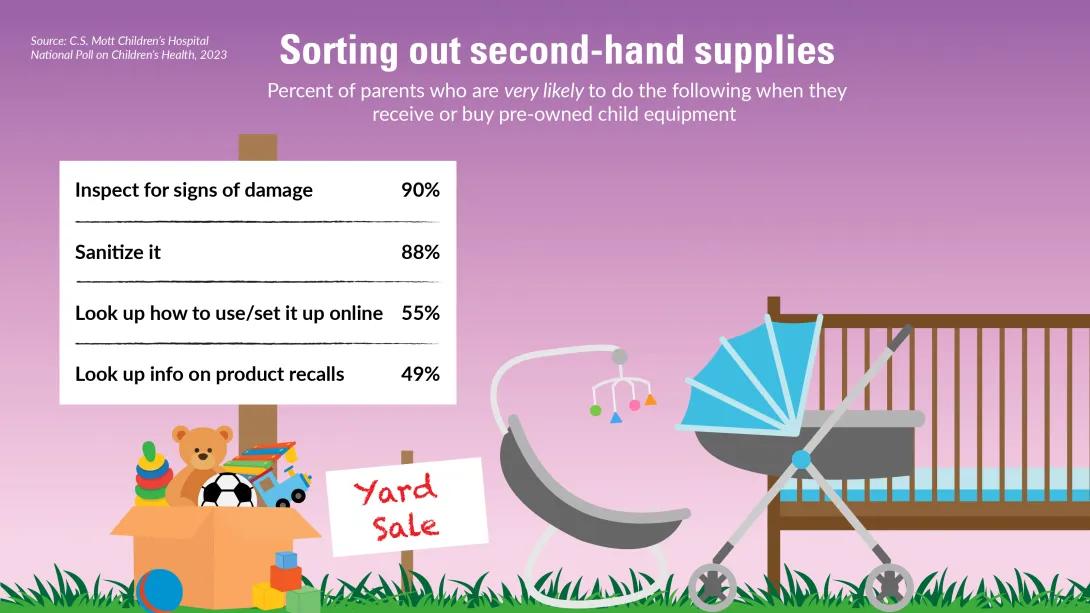
Most parents say that when they receive or buy pre-owned equipment, they are very likely to inspect it for signs of damage and sanitize it. But just half are as likely to do an internet search for instructions on how to set up and use the equipment or for information about product recalls.
“Regardless of whether they receive the item from someone they know well or from a garage sale, parents should take diligent steps to make sure the equipment meets current safety standards and is safe for their child,” Clark said.
Meanwhile, 4% of parents polled are not comfortable using any pre-owned equipment and three-quarters say they’d prefer to buy new items to ensure safety.
But budget concerns can be a barrier, especially since families often require duplicate pieces of equipment to support their child’s sleep, transportation and other daily activities at grandparents’ or babysitters’ homes.
Parents with household incomes under $100,000 are more likely to say they have used pre-owned equipment compared to those over $100,000.
4 key steps to take before using or donating pre-owned children’s equipment
1. Check for recalls
Parents can search for recall information from the United States Consumer Product Safety Commission along with its associated website, saferproducts.gov, which is a comprehensive search engine for all recalled products and a portal to report any products that have malfunctioned.
“Before allowing a child to use a pre-owned item, it’s essential to check for product recalls, which mean a manufacturer has asked customers to return or stop using the product due to a discovered safety hazard,” Clark said.
She added, “Parents should keep in mind that safety regulations are constantly evolving as research identifies features that pose a risk of injury.”
This is particularly important when it comes to cribs, she notes, one of the most common types of pre-owned equipment.
"It is likely that some parents using pre-owned cribs may not be aware of how safety standards have changed.”
Current standards for cribs specify that they shouldn’t have a drop-side rail, the crib rails should be less than six centimeters apart and the headboard have no decorative cut-out that can trap a child’s body.
2. Research installation directions
Parents often receive pre-owned equipment without the original packaging. Clark recommends parents in this situation search the website of the product’s manufacturer to find online instructions.
Regardless of whether they receive the item from someone they know well or from a garage sale, parents should take diligent steps to make sure the equipment meets current safety standards and is safe for their child."
- Sarah Clark, M.P.H.
Without proper assembly, items could have malfunctioning parts, such as brakes that do not work or wheels that come off on a stroller.
“If parents don’t properly follow assembly instructions, cribs, strollers and playsets can collapse or malfunction, potentially causing serious injuries to the child,” Clark said.
“To prevent these dangers, it’s important to carefully follow the manufacturer's instructions when assembling any items being used by a child, and to double-check that all parts are securely in place.”
3. Do extra research for car seats
Car seats present a unique challenge, as their safety considerations vary based on the child’s age, height and weight and they typically have an expiration date.
“It’s particularly important for parents to obtain the product-specific information to ensure the car seat meets safety guidelines for their child, hasn’t been involved in a crash and that they have proper guidance for installation,” Clark said.
If parents aren’t able to find instructions or have difficulty with assembly, many fire stations or other community organizations offer assistance with installation.
4. Do your diligence when you’re donating
Four in five parents polled have donated or sold pre-owned child health and safety equipment, most often to a family member or friend or a charitable organization as well as at a garage sale or to a children’s resale shop.
Parents passing off children’s gear should check for recalls, inspect the item for any serious wear and tear, clean the item thoroughly, make sure all the parts are included and, when possible, attach the product instructions to the equipment so that the new owners can assemble and install it correctly.
“Before passing on an item to another family, parents should ensure it’s safe and in good working order,” Clark said. “If not, parents should dispose of the equipment to avoid risking injury of another child.”

Health Lab
Explore thousands of health news & research stories by visiting the Health Lab homepage for more.
Media Contact

Public Relations
Department of Communication at Michigan Medicine
Stay Informed
Want top health & research news weekly? Sign up for Health Lab’s newsletters today!
Featured News & Stories
Nerf gun accident causes retinal detachment in pediatric patient
Pediatric patient treated for rare kidney cancer

Rabies is on the rise: Experts offer advice

E-Bikes are everywhere, but most parents say they don’t know enough about them

Have an MCAS diagnosis? Well, maybe not