From Fear to Fighting for Change: My Journey in Sexual Health Education (So Far)

High School
My high school sex education experience can be summed up in three words: sex is risky.
I have vague memories of close-ups of various sexually transmitted infections (STIs), a condom being rolled onto a plain wooden dildo, a video of someone giving birth and…actually, that’s about it. Notably missing from my classroom memories are discussions around boundaries and consent, communication with partners or anything resembling a pleasure-centered approach. That being said, my school-based education was still more thorough than what many high schoolers across the U.S. receive. With only 26 out of 50 states requiring medically accurate sex education in public schools (as of May 2025), many of us enter college, and later medical school, with limited sex education. Looking back, this early framing of sex as something primarily risky sparked a process of unlearning and relearning that has continued to this day.
College
The next steps of my sex education journey occurred while in college. My understanding of consent and boundaries deepened through UC Berkeley Hillel’s Crafting Consent fellowship. I trained as a volunteer with Peer Health Exchange to provide health education at an Oakland high school, learning a lot along the way. Living in the Bay Area expanded my awareness of the diversity of sexuality and sexual expression that exists. And, of course, I garnered plenty of tidbits through being surrounded by thousands of peers. Because of these experiences, I began to take my education into my own hands, picking up books such as “The Ethical Slut” by Dossie Easton and Janet Hardy and “Refusing Compulsory Sexuality: A Black Asexual Lens on Our Sex-Obsessed Culture” by Sherronda J. Brown.

Medical School – Building a Foundation
When I finally began medical school, I was excited to dive deeper into these topics and learn more about the types of concerns that patients have regarding sex. However, I was ultimately disappointed by the quantity and quality of education related to sexual health that I received as an M1 and M2. Didactics seemed to be largely focused on STI treatment/prevention and contraceptive options, with one small-group session M1 year focused on taking a sexual history. However, I knew that these were not the only sexual health concerns that mattered to our patients.
How did I know?
I asked.
In my outpatient clinical rotations as an M2, especially at annual health maintenance visits, I would ask if people had any questions or concerns related to sex or their sexual health. And they often did. Patients told me about their experiences of painful penetration, erectile dysfunction, desire discrepancies, changes to their sex life because of medical conditions and many other common problems people experience. I also got more specific exposure to patients with sexual dysfunction, especially erectile dysfunction, on my urology month as an M2. However, I still didn’t feel confident in my ability to offer potential solutions or steps forward. These interactions sparked the idea of creating an elective focused on sex and sexuality for medical students.
Creating “Sexual Health: Beyond the Basics”
As an M1, I had helped write some of the “Introduction to LGBTQIA+ Health” elective that alumni Hannah Glick and Anuj Patel (class of 2023) created. I thought the online asynchronous format was a great first step in improving medical education on various topics. I decided I wanted to create a similar course focused broadly on sex and sexuality. Before moving forward, I conducted a literature review and spent time brainstorming learning objectives and topics that could be included in the curriculum. I then proposed the idea to Dr. Julie Blaszczak, who is also the faculty advisor for the “Introduction to LGBTQIA+ Health” elective (spoiler: she was supportive). I found an additional mentor in Mieke Beckman, a certified sex therapist who works at Michigan Medicine and was generous in sharing her expertise. With my mentorship team set, I was ready to dive into the process.
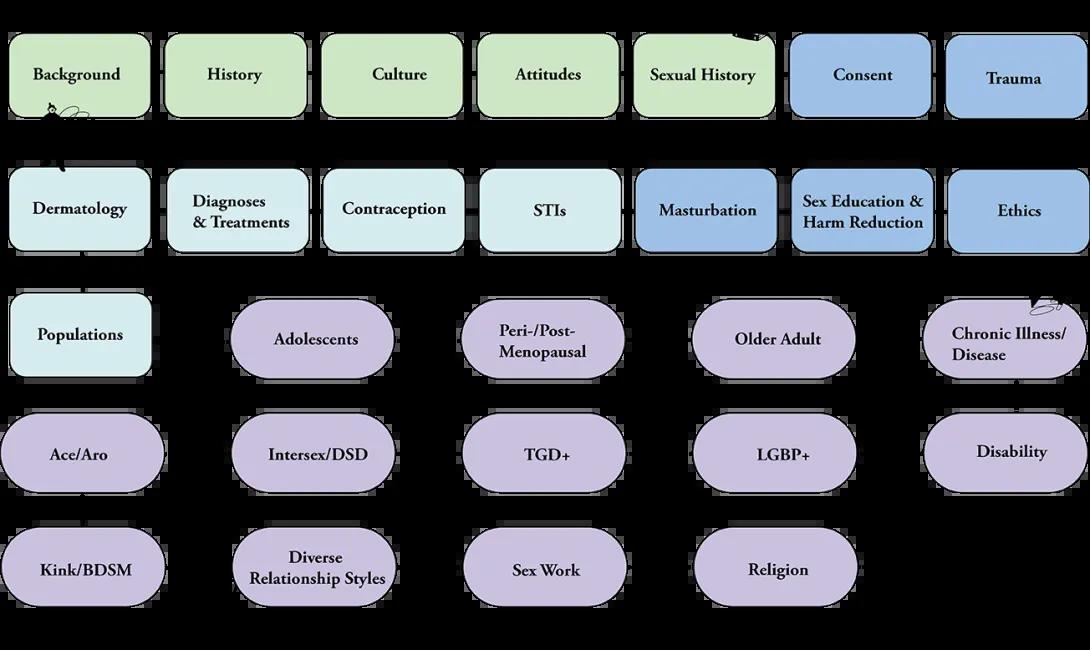
Over the next year and a half, I conducted a needs assessment of UMMS students; proposed the elective to the Branches heads; went through multiple iterations of curriculum outlines; recruited and managed a team of over 30 faculty, professional and student contributors; and ultimately facilitated the creation of over 40 hours’ worth of reading, listening, watching and learning about sex, sexuality and sexual health. The “Sexual Health: Beyond the Basics” elective has now been available to M3 and M4 students since February 2025 and was recently approved become permanently offered.
Medical School – Branching Out Further
As time has progressed, I’ve only become more passionate about the importance of improved, pleasure-centered sex education for healthcare professionals. This resulted in an essay I wrote that was recently published in The Pharos, AOA’s quarterly journal, where I advocate:
Sexuality is a part of everyone’s life. This is true regardless of age, race, ethnicity, ability, income, or any other marker of identity or behavior. Patients and providers each bring their own experiences and expertise to every encounter, creating space for bidirectional teaching. However, for too long when it comes to sexuality, provider knowledge and comfort have constrained this exchange, placing an undue onus on patients to raise the issue. The health care community, to ensure comprehensive and effective patient care, must improve its understanding of and education on sexuality and pleasure, and their relationship to overall health and well-being.
Reprinted from The Pharos, issue 4, season Autumn, year 2025. Copyright 2025 by Reni Forer. By permission of Alpha Omega Alpha Honor Medical Society.
If you’re interested, you can read the full article here.
Recently, I’ve been lucky enough to start providing education to people outside of Michigan as well. In the past year, I presented at several conferences on topics related to kink/BDSM and sexual pleasure. It’s been awesome to see how excited people are to learn more about these topics in order to better support their patients.

At the same time, I think it’s important to name that I still have plenty to learn myself. Over the past few years, I’ve been working on growing my own skills and knowledge related to sexual health and patient care. I got more practice having conversations about sex and sexual health through electives such as adolescent medicine and gender-affirming care. I also completed a year-long Sexual Health Certificate Program in Sexuality Counseling and Education through the U-M School of Social Work. And I recently spent a month at the Institute for Sexual and Gender Health at the University of Minnesota, learning from experts in gender-affirming care, sex and relationship therapy and compulsive sexual behavior. The more I learn, the more I realize how much more there is to learn.
Looking Forward
As I’ve been interviewing with psychiatry residency programs this fall, I’ve made no secret of my passion for this topic. When asked what I am most proud of or what I have enjoyed working on the most as a medical student, my answer is unfailingly the “Sexual Health: Beyond the Basics” elective. Although I was worried some would question my interest in this area, I’ve been pleasantly surprised by my discussions with interviewers about the overlap of mental and sexual health and the role of psychiatry in this intersection. Wherever I train, I plan to continue advancing sexual health education that is clinically rigorous, pleasure-aware, and grounded in the realities of patients’ lives. And I hope you’ll join me in recognizing its importance!
Citations:
Fairbanks M. Lague I, editors. (2025). “Sex Education and HIV Education,” The Guttmacher Institute. https://www.guttmacher.org/state-policy/explore/sex-and-hiv-education.
Forer R. (2025). “Beyond the bedroom: Advocating for pleasure-centered sexual health education in medicine,” The Pharos, 4, 25-31. https://www.alphaomegaalpha.org/wp-content/uploads/2025/11/pp25_31_A_FORER_AUT25.pdf

Reni Forer is a fourth-year medical student at the University of Michigan Medical School. She recently completed a research year in Peru and is currently in the process of applying to psychiatry residency. When she’s not getting work done in a café, you can find her reading books on Libby, cooking a favorite recipe or going on a run in nature.
Media Contact
MD Admissions
University of Michigan Medical School
In This Story
Julie Blaszczak, MD, MEHP
Clinical Associate Professor
Related
A New Student-Designed LGBTQIA+ Health Curriculum at the University of Michigan Medical School
Featured News & Stories
One Patient, Five Schools: Building Interprofessional Care at Michigan's Student-Run Free Clinic
Beyond the White Coat: The Med Student Tradition Behind Michigan’s Smoker
Learning about the Life Loaf: My Experience Working in OBGYN Research
A Global Classroom: M1s Experience Medicine in China
Rethinking care: How ‘de-implementation’ can improve quality and reduce burnout