What I'm Reading in APS Research: June 2025
What I’m Reading in APS Research, written by Dr. Ajay Tambralli, was created to provide information about some of the latest APS research and to help everyone better understand the ins and outs of new discoveries. In this month’s edition, Dr. Tambralli explores the amazing properties of camelid antibodies and their potential applications in future therapies.
Why llamas may hold the key to the next generation of medicines
Our immune system protects us by making special proteins called antibodies. These antibodies can recognize and attach to specific targets - like viruses, bacteria, and other harmful substances. However, sometimes antibodies mistakenly attack the body’s own tissues, leading to autoimmune diseases such as rheumatoid arthritis, lupus, and antiphospholipid syndrome (APS).
Most animals, including humans, produce traditional antibodies that are large, Y-shaped proteins (see Figure A below). Each antibody is made up of two types of protein chains: light chains (shown in orange) and heavy chains (shown in blue). The unique combination of these chains creates a binding site - the grooves at the ends of the “Y” - that fits a specific target. Amazingly, our immune system can mix and match these chains in many ways, allowing it to potentially produce trillions of different antibodies. This gives us the ability to recognize and respond to a huge variety of threats.
In addition to being naturally produced in our bodies, traditional antibodies are also manufactured in labs and used as biologic drugs to treat autoimmune diseases. For example, medications like infliximab (Remicade) and adalimumab (Humira) are based on traditional antibodies and work by targeting and neutralizing a molecule called TNF-α, which drives inflammation in several autoimmune conditions.
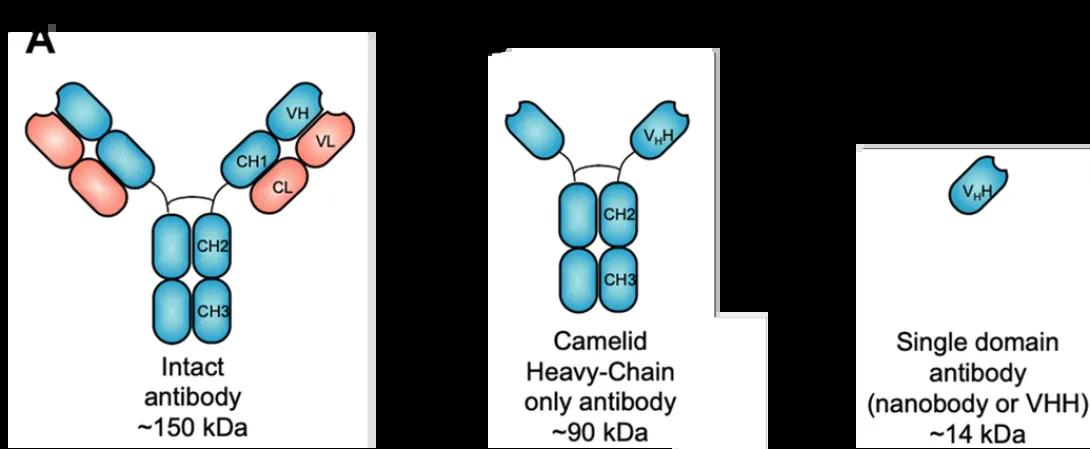
However, in a quirk of nature, some animals - such as camels, llamas, and alpacas - produce a unique type of antibody made of only heavy chains (see Figure B). These are called camelid antibodies, and they offer some potential advantages over traditional antibodies: they are smaller, more stable, and can penetrate tissues more easily.
Importantly, the part of the camelid antibody that binds to its target is found on one end of the heavy chain. This small, functional piece is known as a nanobody (see Figure C). Nanobodies are tiny - about 10 times smaller than a traditional antibody and six times smaller than a full camelid antibody. Their small size allows them to reach tight spaces and hidden grooves on their targets that traditional antibodies can’t access, making them particularly effective at neutralizing certain targets.
Interestingly, sharks also produce heavy-chain-only antibodies, and nanobodies can therefore also be engineered from shark antibodies.
Unfortunately, the same features that make nanobodies powerful can also be drawbacks. For example, because they're so small, nanobodies are cleared quickly from the body. However, scientists can modify them to prolong their stay in the body. Another limitation is that nanobodies lack the bottom half of the Y shape, known as the Fc region. In traditional antibodies, the Fc region helps recruit other parts of the immune system to help clear (and, in some cases, kill) the target. Without it, nanobodies might not trigger as strong an immune response. This limits some of their uses, but researchers are finding creative ways to overcome this, too.
From a technological standpoint, nanobodies are easy to engineer, stable, and cost-effective to produce. Their unique properties make them useful in various clinical areas, including medical imaging and drug development. In fact, nanobody-based drugs have already been approved to treat thrombotic thrombocytopenic purpura (with a drug called caplacizumab) and rheumatoid arthritis (with ozoralizumab, approved in Japan). Several others are being studied for cancer treatment.
Our group has had preliminary discussions about developing nanobody-based therapies for APS. This is still in early stages, but we hope to explore it further in the coming years.
Thank you for reading this article. I hope you found the topic as fascinating as I do. I think many of us take inspiration from nature - and it’s amazing how creatively it can solve the same problem in different ways, such as producing antibodies with different structures that all serve to protect an individual.
In summary, some animals produce antibodies with unique structures that can be adapted into nanobodies. These nanobodies have both advantages and limitations, but they hold exciting potential for future medicines.
References
- Berland L, Kim L, Abousaway O, Mines A, Mishra S, Clark L, Hofman P, Rashidian M. Nanobodies for Medical Imaging: About Ready for Prime Time? Biomolecules. 2021 Apr 26;11(5):637. doi: 10.3390/biom11050637. PMID: 33925941; PMCID: PMC8146371.
- Yong Joon Kim J, Sang Z, Xiang Y, Shen Z, Shi Y. Nanobodies: Robust miniprotein binders in biomedicine. Adv Drug Deliv Rev. 2023 Apr;195:114726. doi: 10.1016/j.addr.2023.114726. Epub 2023 Feb 7. PMID: 36754285; PMCID: PMC11725230.
- Steeland S, Vandenbroucke RE, Libert C. Nanobodies as therapeutics: big opportunities for small antibodies. Drug Discov Today. 2016 Jul;21(7):1076-113. doi: 10.1016/j.drudis.2016.04.003. Epub 2016 Apr 11. PMID: 27080147.
- Scully M, Cataland SR, Peyvandi F, Coppo P, Knöbl P, Kremer Hovinga JA, Metjian A, de la Rubia J, Pavenski K, Callewaert F, Biswas D, De Winter H, Zeldin RK; HERCULES Investigators. Caplacizumab Treatment for Acquired Thrombotic Thrombocytopenic Purpura. N Engl J Med. 2019 Jan 24;380(4):335-346. doi: 10.1056/NEJMoa1806311. Epub 2019 Jan 9. PMID: 30625070.
- Tanaka Y, Kawanishi M, Nakanishi M, Yamasaki H, Takeuchi T. Efficacy and safety of anti-TNF multivalent NANOBODY® compound 'ozoralizumab' without methotrexate co-administration in patients with active rheumatoid arthritis: A 52-week result of phase III, randomised, open-label trial (NATSUZORA trial). Mod Rheumatol. 2023 Aug 25;33(5):875-882. doi: 10.1093/mr/roac126. PMID: 36201360.
Join Our Email List
If you are interested in receiving updates on our patient care and research efforts, please join our APS Program email list.
In This Story

Ajay Tambralli, MD
Clinical Assistant Professor
Featured News & Stories

What’s changing in Medicaid and what can you do?

Going the extra 100 miles

Nine from Medical School honored as part of annual Faculty and Staff Awards

Congratulations to Stephen Gonzalez, PhD