UMMS surgeons partner to expand access to sight-saving surgery in wartime Ukraine
Ukrainian ophthalmologists are working with Kellogg Eye Center and other partners to expand cornea transplant and eye banking services in the country.
Author |
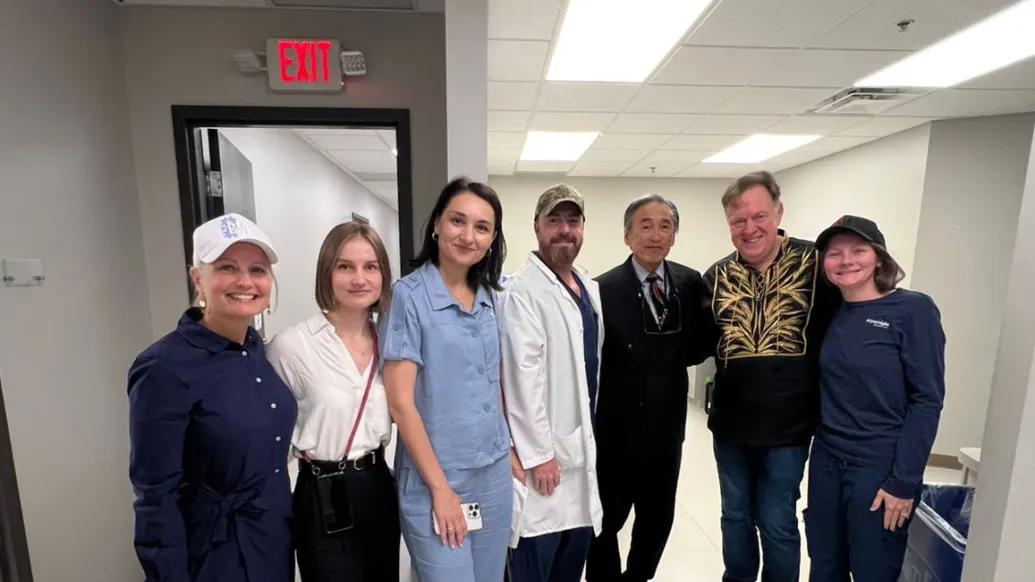
The Kellogg Eye Center is partnering to expand corneal transplant services in Ukraine at a critical time.
A group of Ukrainian eye surgeons spent much of August in Ann Arbor, shadowing Michigan Medicine counterparts and learning how they approach corneal transplants—restoring eyesight by replacing the thin, delicate layers at the front of the eye using donor tissue.
“Before the war in our country, it was common for patients to go to Russia or Europe for corneal transplants,” said Elizabeth Baran, one of three Ukrainian ophthalmologists who spent two weeks at Kellogg Eye Center in mid-August.
The war with Russia has both exacerbated the need and made travel more difficult—if not impossible. “There are so many young men who receive very severe injuries,” Baran said. “But very few doctors practice this kind of surgery.”
The visit is part of a larger collaboration between Kellogg Eye Center faculty and two Michigan organizations, Eversight, an eye-bank for tissues used in transplant procedures, and Eye Care for Ukraine, which aims to expand such services there. The country’s national regulatory framework for organ and tissue donation is relatively new, having been passed in 2019. In 2022, shortly after Russia’s invasion, the government passed a law to partially fund transplant services for military patients and further strengthen transparency and protections for tissue donors and recipients.
Brian True, the president and founder of Eye Care for Ukraine, is a Michigan-native who lives full-time in Kyiv and regularly meets with government and medical leaders, lobbying for the expansion of transplant services. Eye banks coordinate tissue donation, handling, and storage for tissues. Currently, Ukraine has just one such facility, and few Ukrainian doctors perform corneal transplants.
“Bringing doctors to the U.S. to introduce them to the procedures and processes is just the first step. The long-term goal is to establish an eye bank and expand services around the country,” said True. “I have not met a single ophthalmologist in Ukraine who doesn’t speak about the importance of this need.”
During their time in Ann Arbor, Baran and two colleagues, Yana Sirman and Georgii Parkhomenko, observed UMMS faculty perform a range of procedures, including penetrating keratoplasty, in which the full thickness of the cornea is replaced, and lamellar keratoplasty, in which only select damaged layers are replaced.
“I am grateful to have had the experience of visiting Michigan to learn how transplants are done here. I can begin to imagine how to perform them for my own patients,” said Parkhomenko.
In addition to clinical observation, the group visited Eversight. The Ann Arbor-based eye bank serves all of Michigan but also has a global development team that has helped establish and expand eye banking services in other parts of the world—efforts that Kellogg Eye Center has been a part of.
“We have facilitated collaborations with Eversight in places like Taiwan and India. This is much more challenging because of the war. It has hindered our efforts, but it also makes the need so much more urgent,” said Kaz Soong, an Emeritus Professor of Ophthalmology, who is leading the UMMS involvement in the partnership.
While certain illnesses and disorders necessitate corneal transplants, injuries in war zones—among both military personnel and civilians—have heightened the demand. Some experts estimate that up to 15% of all war-related injuries involve ocular trauma.
Even apart from direct injuries, the ongoing war has affected every aspect of care in Ukraine. Parkhomenko, who leads a large ophthalmology clinic in central Kyiv, gave a presentation to Kellogg Eye Center faculty during his visit describing the wartime conditions at his practice. His team launched a mobile ophthalmology clinic, bringing eye care services to military bases around the country for soldiers on deployment.
Among servicemen and civilians alike, requests for corrective laser surgery have skyrocketed, as supply chain disruptions make it difficult to replace prescription glasses or contact lenses.
At his primary clinic in Kyiv, signage posted in the main reception area assures nervous patients that the facility has a suitable bomb shelter. On August 24, 2022—Ukrainian Independence Day—heavy shelling in Kyiv forced Parkhomenko, his staff, and their patients into the shelter more than a dozen times.
When the war began, Parkhomenko’s clinic employed 40 ophthalmologists. More than three years later, 35 remain and continue to work, including his own son.
“I’m sure many people think we are crazy for doing this,” he said. “I think I speak for ordinary Ukrainian doctors, administrators, and nurses when I say that we see a direct connection between our work and victory. Our choice to continue working—to expand our services—is a declaration of our commitment to our patients and our nation.”
Featured News & Stories
Kellogg care inspires gift to vision research

Studying Period Pain

From months to just days: New U-M tool transforms training grant data tables

Mediterranean diet can slow progression of age-related macular degeneration
From walk-in clinic to national leader: How Michigan Medicine’s Pediatric Emergency Division was built