Tradition meets Tech: UMMS Students Explore Medicine in China
Medical students spent two weeks in China as part of a unique program that combined clinical and cultural exchange.
Author |
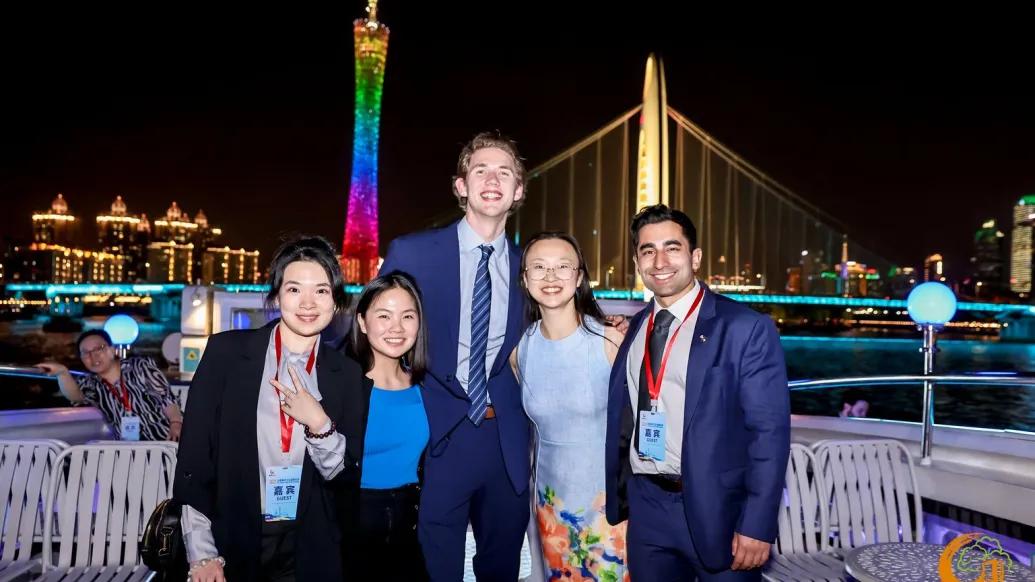
Six UMMS students recently traveled to China as part of the U.S.-China Youth Health Dialogue Program, an exchange designed to build bridges between future medical leaders in both nations.
Joining peers from other U.S. institutions as well as counterparts from China, the participants visited multiple hospitals and healthcare centers in three cities—Guangzhou, Fuzhou, and Beijing—touring facilities, observing patient care, and engaging with providers across numerous specialties.
“These experiences broaden our understanding of medicine and the diverse ways it can be delivered and perceived by patients,” said third-year student Max Wagner. “We embraced so many opportunities to step outside our U.S.-based clinical lens to see patient care from a new cultural perspective.”
Wagner and other participants gained firsthand exposure to China’s East-meets-West approach to healthcare, from learning how artificial intelligence is being used to integrate VR and 3D organ modeling in the operating room, to watching traditional techniques such as cupping and acupuncture in practice.
“It made me reflect on how similar programs could be implemented at our own institution to help students get involved in community service during clinical training,” said Marina Khreizat, also an M3. “As a future physician, I want to remain open-minded to the beliefs and practices that shape how patients view their health and treatment.”
This marked the second year that UMMS students have participated in the Health Dialogue, which also included students from the University of California and the University of Chicago.
Global REACH collaborated with the UMMS Office of Medical Student Education to select participants and coordinate aspects of the experience, including a visit to Peking Union Medical College Hospital, a longtime institutional partner.
“Programs like this offer far more than clinical insight—they challenge our students to think beyond borders, engage with diverse systems of care, and appreciate the cultural contexts that shape health outcomes,” said Amy Huang, MD, Director of Asia Programs at Global REACH. “Such experiences are essential in preparing the next generation of physicians to lead with empathy, adaptability, and a truly global perspective.”
Featured News & Stories
Youth Suicide Prevention Initiative at the forefront of vital mental health care

New insight into how lipodystrophy can affect overall health
Nerf gun accident causes retinal detachment in pediatric patient
PMOS is the New PCOS
Gray Areas: Realistic Possibility of Reversing Diabetic Neuropathy