
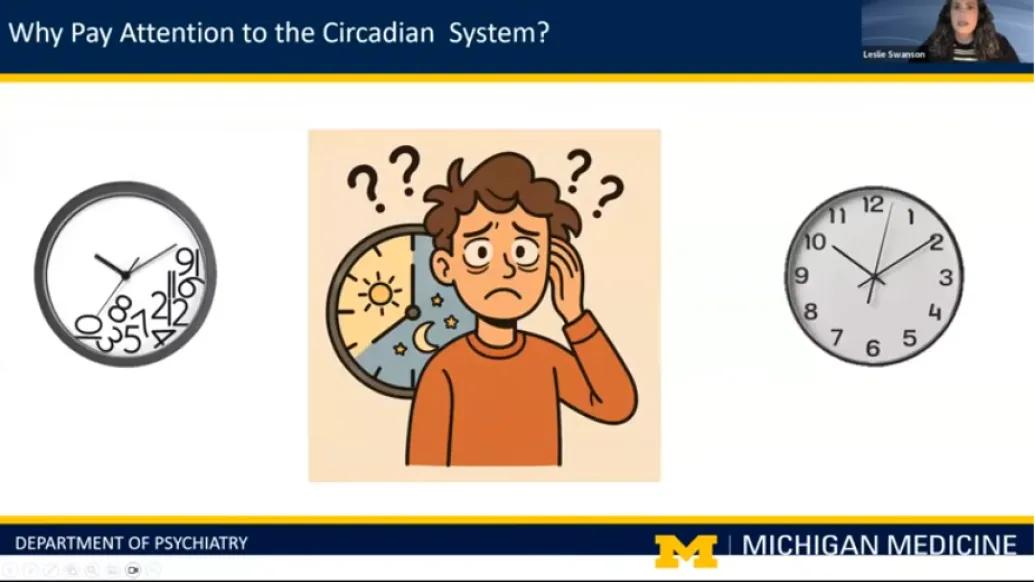
Several of our sleep and circadian rhythm experts were featured in a 4-part webinar series by the University of Michigan Alumni Association.
Sleep is one of the most powerful tools we have for health. This four-part mini-course explores the science behind how sleep works, practical strategies for improving sleep quality, and what happens when sleep goes wrong. Along the way, we’ll examine changes across the lifespan, the impact of lifestyle and health conditions, and the truth behind common sleep myths. Through expert insights and conversations, participants will gain both a deeper understanding of sleep and practical takeaways to rest better — no matter their age or circumstances.
Lecture 1: The Science of Sleep
What actually happens when we fall asleep? In this session, we’ll explore the biology of sleep — why we need it and what’s happening in the brain and body during different stages of rest. We’ll also explore circadian rhythms, gender differences, and how sleep changes across our lifespan.
Lecture 2: Foundations of Healthy Sleep
Good sleep doesn’t just happen — it’s built. This session will cover practical strategies for creating the conditions that support high-quality rest, from healthy routines and sleep environments to nutrition, stress management, and screen use. We’ll also look at real-world challenges — like parenting young children, navigating work schedules, or managing a busy lifestyle — and discuss ways to get better sleep even when circumstances aren’t ideal.
Lecture 3: When Sleep Goes Wrong
Insomnia, sleep apnea, restless nights — many of us know what it feels like when sleep doesn’t work the way it should. This session explores the most common sleep challenges and disorders, their effects on both physical and mental health, and how to recognize when it’s time to talk with your doctor. We’ll also discuss treatment approaches and coping strategies to help you move toward healthier sleep.
Lecture 4: Sleep Myths: Fact or Fiction?
Think you know sleep? Put your sleep knowledge to the test as we separate myth from reality in this interactive session. With live polls and expert insights, you’ll walk away knowing what really matters for better sleep.
Watch the entire series on YouTube.
In This Story
J Todd Arnedt, PhD
Professor
Helen J Burgess, PhD
Professor
Greta B Raglan, PhD, DBSM
Clinical Associate Professor
Tyler Grove
Clinical Associate Professor
Leslie M Swanson, PhD
Clinical Professor
Anita V Shelgikar
Clinical Professor
Todd K Favorite
Adjunct Clinical Associate Professor
Featured News & Stories

Nerf gun accident causes retinal detachment in pediatric patient
FDA-approved drug offers hope for patients with polycythemia vera, a rare bone marrow disorder
Jacob Mack: Helping Trainees Take the Next Step
Pediatric patient treated for rare kidney cancer
Announcing CCMB/DCMB Fall 2026 Seminar Series

