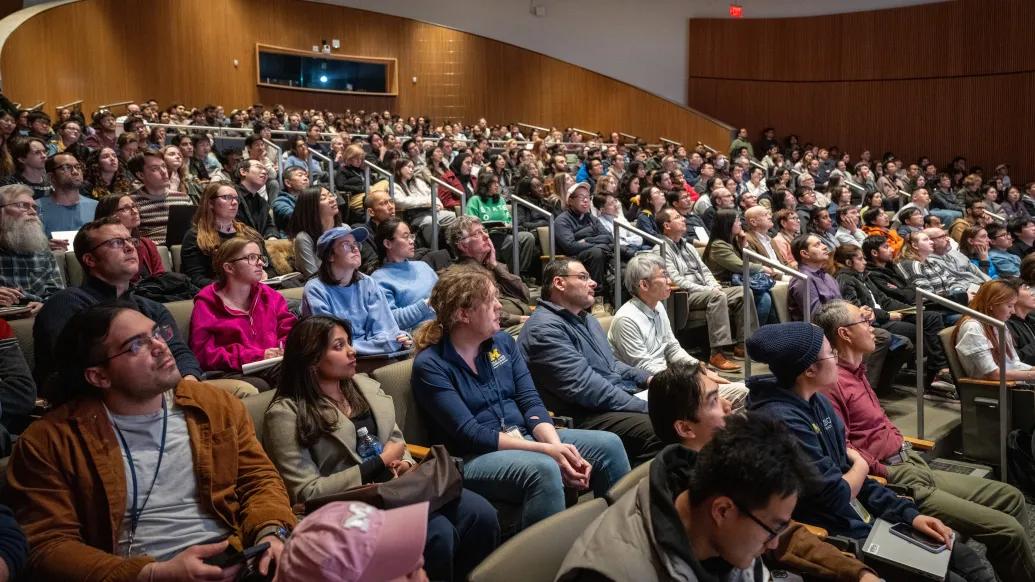
The Kahn Auditorium was standing room only for the ninth annual Ommen Lecture, this year presented by Aviv Regev, PhD.
Described as a “Titan of her field” by Gilbert S. Omenn himself, Regev is the Executive Vice President for Genentech Research and Early Development – a biopharma company which aims to discover, develop and market innovative medicines.

Her lecture, “From Cell Atlases to Medicines, with AI,” discussed the future of medicine with machine learning as a game-changing player.
Researchers generate huge data sets comprised of information on human genes, cells and proteins that are too large to be analyzed by hand. To discover what is affecting health and how, researchers have found new ways to examine and interpret these data.
Deep learning algorithms help researchers find patterns in data, uncovering molecular circuits and specific protein targets to help us understand the mechanisms of complex diseases. Looking forward, these algorithms will help scientists and physicians personalize treatments for patients.
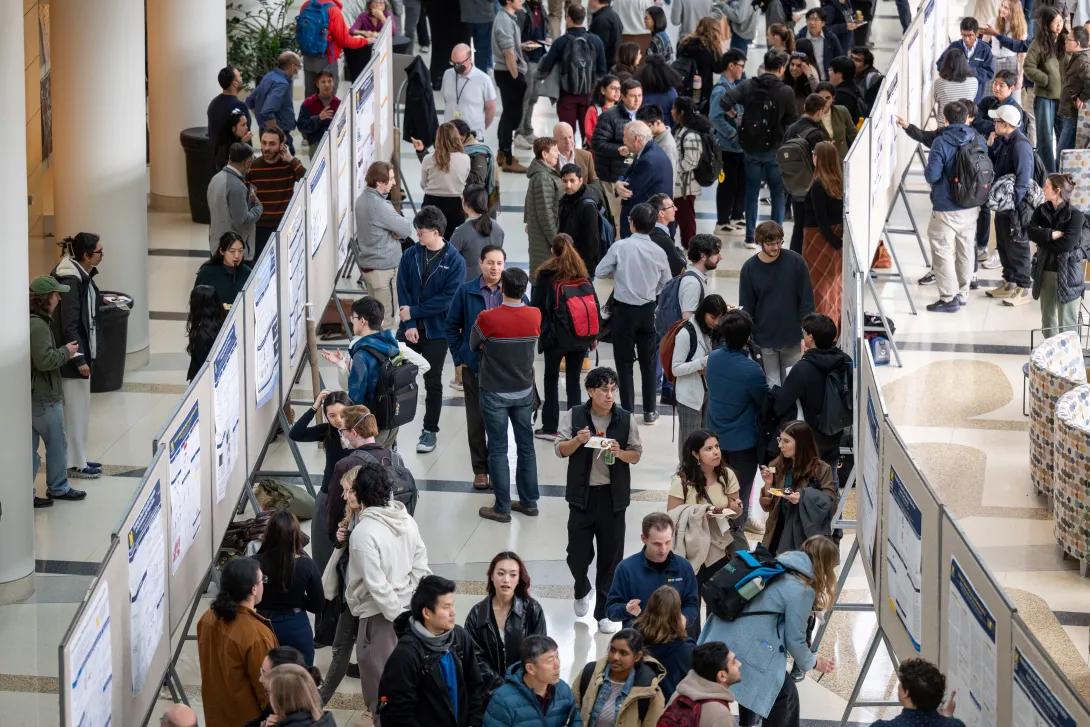
Following the lecture was a poster session featuring 46 poster presentations, with a focus on how deep learning can accelerate research on health issues such as diabetes and tumors. The posters were from each of the four host units: the Gilbert S. Omenn Department of Computational Medicine & Bioinformatics, the Genome Science Training Program, the Life Sciences Institute, and the Single Cell Spatial Analysis Program.
The Omenn Lecture series is named in honor of Gilbert S. Omenn, MD, PhD, who is the Harold T. Shapiro Distinguished University Professor in Computational Medicine & Bioinformatics, Internal Medicine, Human Genetics, and Environmental Health.
"This inspirational lecture discussed AI's emerging place in medicine as a powerful tool for diagnosing and treating disease,” Omenn said. “I am proud of the attendance from our four cosponsoring U-M units. We filled the Kahn Auditorium to overflowing, the largest turnout to date!"
In This Story

Gilbert S Omenn, MD, PhD
Professor
Featured News & Stories

Kellogg care inspires gift to vision research

Studying Period Pain

From months to just days: New U-M tool transforms training grant data tables

Mediterranean diet can slow progression of age-related macular degeneration
From walk-in clinic to national leader: How Michigan Medicine’s Pediatric Emergency Division was built