New Emergency Department “Fast Track” helps children get care faster

Author | Danielle Jimenez

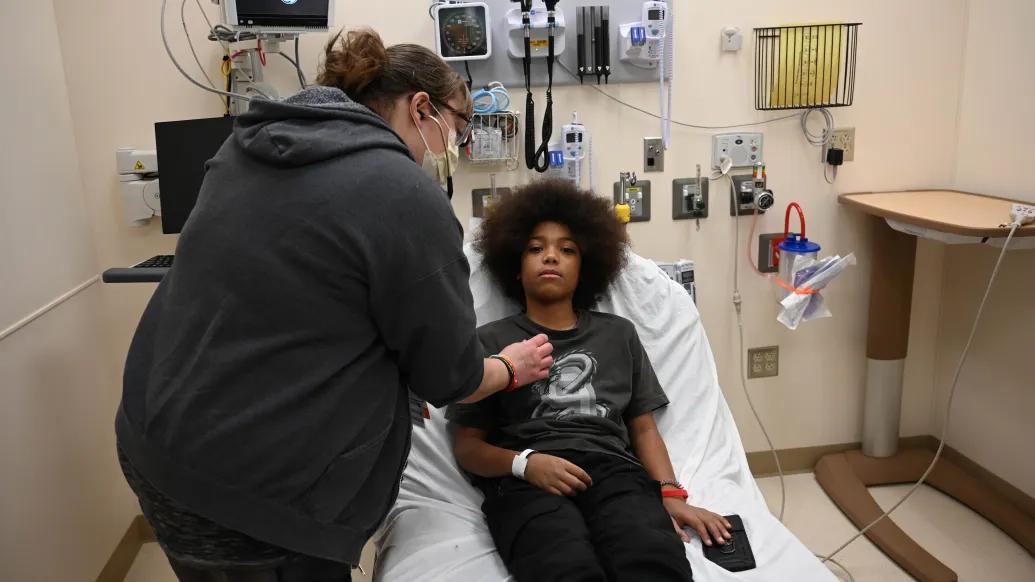
A PA listens to a patients heart
The Fast Track rooms have patient monitors, suction, oxygen — all the typical equipment that you would find in the ED.

After years of planning and construction, Children’s Emergency Services (CES) at C.S. Mott Children’s Hospital has launched a new four-room Fast Track to help families spend less time waiting, and it’s paying off.

“During the pandemic, pediatric visits essentially fell to close to nothing,” said Marisa C. Louie, MD, Clinical Assistant Professor of Pediatrics and Emergency Medicine.
“When everything shut down, kids stopped getting sick, and then it rebounded with a vengeance.”

That rebound led to what staff called the tripledemic year, when influenza, RSV, and COVID-19 cases soared in hospitals.

“For the first time ever, we saw a big increase in our low-acuity patients,” Dr. Louie said.
“We started looking to see what we could do to move lower-acuity patients a little bit faster through our ED.”
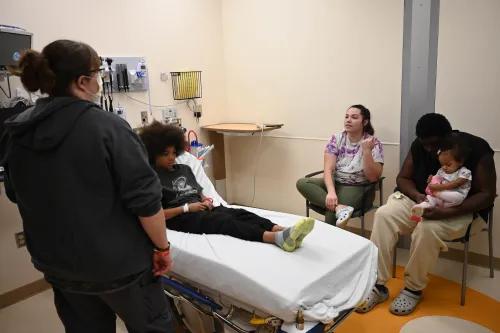
A PA, patient and family members talk in a fast track room
Patients in Fast Track are seen quicker and can be treated for minor injuries, colds, ear infections, sore throats, rashes, and similar needs.

To solve this, CES partnered with University of Michigan engineering students who helped design what the team would need. Construction followed, and last spring, four fully equipped rooms opened next to the waiting area.

“They have patient monitors, suction, oxygen — all the typical equipment that you would find in the ED,” Dr. Louie said. “They’re intended for Fast Track, but the rooms are pretty comparable in size to our main ED.”

The new area offers a quieter, more private space for lower acuity conditions. These cases might have previously occupied hallway spaces.

“From a patient experience standpoint, this is a huge improvement, because you’re in a room in a relatively quiet part of the ED,” Dr. Louie said. “It’s very “shiny” and feels airy and spacious.”

The Fast Track treats minor injuries, colds, ear infections, sore throats, rashes, and similar needs — what Dr. Louie described as “urgent care plus.”

“We’ll handle lacerations that a lot of urgent cares won’t do,” she said. “We can do X-rays, and there’s no reason a tech can’t come put a splint on over there.”

By routing these cases through the Fast Track, CES can shorten waits for families while allowing emergency staff to focus on higher-acuity patients.

“It allows us to practice at the top of our license and practice independently, which is a win for our team,” said Sarah Ketelhut, PA-C, who manages the department’s Physician Assistant (PA) team. “We have 567 years of PA experience on our team, and 367 of that has been in our emergency department.”

The Fast Track operates during the busiest pediatric hours — 11 a.m. to 11 p.m. Data already shows stays are significantly shorter than the main ED.

“I think it’ll help the ED by decreasing waiting-room time and “left-without-being-seen” rates,” Ketelhut said. “That’s a benefit not only to the ED, but to our patients.”

Staff also hope that families will recognize this option.

“Sometimes people walk in, see a full waiting room, and are like, ‘Ope, I’m out,’” Ketelhut said. “But this is an option. If you think you have something straightforward, this unit is here and open.”

As patient volumes shift, the team will continue refining the model.

“If we see volumes change, there are opportunities to look at staffing and make adjustments,” Dr. Louie said.

For now, families can take comfort knowing that when a minor emergency brings them to Mott, there’s a dedicated space designed to get kids the right care and get them home faster.


More Articles About:

Emergency & Trauma Care emergency departments Emergency Medicine C.S. Mott Children’s Hospital Pediatric

In This Story

Marisa C. Louie

Marisa C Louie, MD

Clinical Assistant Professor

Featured News & Stories
Brian Zink headshot
Department News

Finding Joy in Leadership: Brian Zink, MD, on Coaching, Purpose and the Next Phase of Academic Medicine

Leadership in academic medicine can come with challenges that are rarely talked about— isolation, burnout, and making tough decisions. “Leadership positions can feel lonely, particularly for new leaders,” said Brian Zink, MD, Senior Advisor and Adjunct Professor of Emergency Medicine at the University of Michigan. “There is often a sense of vulnerability and even imposter syndrome when you assume these roles.” Dr. Zink has been in many leadership positions in academic medicine for over 30 years, including nearly 12 years as chair of emergency medicine at Brown University and Senior Associate Dean for Faculty and Faculty Development at UMMS. He has entered what he calls “a next phase of life,” instead of retirement. He is now helping others navigate the pressures of leadership through coaching, mentorship, and faculty development. “The big thing that I'm trying to help people with is how to have a satisfying, enjoyable life, and how to find joy in their leadership role,” Dr. Zink said. “Leadership can be very time-consuming, very intense. I want to help leaders find clarity, confidence, and balance in their careers.” He began his career at Michigan Emergency Medicine in 1992 as one of the department’s first faculty members. Early on, his early career focused on alcohol effects and trauma research. Afterward, he transitioned into leadership roles in the medical school before becoming chair at Brown, where he helped lead and grow their emergency medicine department for nearly 12 years.
A person wears a protype infant sling on the front of their body. The sling has a special window to allow light to reach the baby.
Health Lab

Medical student’s invention aims to help infants with jaundice

University of Michigan medical student Daniel John has created BiliRoo, a low-cost, non-electric device designed to treat jaundice in newborns
Graduating Residents and fellows pose for a photo in from of a screen that says "Congratulations Emergency medicine 2026 graduates"
Department News

Emergency Department Celebrates 2026 Residency and Fellowship Graduates

Flowers, applause, and proud smiles filled the room as the Department of Emergency Medicine celebrated its 2026 residency and fellowship graduates on June 12. Surrounded by family members, friends, faculty mentors, and even children, graduates marked the culmination of years of rigorous training and the beginning of careers dedicated to caring for patients during life's most critical moments. “It's because of you that many patients have been healed,” said Prashant Mahajan, MD, MPH, MBA, Department Chair. “Since many will not celebrate you, I want you to celebrate yourselves.” The ceremony recognized 16 graduating emergency medicine residents and seven fellowship graduates who will continue their careers in emergency medicine, critical care, medical education, pediatric emergency medicine, and emergency medical services across the country.
woman looking at screen in office clinical area
Health Lab

How AI is helping emergency physicians learn from their patients

How the “Tell Me What Happens Next” initiative is being used by the Department of Emergency Medicine’s new Division of Clinical Informatics using artificial intelligence.
baby with hearing aid on ear looking from side view with blue pacifier in mouth
Health Lab

Research may help better predict outcomes in kids with congenital cytomegalovirus

Two new studies may help researchers and clinicians better understand congenital cytomegalovirus (CMV), the most common infectious cause of birth defects and a leading cause of non-genetic hearing loss in children.
family smiling inside capitol
Health Lab

12-year-old shares journey with sickle cell anemia on Capitol Hill

A 12-year-old takes his story to Washington, D.C., sharing with lawmakers how specialized treatment transformed his life with sickle cell disease.