A New Collaborative to Better Predict, Prevent, and Treat Type 1 Diabetes
MAI-T1D Project Launched to Map Type 1 Diabetes Progression Using Multi-modal AI
Author |
Type 1 Diabetes is a lifelong chronic disease affecting more than 1.7 million Americans, including over 300,000 children and adolescents. To better prevent and treat this disease, it’s important to fully understand how and why it develops. The new Multimodal AI for Type 1 Diabetes (MAI-T1D) project – funded by the National Institutes of Health – aims to use the latest advances in artificial intelligence (AI) alongside a wide range of health data to speed up discoveries to better treat and prevent T1D.
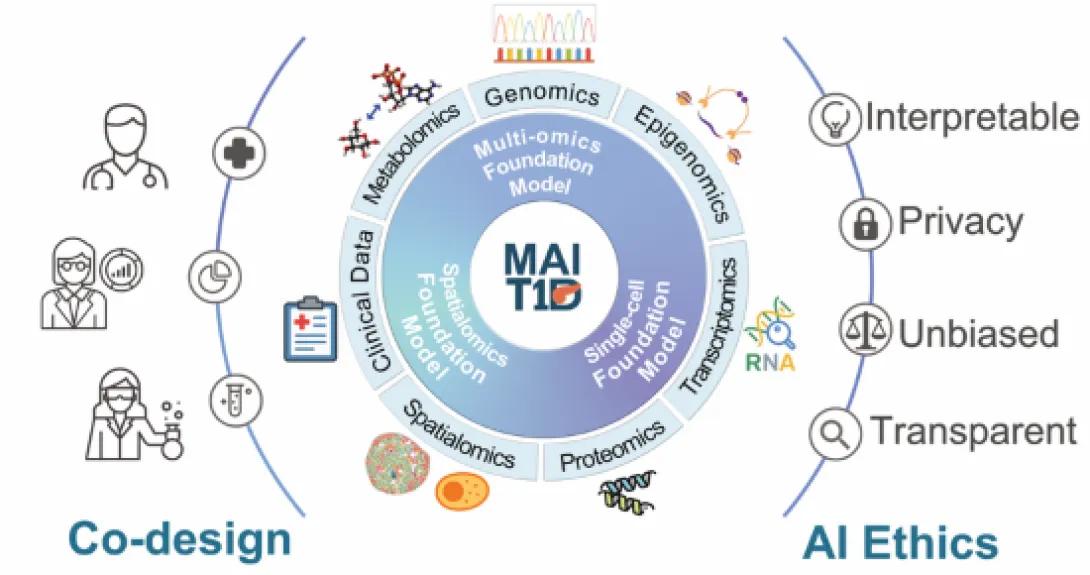
MAI-T1D is a collaboration between scientists from leading institutions, including the University of Michigan, UCLA, Vanderbilt University, Weill Cornell Medicine, and the University of South Florida. Together, they are building new AI models that examine a variety of information, like genetics, proteins, and changes in individual cells, to better map how T1D develops – from the signs of immune system changes through to symptoms and diagnosis. The aim is to uncover what causes the immune system to attack insulin-producing cells, understand how these cells decline, and find ways to prevent or delay T1D – even before it causes symptoms.
To train and test these AI models, the team will use large, detailed datasets from the Human Pancreas Analysis Program (HPAP), which studies pancreas samples from healthy people and people with T1D at various stages, with a commitment to scientifically rigorous and responsible use of data. They will also use data from TEDDY (The Environmental Determinants of Diabetes in the Young) an international study that follows children who are genetically at-risk for T1D, tracking their health and environmental exposures over time.
Led by Jie Liu, Ph.D. (University of Michigan), and bringing together more than 25 scientists with experience in AI, genetics, and diabetes research, the MAI-T1D team hopes to advance our understanding of T1D. genetics, integrative multi-omics). Their ultimate goal is to make it possible to predict and prevent the disease more precisely, improving lives for those with or at risk for T1D.
Key investigators include Shuibing Chen, Ph.D. (Cornell University; single-cell and spatial multi-omics), Marcela Brissova, Ph.D. (Vanderbilt University; islet biology, HPAP leadership), Kenneth Young, Ph.D. (University of South Florida; AI and bioinformatics for TEDDY, TrialNet, RADIANT), Kai-Wei Chang, Ph.D., and Wei Wang, Ph.D. (UCLA; multimodal AI and foundation models), and Stephen Parker, Ph.D. (University of Michigan; diabetes genetics, integrative multi-omics)
References:
Centers for Disease Control and Prevention. (2021). National Diabetes Statistics Report: Data and Research Portal. U.S. Department of Health & Human Services. Retrieved from https://www.cdc.gov/diabetes/php/data-research/
In This Story

Jie Liu, PhD
Associate Professor

Stephen CJ Parker, PhD
Professor
Featured News & Stories
First national survey by U-M clinician-researchers finds nearly all family medicine residencies teach menopause care
Comprehensive DNA sequencing reveals hidden drivers of cancer
Noah Carey, MD/MPH student: Connecting medicine, public health and purpose

Regents approve Urology acting chairs, Cell and Developmental Biology interim chair

Keith E. Cook, PhD, MS, appointed Chair of Biomedical Engineering