New back pain procedures provide relief for Michigan Medicine patients
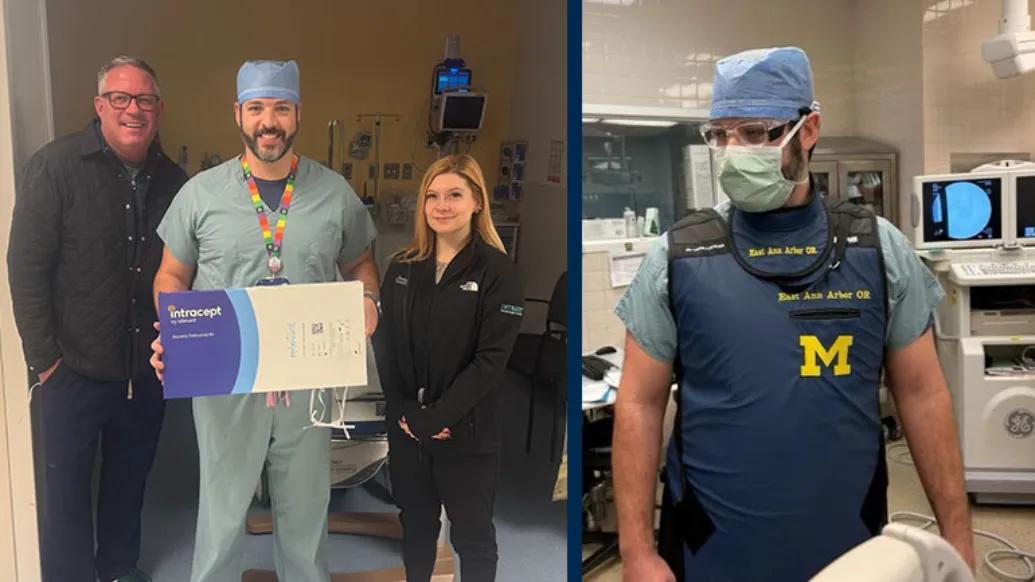
Two new procedures provided by Michigan Medicine’s Back and Pain Center offer promising relief for patients with severe back pain.
“It’s exciting to be able to offer this new technology for our patients,” said Ryan Meral, MD, who serves as a clinical assistant professor in the Department of Anesthesiology. “For patients who don’t want surgery and don’t want to be on chronic pain medication, these procedures provide a nice, safe, well-researched alternative.”
Both procedures – basivertebral nerve ablation, also known as the Intracept procedure, and minimally invasive lumbar decompression, or MILD – target the cause of pain to provide long-term relief for patients.
Improving patients’ quality of life
The first two Intracept procedures were completed at the end of 2024, and the Back and Pain Center hopes to perform the first MILD procedure soon.
“Both patients were great candidates and had failed more conservative interventional pain therapies,” said Pain Management Division Clinical Instructor T.J. Stropp, MD, MPH, who performed the first procedures. “Neither of them had clear-cut surgical targets, nor did they want to go through a spine surgery.”
Intracept is used to treat patients with vertebrogenic low back pain, which occurs when the bones of the spine have become damaged. Treatment involves applying radiofrequency heat to the nerves, which disrupts the pain signals sent to the brain.
For the MILD procedure, which provides treatment for patients with lumbar spinal stenosis, physicians shave off excess ligament tissue in the patient’s back. This reduces nerve compression, which alleviates pain and restores mobility.
“With these procedures, we’re opening a new chapter in what we can offer patients who are looking for pain relief options,” said Division of Pain Medicine Associate Director Goodarz Golmirzaie, MD.
Both Intracept and MILD are outpatient procedures that can be performed in one to two hours. Most patients recover relatively quickly with minimal physical restrictions.
“It was gratifying to be able to offer these patient a safe and effective minimally invasive procedure that could greatly increase their functional status and quality of life,” said Stropp. “That's what it’s all about - helping patients and improving their quality of life.”
An in-depth treatment strategy
Ensuring safety and reliability is a critical first step when introducing new treatment options at the Back and Pain Center. The team reviewed the data on Intercept and MILD for two years before pursuing either procedure.
“While these are newer procedures, they are not brand new. They have been around long enough to have good evidence with a solid track record of safety and efficacy,” said Paul Hilliard, MD, clinical associate professor of anesthesiology. “We don’t want to always be reaching for the latest ‘shiny object’ but want to offer interventions that have good outcomes and evidence to support them.”
Intercept and MILD, along with neuromodulation device implants and vertebral augmentation procedures, are part of a robust treatment strategy offered by the Back and Pain Center.
“It is truly rewarding to be able to broaden our scope of practice in the Back and Pain Center, allowing us to offer advanced pain therapies to more patients,” said Stropp. “I am eager to help more patients with these treatments in the near future by collaborating with colleagues from various specialties to identify those who might benefit.”
In addition to back pain treatments, the Center also provides support for a range of other pain conditions, including joint and nerve pain, knee and hip pain, and cancer-related pain, among others.
“Pain is complex and often mixed,” said Hilliard. “It is important to have the right intervention for the right patient. Nothing beats a careful and thoughtful evaluation. This is what we provide at the Back and Pain Center.”
In This Story

Ryan Meral, MD
Clinical Assistant Professor

Travis Stropp, MD
Clinical Instructor

Goodarz Michael Golmirzaie, MD
Clinical Associate Professor

Paul Hilliard, MS, MD
Clinical Professor
Featured News & Stories
To reduce chronic pain, a new digital program could help

U-M to launch $16.5M NIH-funded project to advance personalized treatment for chronic lower back pain

Primary care physicians are hesitant to accept chronic pain patients using opioids or cannabis

Young man’s debilitating back pain a thing of the past

What to do when pain lingers