Meet Dr. April Kriebel, a recent graduate from the Welch lab
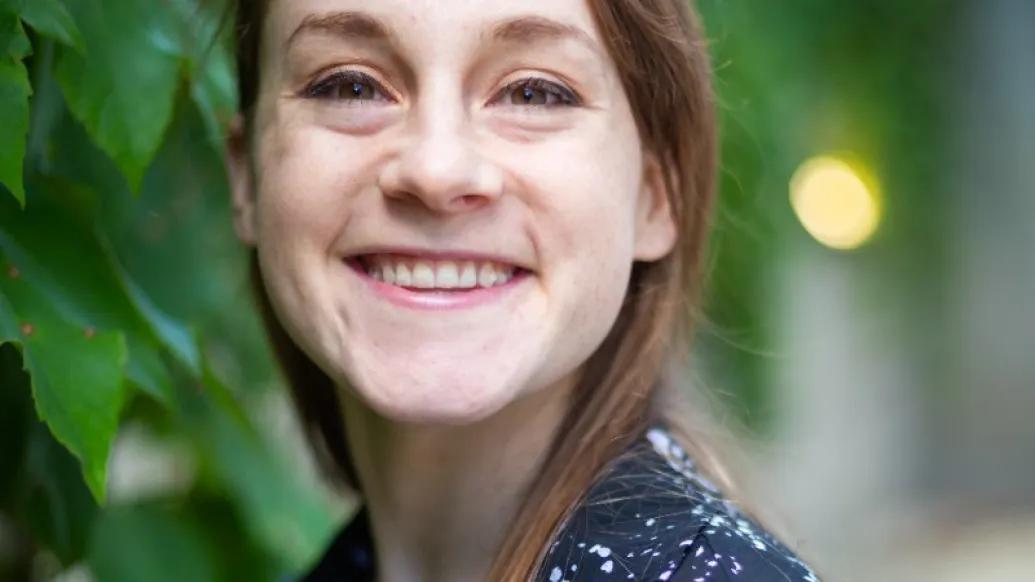
On March 11, 2024, April Kriebel, Ph.D., defended her doctoral dissertation titled: “Computational Methods for Linking Molecular and Anatomical Data with Spatial Transcriptomics.”
There might be over 5,000 types of cells in the brain, making the brain the most complex and mysterious organ. And yet, our knowledge about these cells is very limited. Many brain cells are neurons that transmit electrical impulses, and these can be classified based on gene expression. Other types of cells support the neurons and the brain functions. For example, some cells clean debris from the brain (microglia) and others form the myelin sheaths that help with signal transduction (oligodendrocytes). But beyond these basic facts, for most brain cells, many questions remain to be answered: for example, are there particular locations for each cell type in the brain? What do these cells do? How do they interact with each other?
All these questions fuel Dr. Kriebel’s scientific passion as she develops statistical methods to categorize and localize different types of cells in the brain. “We know so little about the brain, and it’s such a complex and fascinating organ!,” Kriebel said. Using both established and novel algorithms, Kriebel integrated several different kinds of data, categorized types of cells, and also made predictions about where these cells are located within the brain.
She first tested the developed pipeline with data from the isocortex, an area of the brain that has been well-studied. Using that previously existing knowledge, she could validate her method and then apply it to other areas of the brain. “Processing region by region of the brain was very helpful, because we could validate our results against pre-existing knowledge. We could then move onto other areas of the brain that have been less studied, such as the hypothalamus and thalamus, and have greater confidence in our results.”
One of Kriebel’s challenges was integrating different data sets. Using data from several labs, she had access to epigenetic and transcriptomic data measurements, which she used to assign cell types. She used spatial transcriptomic data to estimate their location in the brain. She then overlaid these results on vascular and neuronal activation datasets that had already been registered within the brain.
From these results, she could investigate which cell types were present in areas of high vascular density, and what neuronal cell types might be involved in a physiological response. To understand neuronal activation, Kriebel used a c-Fos dataset that captured neuronal activation at the single-cell level at different time points after a mouse had experienced a footshock. By overlaying this dataset with the molecular data, it became possible to correlate specific cell types with neuronal activity in response to footshock, as measured by c-Fos.
Kriebel used datasets that are publicly available, largely generated as part of the BRAIN Initiative consortium to which the Welch Lab belongs. This includes data generated by the Allen Institute for Brain Science and the Macosko lab, among others.
The first part of her research is already published in Nature Communications (2022) and she is preparing another manuscript based on several chapters of her dissertation. “It is exciting to get to the publication stage because we want this computational tool to help the greater scientific community,” Kriebel said. “If this tool could serve to establish a baseline for cell type location and hint at potential function it would help prioritize different avenues of potential research. It could save a lot of research time and money.”
Kriebel’s trajectory has been one of discoveries, personally as a first-generation student as well as intellectually and scientifically. She has always had a strong passion for mathematics and neuroscience, and has strived to integrate these two areas of interest.
During her undergraduate years at Spring Arbor, a small liberal arts college in Michigan, her first scientific foray was in mathematical modeling for insurance data –but the insurance world was too far from neuroscience. She then attended a semester at the University of Minnesota Summer Institute in Biostatistics where she applied mathematical modeling to public health. This experience felt closer to her interests although not quite her niche yet. While she kept exploring various fields of research and learning from these experiences, her Spring Arbor mentor, a U-M alum, encouraged her to apply to U-M graduate school. “I’m very grateful for the confidence he gave me,” she said. This is how she found DCMB and got hooked. “Bioinformatics has a little bit of everything, and I love that about it. I like neuroscience and mathematics, and the format of the Graduate Bioinformatics Program allowed me to pursue these two interests.” She also appreciated that her research project with professor Welch was very concrete.
Before joining the Welch lab, Kriebel did two rotations in DCMB to explore research opportunities and find a mentor. “It’s really important to find the right mentor for you,” she said. “That’s even more important than the project itself. You will always want to do good reproducible science; what’s key is to find someone who will support you, be kind, and nurture your curiosity. I came from a small liberal art college and when I first arrived at U-M, I needed a lot of guidance. This is what I needed and received, but not everyone has the same style nor needs.”
“It’s key to find someone who will support you, be kind, and nurture your curiosity.”
Kriebel is now looking for a position in either the grant management space, or as a research assistant or a data scientist.
She has played soccer since her childhood and outside the lab, she loves hiking, especially in the western side of the US, reading, baking, and chilling with her tabby cat, Miso.
Paper cited: Kriebel, A.R., Welch, J.D. UINMF performs mosaic integration of single-cell multi-omic datasets using nonnegative matrix factorization. Nat Commun 13, 780 (2022). https://doi.org/10.1038/s41467-022-28431-4
Featured News & Stories
Improving care for patients with brain injuries
Human connection takes center stage at Medical School Commencement

Alum reconnects to his roots through Doctors of Tomorrow scholarship fund
Advancing proteomics through computational innovation: Kai Li successfully defends dissertation
Scholarship honors love and gratitude