Honoring Service in Every Sense: GI Physicians Reflect on Their Military Journeys This Veterans Day
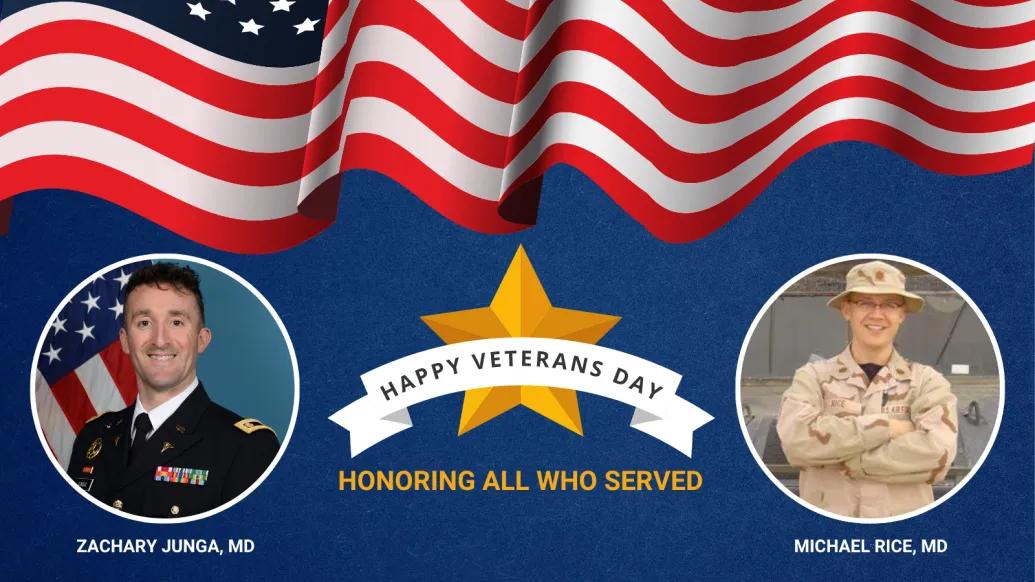
This Veterans Day, we honor two distinguished gastroenterologists, Dr. Michael Rice and Dr. Zachary Junga, whose careers in medicine were profoundly shaped by their years of military service. Their experiences in the United States. Air Force and United States Army not only strengthened their leadership, adaptability, and sense of purpose but continue to inform their commitment to caring for others every day.
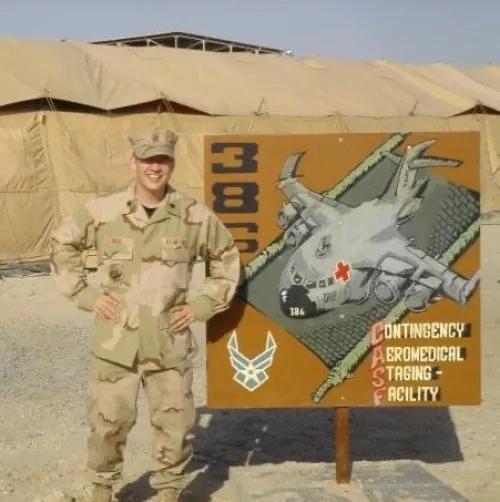
Dr. Michael Rice: Finding Purpose in Service and Teamwork
Michael Rice, MD, served as a Major in the United States Air Force from 2004 to 2008, a period marked by global deployments in support of Operation Enduring Freedom. Stationed at Wright-Patterson Air Force Base, Dr. Rice was part of the 88th Medical Group — one of the Air Force’s largest and most advanced medical centers. Within months of entering active duty, he deployed to Kuwait, serving as a critical care physician at the 386th Contingency Aeromedical Staging Facility, where he provided stabilization and support for critically injured service members awaiting evacuation.
What stands out most from his service, Dr. Rice recalls, is the camaraderie and teamwork. “I worked alongside remarkable people who demonstrated professionalism and compassion under intense circumstances,” he says. “Many of my earliest leadership lessons came from those shared experiences.”
Adjusting to military life was both exciting and challenging — particularly as Dr. Rice navigated deployments while separated from his wife during her surgical training. Yet, he found deep meaning in the mission and the people he served with.
Dr. Rice’s medical training was shaped by mentors like Dr. David Peura, a retired army colonel and past president of the American Gastroenterological Association. “He modeled professionalism, humility, and service,” Dr. Rice reflects. "While the military didn’t determine my choice of specialty, it reinforced my belief that medicine in itself is a profound form of service.”
Today, Dr. Rice applies lessons from his military experience to his roles in patient safety, education, and clinical care. “Military service deepened my commitment to teamwork, communication, and adaptability,” he says. “Attention to detail, chain of command, and high-reliability principles all echo through how I approach complex systems in healthcare today.”
On Veterans Day, Dr. Rice reminds us that service takes many forms.
“The values the military reinforces — selflessness, teamwork, integrity, and resilience — aren’t limited to those in uniform. We honor veterans when we carry those same principles into our own communities and professions.”
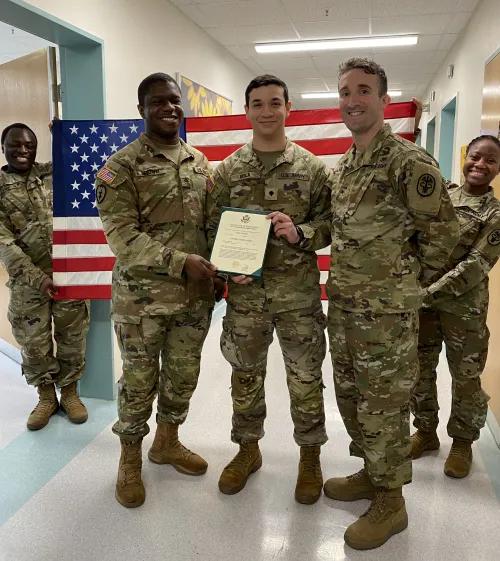
Dr. Zachary Junga: A Journey of Service, Leadership, and Resilience
Zachary Junga, MD, dedicated 15 years to the U.S. Army, serving four years in the reserves and 11 on active duty, ultimately separating as a Major Promotable — having been selected for promotion to Lieutenant Colonel. His military medical journey began at Walter Reed in Bethesda, Maryland, where he completed his internal medicine residency and gastroenterology fellowship, later serving as chief of Gastroenterology at Landstuhl Regional Medical Center in Germany.
Adjusting to military life took time, Dr. Junga admits. “Military life in the medical corps is different than in other parts of the military,” he explains. “Fortunately, I had great mentors and teammates who got me squared away.” Now, he finds himself making the reverse transition — learning to adapt again to civilian life.
Dr. Junga’s desire to serve predates his medical career. “I wanted to join the military before I ever thought about medicine,” he recalls. Initially unable to enlist due to a hearing condition, he later joined the Army after receiving a waiver during medical school. “It felt like a calling I wasn’t sure I’d ever have the chance to answer.”
Throughout his career, Dr. Junga developed patience, resourcefulness, and resilience, qualities he now brings to his medical practice.
“You learn to accomplish the mission with less-than-optimal circumstances. Those skills serve you well in medicine.”
His military training also taught him to thrive under pressure, from trauma and mass casualty drills to field exercises and NBC (nuclear, biological, chemical) response training.
Transitioning to civilian medicine has been smooth in many ways, but not without its quirks. “I find myself struggling with what to wear at times,” he says. “You don’t realize how regimented things like that are until you leave.”
Above all, Dr. Junga uses Veterans Day to highlight those who often serve silently: military families. “Don’t forget about the spouses and families of service members,” he says. “They sacrifice a tremendous amount but don’t get the recognition of wearing the uniform. I couldn’t have done it without my wife, kids, and family.”
Continuing the Mission of Service
Both Dr. Rice and Dr. Junga remind us that the values instilled through military service — dedication, teamwork, compassion, and integrity — are timeless and universal. Though they’ve traded military uniforms for white coats, their mission endures: to serve others with skill, humility, and heart.
This Veterans Day, we honor them — and all who have worn the uniform — for their enduring commitment to caring for others, in every sense of the word.
Featured News & Stories

Talent show brings joy to kids at children’s hospital
Please welcome new postdoc, Dr. Rehana Akter!

Uncovering cellular stress signal triggered by Salmonella
Max Wicha set to retire after 46 years

Monica Starkman, M.D., contributes two new articles to Psychology Today's On Call