Helping Hands: Ibtissam Gad Is Rethinking How Clinicians Learn to Feel Disease
Author |
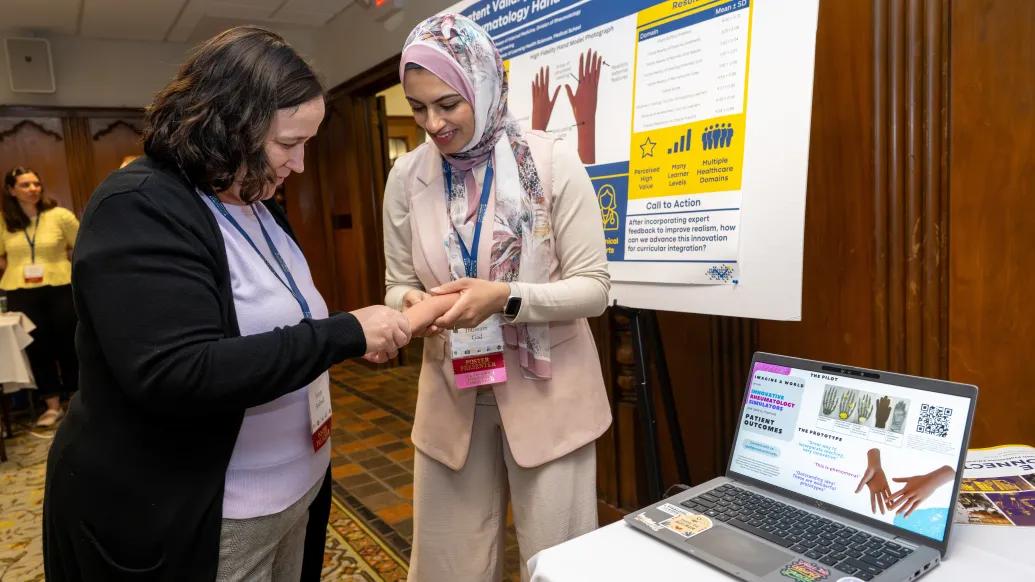
For most physicians, learning to recognize swollen joints begins in the classroom. Students study anatomy, learn examination techniques, observe experienced clinicians, and gradually gain experience examining patients during medical school and residency.
For Ibtissam Gad, MD, a clinical assistant professor in Michigan Medicine's Division of Rheumatology, one limitation stood out. Learners often had relatively few opportunities to practice distinguishing subtle swelling by touch, and asking patients whose joints were already painful to undergo repeated examinations wasn't ideal for anyone involved.
"You can repeatedly touch the model," Gad said. "If a patient is in pain, it's uncomfortable for both them and the learner to keep doing it over and over."
That realization led Gad to develop the first low-cost simulation model designed to teach learners how to detect swelling in the small joints of the hand, an important skill when diagnosing autoimmune diseases such as rheumatoid arthritis and lupus. Up to 20% of people have hand pain, yet no dedicated hand model existed to help learners practice this part of the physical exam.
When Gad joined the RISE Innovator Development Program (IDP), she brought that challenge with her. Through the yearlong program, she refined the idea, identified and secured external funding opportunities, and began transforming a homemade teaching aid into a model now drawing interest from educators across multiple specialties.
Building a Better Way to Learn
The first version was built with everyday materials. Gad used Playfoam® beneath layers of gloves to recreate swollen joints, creating each pair for less than five dollars. She paid for the supplies herself and used the models to teach trainees.
At first, Gad viewed the project as a practical teaching tool rather than the start of a broader educational innovation. She began thinking differently after describing the idea to a mentor, Lisa Zickuhr, MD, MHPE.
"I was just telling her about the idea," Gad recalled. "She said, 'Wait, this is way more than something you're just doing on the side. This idea has a lot of potential.'"
That conversation encouraged Gad to think beyond the classroom where she first developed the model. She began exploring how a simulation could give learners repeated practice with a clinical skill that has traditionally depended on finding the right patient at the right time.
From Homemade Model to Real Education Innovation
Early studies showed the low-cost model helped learners develop foundational examination skills. They also revealed an important limitation. The simple design could not fully recreate the complexity of a real hand, and those skills did not consistently transfer to patient care.
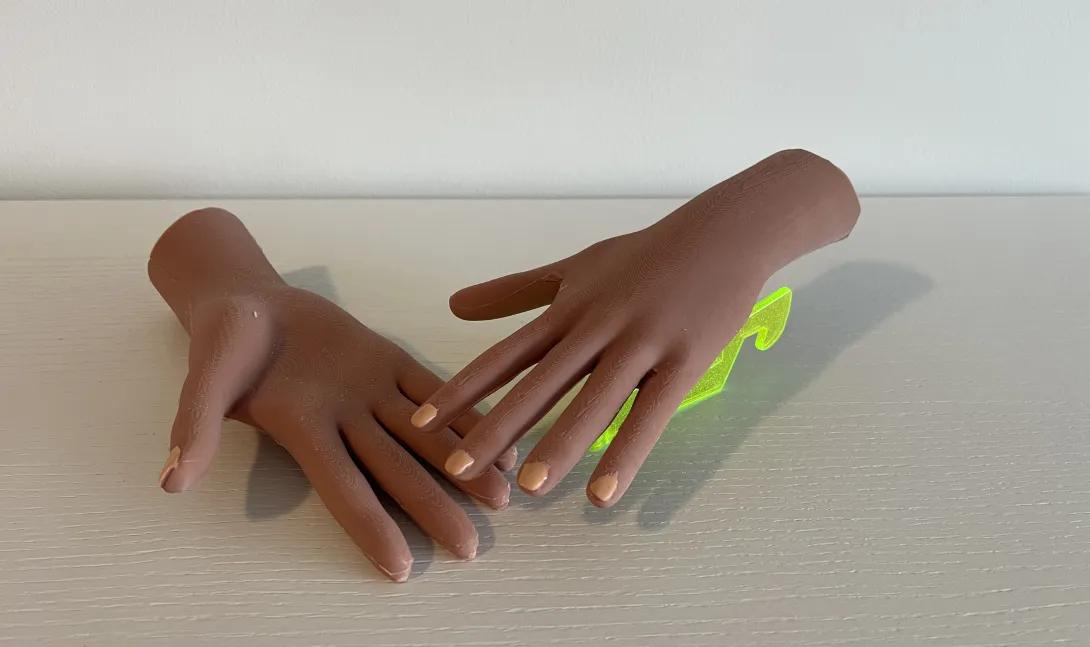
With support from the IDP, Gad partnered with Deborah Rooney, PhD, of Michigan Medicine's 3D Innovations Lab and undergraduate biomedical engineer Georjeana Swartout to build a more advanced model. The life-sized silicone hand features articulated joints that bend naturally, carefully designed areas of swelling, and even painted fingernails to create a more realistic examination experience. Twenty-five rheumatologists evaluated the prototype and offered feedback that continues to shape its refinement.
Interest in the model has spread well beyond rheumatology. Family medicine, orthopedic surgery, plastic surgery, internal medicine, occupational therapy, physical therapy, and advanced practice training programs have all expressed interest in using it. Gad's team is also collaborating with educators at the University of Wisconsin, Legacy Health in Washington, the University of Alabama, and Emory University School of Medicine to better understand how learners perform hand examinations across different training environments. At Michigan Medicine, collaborators are also exploring whether the low-fidelity model can help patients recognize swollen joints before telehealth visits.
That growing interest has also led to invitations to share the work more broadly. Gad demonstrated the simulation during HPE (Health Professions Education) Connect '26 in April, giving attendees a chance to experience the model firsthand, and recently presented on innovative educational strategies in rheumatology during APLAR 2026, an international webinar hosted by the Asia Pacific League of Associations for Rheumatology and the American College of Rheumatology.
As the project continues to evolve, those presentations have helped introduce the model to educators and clinicians well beyond Michigan Medicine. Her work has also been published in the Journal of Clinical Rheumatology, which established validity evidence for the low-fidelity model, and in MedEdPORTAL, where educators can access the complete the Helping Hands curriculum and workshop to implement the model in their own training programs.

Developing a Vision with RISE
The IDP also changed how Gad approached the work itself. She still laughs about the program's opening session, when participants were asked to develop a vision statement.
“I remember thinking, 'A vision statement? I need a vision statement?'” Today, that statement sits on her computer desktop: “Imagine a world where innovative rheumatology simulators are able to improve patient outcomes.”
Looking back, Gad said the exercise fundamentally changed how she thought about the project. "The sky's the limit," she said. "I didn't realize at first how far it could go."
Gad said one of the program's greatest strengths was the people in the room. Members of her IDP cohort represented disciplines ranging from physical therapy and psychology to medicine, and each brought different ways of thinking about education innovation. Their questions and feedback regularly shaped how she approached the project.
She found the same kind of mentorship from the RISE leadership team. Faculty mentors encouraged her to apply for grants, challenged her thinking, and helped her recognize weaknesses she hadn't seen herself. "You don't know what a blind spot is until somebody points it out," Gad said. "They really helped me identify those blind spots and expand my knowledge of education innovation."
Preparing the Next Generation of Clinicians
Much of Gad's attention is now focused on implementation. She and her collaborators continue to refine the model with industry partners while expanding the curriculum so educators across specialties can incorporate it into existing training or use it as a self-guided learning experience in simulation centers. Additional support from the Gilbert Whitaker Award, the Graduate Medical Education Innovations Award, the University of Michigan Simulation Center, and RISE is helping move that work forward.
She hopes the simulations give learners more opportunities to practice recognizing the subtle signs of autoimmune arthritis before they encounter patients, giving them a better chance to identify disease early and help prevent permanent joint damage.
Stay up to date on the latest innovations in medical education at U-M with the RISE monthly newsletter.
In This Story

Ibtissam M Gad, MD
Clinical Assistant Professor
Related
Facing Your Own Fears First: Training Clinicians to Deliver the Anxiety Treatment They've Been Avoiding
Featured News & Stories

Depression in OBGYN residents needs more attention, study suggests
A metabolic “switch” that could help reset scar-producing cells in scleroderma
Pain, psychological factors and physical function closely linked in people with systemic sclerosis
Hear From the RISE Curriculum Director: October 2026
Teaching Ultrasound at the Bedside