Helping babies breathe easier from their very first moments
U-M’s findings show steps that are better for the baby, as well as the clinician.
Author |
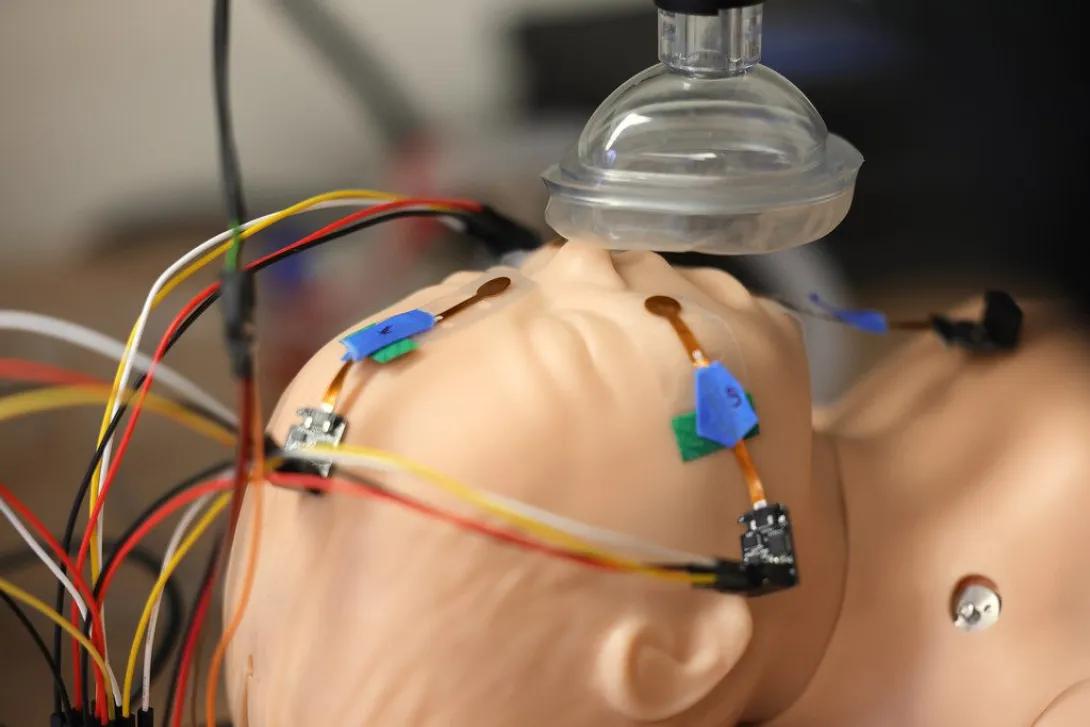
Photo Credit: Brenda Ahearn/University of Michigan, College of Engineering, Communications and Marketing
For roughly 5% to 10% of newborns each year, the first moments outside the womb require help from a stranger – namely, medical staff making sure the baby takes its first breath.
The medical term is positive pressure ventilation (PPV), and it delivers that first bit of air or oxygen into the infant’s lungs to help them properly inflate within seconds after birth. A collaborative research effort between Michigan Engineering and Michigan Medicine has broken down the means of providing that first breath in the delivery room, offering suggestions that will help reduce the risk of injury.

“We can improve the way we resuscitate newborn infants and make it more successful,” said Gary Weiner, a U-M clinical professor of pediatrics, who worked with U-M engineers on the project. “By doing that, we increase the potential for saving lives and decrease the need for more invasive resuscitation measures, like chest compressions or having to insert a breathing tube in their throat.”
When the face mask designed to deliver air is pressed down too hard, it can compress the newborn’s airway, preventing air from getting to the lungs altogether.
Roughly 400,000 babies delivered in the U.S. each year require assistance with their first breath, and two types of devices are commonly used to deliver it: self-inflating bags (SIBs) and T-piece resuscitators. An SIB is exactly what it sounds like—a large circular bag that is squeezed by hand, pushing air into the lungs. The smaller T-piece consists of a tube connected to an external air source, with a valve that sits atop the mouthpiece that a clinician repeatedly toggles to control flow.
With both pieces of equipment, medical staff have to balance the need to create a tight seal for delivering air with the potential to cause harm from pushing too hard. Weiner said it’s a procedure that hasn’t received much close analysis before now.
Jacqueline Hannan, a recent PhD recipient at U-M now working as a staff scientist at Beth Israel Deaconess Medical Center in Boston, was willing to give it that closer look.
“We also wanted to understand if there are different tools or strategies that result in more or less force,” she said.
Hannan and her partners created a measurement system using ultra-thin micro-force sensors placed on the face of a manikin, with a second force sensor underneath the head to capture the total amount of force applied. The group tested different devices and mask shapes—work that eventually demonstrated the T-piece was safer for the patient and a lower repetitive-stress injury risk for the clinician than the SIB.
The research also showed what medical providers need to know when using either device.
“We were able to show that you can apply a low level of force and still get a low level of air leakage,” said Leia Stirling, a U-M professor of both industrial and operations engineering and robotics. “That led us to developing strategies that can allow the clinician to get an improved seal without high force.
“A lot of that comes down to how they hold the baby’s head and how they hold the mask.”
But how best to teach these practices?
U-M’s team designed and created a software interface to display measurements from the force sensor system. This real-time feedback provides information that clinicians can use to improve their PPV strategy during training. For example, the system can warn them if their applied force is asymmetric (which can induce leaks) or too high (which can lead to compression of the newborn’s airway).
For the next step, researchers will test their interface using people that have not performed PPV previously to improve clinician training methods.
The group has worked with Innovation Partnerships to submit a patent application for the hardware and software system.
This article originated on the U-M Research website. To see the original article, click here.
In This Story

Gary Weiner, MD
Clinical Professor
Related

Born under a pound: Two newborns beat extraordinary obstacles in the NICU
Featured News & Stories
Identifying avoidant, restrictive food intake disorder in gastroenterology patients

Talent show brings joy to kids at children’s hospital

Foundation gift inspires additional gifts to strengthen youth mental health care

A concussion expert and football father discusses why he values teamwork over zero-risk