
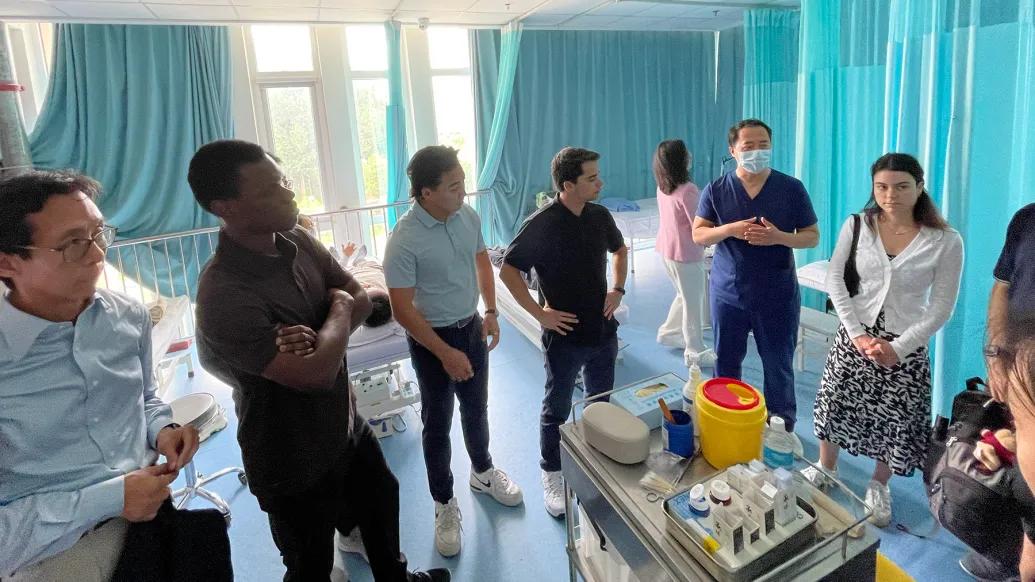
From the fast-paced wards of one of China’s busiest public hospitals, to a community hospital integrating modern and traditional Chinese medicine, a recent experience for first-year students offered a broad view of how care is delivered within one of the world’s busiest health systems.
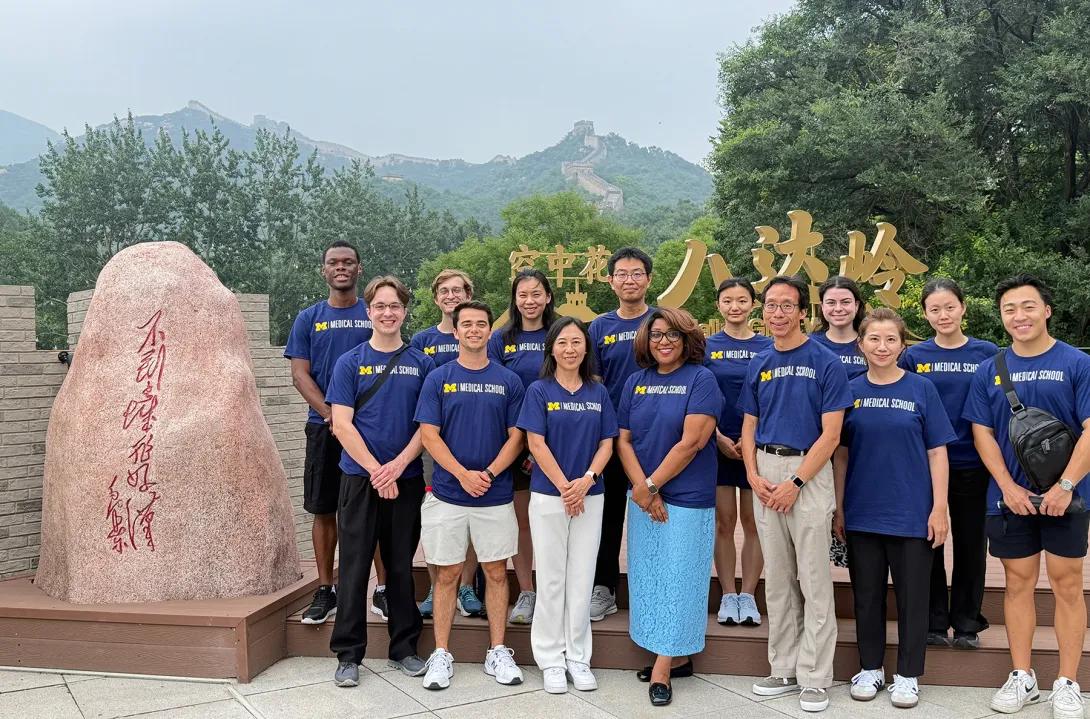
Organized by Global REACH and collaborators at Peking University Health Science Center (PKUHSC), a longtime institutional partner, this summer’s group experience was a first of its kind, partnering Michigan Medicine M1s with PKUHSC students for two weeks of clinical observation, facility tours, and lectures from some of China’s leading global health researchers.
“I will remember what I learned from the physicians, patients and students in China throughout my future career,” said Amanda Putti, among the 10 students who visited Beijing in July. “After a busy year studying on my laptop during pre-clinicals, I was reminded about my passion for medicine, and that, even with the differences in our healthcare systems, the humanity and desire to care for patients is shared across the world.”
Called the Global Health Summer Program, the experience was funded through a grant from the CMB Foundation, a US-based organization that advances health collaboration between the US and Asia. Accompanying the students on part of the visit were UMMS Vice Dean for Medical Education Louito Edje, MD, MHPE, and Assistant Dean for Early Medical Education Andrew Tai, MD, PhD.
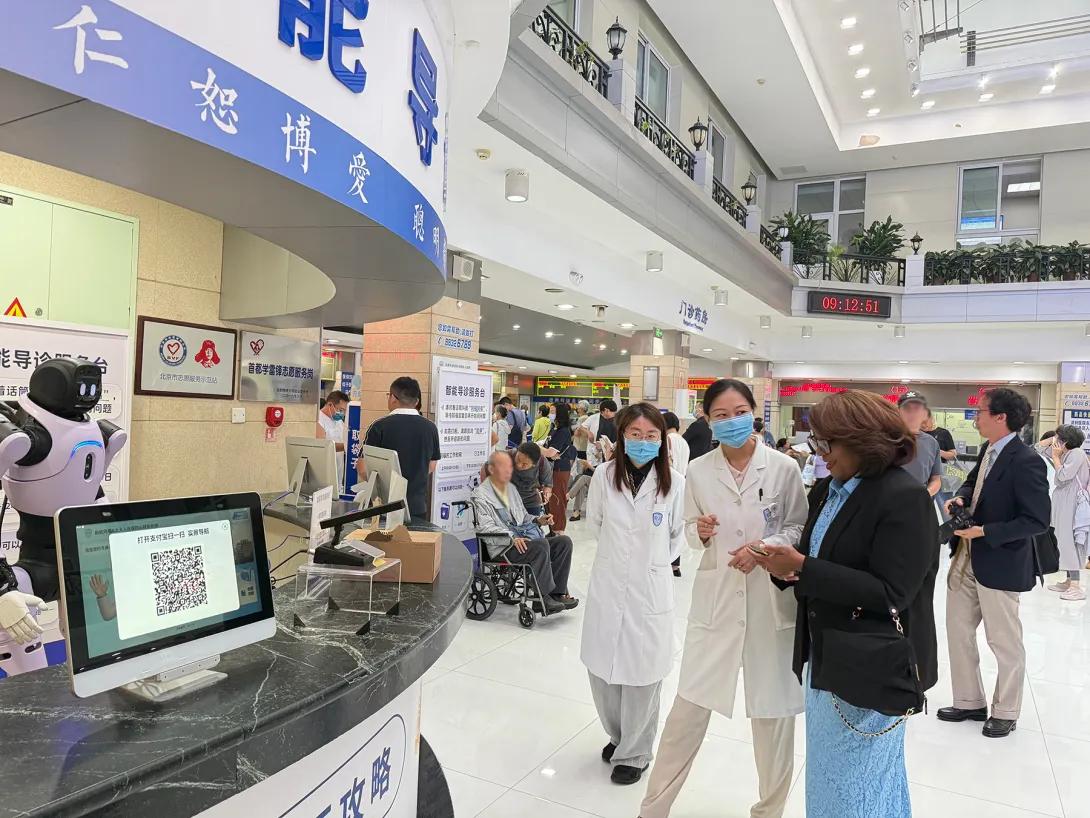
“For the participants, this was a transformative experience,” said Edje. “From opportunities to experience firsthand traditional Chinese medicine remedies like acupuncture, cupping and moxibustion (the practice of burning dried mugwort on or close to specific parts of the body) to seeing advanced technological applications including the use of robots for medication delivery from the inpatient pharmacy to the wards, this visit expanded the worldview of our learners. We plan to make the Global Health Summer Program an annual experience.”
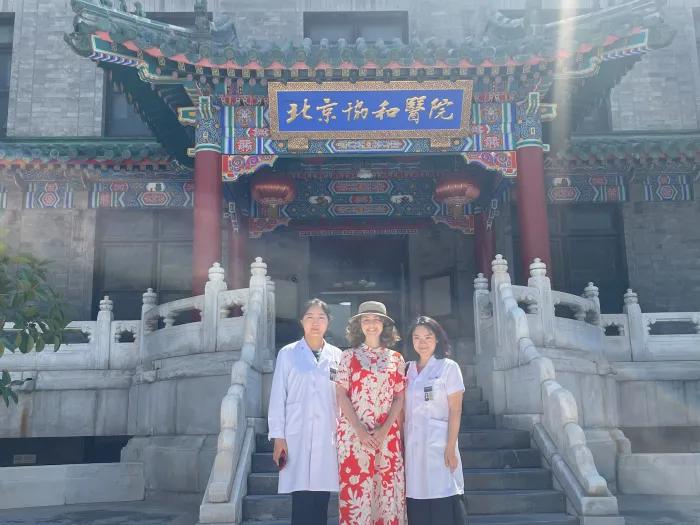
The first week of the program offered morning lectures from PKUHSC faculty on a range of topics, from maternal and child health and caring for China’s aging population, to how the country approaches global health and climate change in health. Afternoons brought a chance to visit various facilities in and around Beijing. Students toured Peking Union Medical College Hospital, a busy public institution, Amcare Healthcare Group Beijing Hospital, a boutique private institution that opened in 2006, and Tinavi Medical Technologies, a robotics company that makes high-tech surgical devices. One highlight was a trip to the outskirts of Beijing to visit the Yanqing District Hospital of the Traditional Chinese Medicine, a regional health center where practitioners blend familiar, modern services—lab testing and diagnostic imaging—with therapies like acupuncture and cupping.
“I was struck by how much culture influences the way medicine is communicated, organized, and delivered. The experience gave me a new perspective on cultural humility: understanding a patient’s culture may require more than learning about their background,” said He Guo. “Sometimes, it requires seeing how medicine is practiced in the place where that culture originated.”
Participants embarked on these excursions with medical students from PKUHSC, also early in their program, who could act as linguistic and cultural interpreters, answer questions, and help the UMMS students process what they were seeing.
“Among the most meaningful parts of the program was getting to know the PKUHSC students. I was particularly interested in hearing about the different pathways Chinese students can take to study medicine and comparing their medical education with ours in the US,” said Spring Gao. “Differences in medical education, healthcare delivery, technology, and culture provide opportunities to put aside assumptions, look at a challenge through a new lens, and consider alternative approaches.”
During the program’s second week, students were divvied into smaller groups with opportunities for extensive clinical observation in Peking University Third Hospital. The students shadowed across variety of departments—emergency medicine, surgery, ophthalmology, neurology—in one of Beijing’s busiest public institutions.
“Inside the hospital, scale stopped being an abstraction,” said Alex Farfel. “Volumes that would strain most systems moved with consistent organization across triage, transfer, handoff, and disposition, with each step designed to protect the throughput of the whole.”
The students watched patients arrive at the hospital early each morning and queue at electronic kiosks to make appointments with providers of their choice, often, though not always, for the same day. The doctors they shadowed saw many patients every hour, working efficiently but without time to build a rapport or explain a diagnosis or treatment plan in depth. Some procedures, including routine colonoscopies and endoscopies, are performed without anesthesia, hastening the process.
“If we were to try to adopt these practices into our own hospitals, clearly things would be cheaper and faster, but I wondered if we would lose part of the physician-patient relationship,” said Brett Arenberg, who observed in the gastroenterology and rheumatology clinics. “It seemed to me that our two systems were highly adapted to our respective cultures and expectations.”
The experience introduced students to an entirely different health system early in their medical education, offering insights they will carry forward through their training and beyond.
“I was impressed by how engaged and interested in learning about the Chinese healthcare system our students were. While they may not yet have much clinical exposure, they certainly have enough knowledge to understand what they were seeing,” said Andrew Tai. “As first-year students, their career path is still quite flexible, so more awareness of and experience with global health can be extremely formative.”
For all the systemic differences, most participants came away with a sense of commonality shared with new friends and peers halfway around the world.
“I began to appreciate that the foundation I am building in my first year of medical school connects me not only to patients I will one day care for, but also to physicians around the world,” said Victoria Chen. “Across differences in language, culture, and healthcare systems, we drew on many of the same frameworks to understand the human body, work through difficult questions, and care for patients. Being in Beijing taught me to approach unfamiliar people and systems not by beginning with what separates us, but by recognizing what we already share.”
In This Story

Louito Edje, MD, MHPE, FAAFP
VICE DEAN
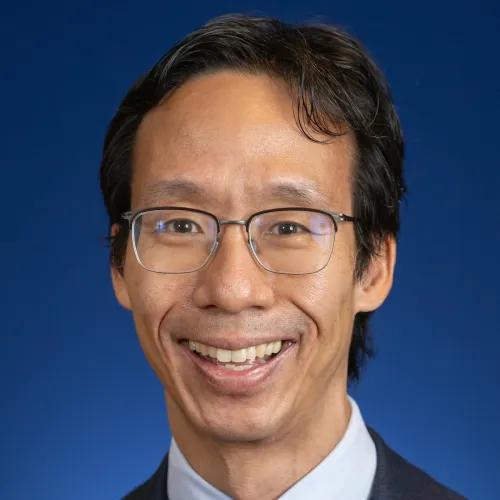
Andrew W Tai, MD, PhD
Assistant Dean
Featured News & Stories

From Uganda to Ecuador: A Journey of Adaptability

Two new global health funds honor champion of women’s health

Small Wins, Big Heart: Reflections on Global Health in Nepal
Through the Looking Glass: Gaining Perspectives in Global Health
Crouching Wolverine, Hidden Dragon: A Summer of Clinical and Research Opportunities in China

