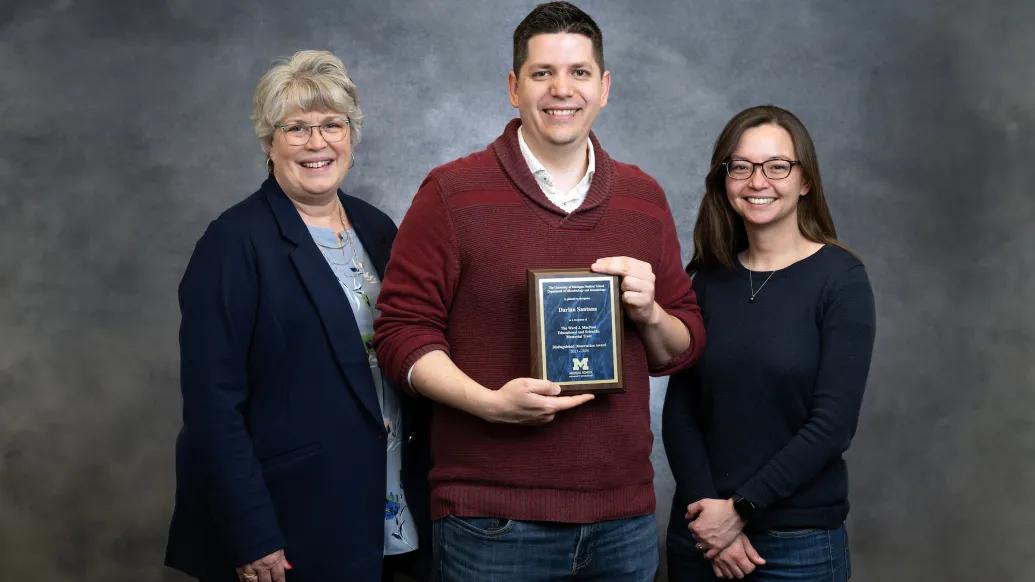
Darian Santana, Ph.D., is a postdoctoral fellow at St Jude Children’s Research Hospital in Memphis, Tennessee. He is continuing his doctoral research on Candida auris, a fungus that has become a major threat to patients in hospital settings.
At the University of Michigan, in Teresa O’Meara’s lab, Santana investigated the molecular mechanisms by which C. auris adheres to surfaces in order to understand its colonization and transmission potential. C. auris utilizes two different processes to adhere to surfaces, which make its eradication very difficult. In his doctoral work, Santana particularly focused on one of these processes and identified a surface protein (adhesin) that plays a major role in the fungus adhesion to surfaces. Santana received the Department of Microbiology and Immunology (M&I) 2024 MacNeal Award for his Ph.D. dissertation titled “A Candida auris-specific adhesin, Scf1, governs surface association, colonization, and virulence.”
M&I MacNeal Award recognizes a Ph.D. dissertation for its overall scholarly credentials, degree of innovation, creativity, and insight, scope and importance of the work and effectiveness of the writing, including whether it is written in language that is reasonably understandable to readers in a variety of disciplines.
It was such a delight to work with Darian. He is such a creative and thoughtful scientist, and one of the things I really appreciate is how he would read and think broadly about the problem and be willing to try new and outlandish experiments in pursuit of an answer. I really cherish our discussions on what is the important problem that we are trying to solve, and how would a particular experiment change the way that we think about the question. He wrote a beautiful and creative thesis that synthesizes the existing work and speculates in interesting ways about the future. He changed the field, and is absolutely deserving of the MacNeal award.
—Teresa O’Meara, Ph.D., Assistant Professor of Microbiology and Immunology
For this dissertation, Santana also received the “ProQuest Distinguished Dissertation Award for 2024” that recognizes the most exceptional scholarly work produced by doctoral students at the University of Michigan who completed their dissertations in 2024.
Santana published his findings as first author in Science, 2023 (DOI: 10.1126/science.adf8972,).
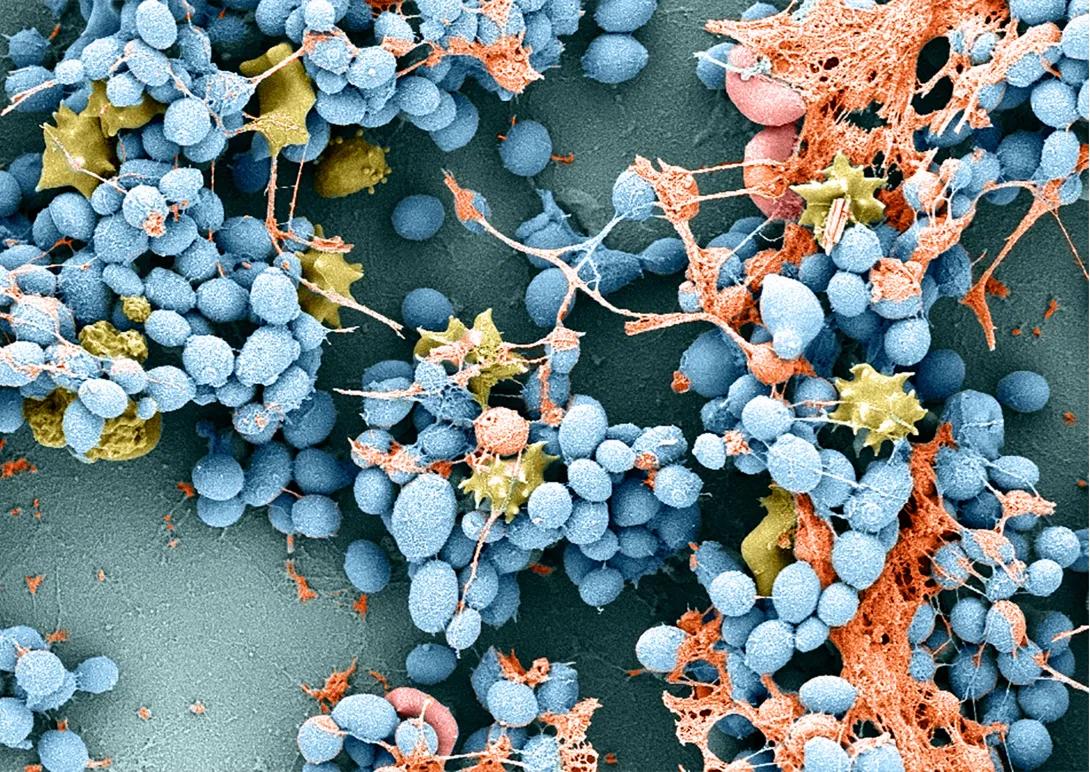
Micrograph of Candida auris colonizing a central venous catheter
About the research
Human infections by C. auris are very recent, seemingly starting in 2009, and appearing in different parts of the world that have no contact with each other. Scientists consider that something at a global scale shifted —be it climate change, pollution, or some other factor still undetermined— causing this explosion of C. auris all over the world.
C. auris is quite unique and its original environment is still mysterious. It could have evolved from a marine environment as it is tolerant of very salty conditions, but it could also have lived in plants or animals. Its adaptation to human and hospital environments causes outbreaks that are very difficult to eradicate and constitutes a serious threat to public health.
Like other microorganisms and Candida cells, C. auris cells are able to chemically manipulate their cell surface to stick to surfaces they encounter. C. auris does this in much the same way as many other species, but has also developed a new type of adhesive protein called Scf1 that exposes positively charged pockets on the cell surface. These charges help C. auris to compete for space when colonizing a surface, mimicking a chemical adhesive strategy used by marine organisms such as barnacles and mussels and perhaps pointing to an environmental origin for C. auris. This new adhesin and the electrostatic adhesion process were the focus of Santana's doctoral research.
Armed with these two ways of conquering and adhering to surfaces, C. auris is extremely resistant to traditional methods of cleaning and disinfecting. Current recommendations to eradicate C. auris focus on killing all the fungal cells on surfaces, following the same protocol as with the strongest bacterial infections. But so far, this approach has not been very successful.
C. auris infections occur in patients suffering from an underlying condition. The symptoms are somewhat generic with fever, chills, extreme tiredness, etc. The fungus can live in specific areas or organs without further spreading but when the fungus spreads into the bloodstream, it can be devastating, and may lead to death.
Currently, drugs to treat any fungal infection are limited and C. auris is already resistant to the most common antifungal drug on the market –suggesting that it has developed resistance even prior to reaching humans.
In his postdoctoral research, Santana seeks drugs to treat C. auris infections. He is particularly interested in the fungus's very frequent mutations that make it resistant to drugs, and investigates the possibility of targeting these mutations for treatment.
About Darian Santana
Santana’s passion for research is fueled by an immense curiosity.
“There is not one morning that I wake up and don’t get excited about doing this research!” he said. “There are always new problems to solve, but it’s really like a puzzle. How do we take it a step further? The only limitation is what we can intellectually think of.”—Darian Santana, Ph.D.
Santana is also motivated by helping others and advancing science that serves humankind. This brought him to be interested in public health and to study this new pathogen. With C. auris, he saw an opportunity to discover new fungal treatments for patients, as well as become an innovator in this field and build his career.
Santana started his professional life in microbiology at Nelson Laboratories where he was testing and validating protocols for drug manufacturing. Seeking to advance science and have a more impactful career, he finished his undergraduate degree and came to the University of Michigan in the dual program for a Ph.D. in Microbiology from the Medical School and a Master’s in Epidemiology from the School of Public Health.
During his doctorate, he reflected upon the ways he could have the most impact on public health, and found that microbiology research would be right for this goal. He also expected that the academic career track would give him the freedom he enjoys to follow his scientific interests while having an impact on public health and patients.
Outside of the lab, Santana enjoys composing music and writing lyrics. He plays the piano and performs for his community. He also likes cooking and baking, playing with the “good yeast” with his children.
Advice to students
Santana recognizes that Ph.D. trainees are all consumed with their dissertation, and he recommends considering one’s career path early on. “I went into the Ph.D. program without really thinking about what it would look like as a career path and how it aligns with what I want to be doing. The earlier you think about this, the earlier you will be prepared to enter the job market when you’re done with your thesis, which should really be the goal.”
“We often come in thinking that the dissertation is the end goal, while it is really only the beginning.”
Santana also very much appreciated how M&I was open to having students interacting with guest speakers, including interviewing faculty. He suggests taking advantage of the networking opportunities offered by the department, especially around lunching with visiting scholars. “I got to meet amazing scientists and I could talk to them about their work. It helped me shape what I value and what I want to do... This is how I met people that I recognized later in another context, and could ask for help and mentoring,” he said.
References
Santana DJ, Anku JAE, Zhao G, Zarnowski R, Johnson CJ, Hautau H, Visser ND, Ibrahim AS, Andes D, Nett JE, Singh S, O'Meara TR. A Candida auris-specific adhesin, Scf1, governs surface association, colonization, and virulence. Science. 2023 Sep 29;381(6665):1461-1467. doi: 10.1126/science.adf8972. Epub 2023 Sep 28. PMID: 37769084; PMCID: PMC11235122.
Solving a sticky, life threatening problem, Health Lab, 2023
In This Story
Teresa O'Meara, PhD
Associate Professor
Featured News & Stories

Human Rabies Exposures Growing Across the Country
Continuing the legacy of a doctor’s doctor
New Certificate in Global Health Program welcomes first cohort of residents, fellows
Karsten Bartels, MD, earns Gladys Sessler Outcomes Research Consortium Award