Perspectives and Pressure Points: An encounter with Traditional Chinese Medicine
Author | Noah Carey
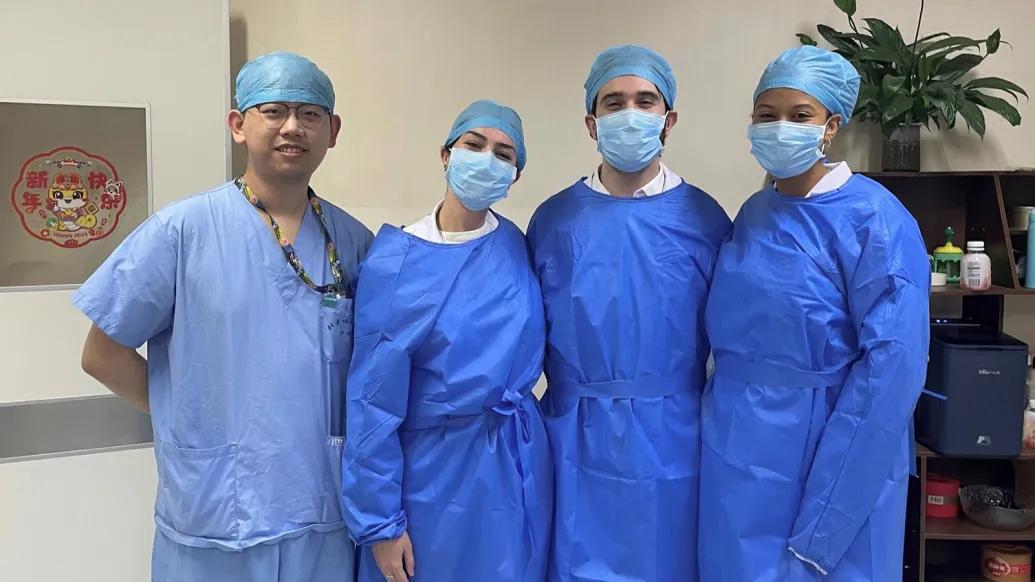
I came to China with a few simple goals. I wanted to learn about a new healthcare system, pick up some language skills, and observe clinical practices that I imagined would feel different yet familiar alongside my experiences as a medical student at UMMS. What I did not anticipate was discovering a new way of viewing health — one rooted not only in the foundational anatomy and physiology of my Western training, but also in Eastern concepts of energy, balance, and lived tradition. These central ideas in Traditional Chinese Medicine (TCM) and learning about them opened my eyes to how culture, philosophy, and healing are deeply intertwined.
This lesson began for me unexpectedly, while exploring the nightlife at Fuzhou. I was practicing Mandarin with my classmates when a young cardiologist overheard us and generously offered help with our pronunciation. As we talked, the conversation shifted to her clinical work. She shared with us how she integrates the TCM technique, acupressure, into her practice. Using a hands-on demonstration, she showed me a pressure point on my hand associated with digestion and another on my wrist linked to heart health. According to TCM theory, stimulating these points helps restore the flow of qi, the body’s vital energy, through specific channels that correspond to different organ systems.
She explained how these techniques are not only used to address symptoms like indigestion or pain, but also to promote overall energetic balance in the body. She didn’t frame these approaches as alternatives to those we learn in medical school, but rather as complementary tools that could support patient recovery, reduce medication burden, or improve quality of life. Her description was thoughtful and grounded, reflecting a deep respect for both scientific evidence and lived experience. In her practice, TCM wasn’t just a cultural formality — it was part of a holistic framework for healing.
A few days later, we observed a live demonstration of Tui Na, a therapeutic massage technique used in TCM. Practitioners applied rhythmic pressure, stretching, and joint manipulation with striking precision. I was surprised by how technical and skillful the practice was, each movement a deliberate intervention grounded in centuries of tradition. It became clear how much training, intuition, and embodied knowledge Tui Na demands, and how easily that expertise can be overlooked in Western contexts.
These moments pushed me to step outside that framework — not to reject it, but to recognize its limits. TCM offers a different language for illness, one rooted in balance, prevention, and connection to nature. Experiencing it firsthand deepened my understanding of how patients from different backgrounds might interpret their symptoms and make decisions about care. It reminded me that good medicine begins with listening, not just to symptoms, but to the worldviews that shape how people seek healing.
A third-year medical student, Noah Carey spent two weeks visiting various partner institutions in China through the US-China Youth Health Dialogue program.
Featured News & Stories
Youth Suicide Prevention Initiative at the forefront of vital mental health care
New insight into how lipodystrophy can affect overall health
Nerf gun accident causes retinal detachment in pediatric patient
PMOS is the New PCOS
Gray Areas: Realistic Possibility of Reversing Diabetic Neuropathy