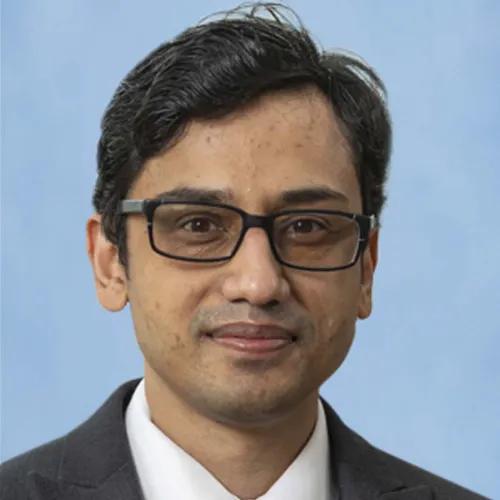
Anutosh Ganguly
Surgery
2215 Fuller Road, Building 31, Room 212
Ann Arbor, Michigan 48105
Manage Your Profile
About
After receiving his Ph.D. in Biochemistry from the Bose Institute at the University of Calcutta, India, Dr. Ganguly completed a postdoctoral fellowship in the Department of Integrative Biology and Pharmacology at the University of Texas Health Science Center at Houston.
Dr. Ganguly's post-doctoral work was in cell biology and the mechanism of drug resistance to microtubule-targeting drugs. After completing his post-doctoral training, he joined the faculty of the University of Calgary, Canada, where his research shifted from cell biology to cellular immunology. He primarily worked on the mechanism of immune suppression by dendritic cell immune paralysis. Using single-cell force spectroscopy and super-resolution microscopy, he found that regulatory T cell adhesion to dendritic cells causes sequestration of Fascin-1, an actin-bundling protein that is essential for immunological synapse formation. Furthermore, Dr. Ganguly found that this process is reversible upon regulatory T-cell disengagement. Importantly, this sequestration of critical cytoskeletal components causes dendritic cells to adopt an inactive state, leading to reduced T-cell priming. The finding was published in the Journal of Experimental Medicine. In Canada, his research was funded by CIHR and the Alberta Lung Association (Co-PI).
Dr. Ganguly joined the University of Michigan in 2019. In his past two years of collaboration with Dr. Clifford Cho, the lab has made significant progress in understanding how a novel mode of focused ultrasound-mediated tumor ablation (histotripsy) initiates a downstream systemic anti-tumor immune response. The findings have been published in BME Frontiers, Cancers, and the Journal of Immunotherapy for Cancer. The lab plans to expand this line of research to dissect the crucial mechanisms involved in histotripsy-induced immunomodulation. Since 2022, Dr. Ganguly's research has been funded by the University of Michigan and the Department of Veteran Affairs.
Qualifications
-
MBALouisiana State University in Shreveport, Shreveport, LA, United States
2021 - 2023
-
PhDBose Institute, University of Calcutta, Kolkata, WB, India
2001 - 2007
-
MSc, BiotechnologyGoa University, Taleigao, India
1998 - 2000
-
BScDr. Babasaheb Ambedkar Marathwada University, Aurangabad, MH, India
1995 - 1998
Research Overview
(I) Understanding the mechanism of cell death after tumor ablation (II) Enhancing the effect of tumor ablation by combination therapy (III) Using "Histotripsy" to increase tumor perfusion for enhanced drug delivery (IV) Immunity after Cryptococcal infection (V) Pathology of deployment related chronic bronchitis.
Recent Publications
-
Hissong R, Li H, Goughenour K, Barnett J, Lintner M, Ballesteros A, Queen H, Ganguly A, Chen G, Xu J, Olszewski M. The Journal of Immunology, 2026 Jul 29; 215 (Supplement_1): vkag141.198Journal ArticleCentral role of IL-10 in CNS-protection from Inflammatory Damage during Cryptococcus Meningoencephalitis 2253926
DOI:10.1093/jimmun/vkag141.198 -
Teitz-Tennenbaum S, Marinetti KN, Ganguly A, Song B, Hicks H, Osterholzer JJ. Frontiers in Public Health, 2026 Jan 1; 14:Journal ArticleDevelopment of peribronchiolar fibrosis is associated with local immune and MAPK pathway activation in a murine model of deployment-related constrictive bronchiolitis
DOI:10.3389/fpubh.2026.1761783 PMID: 41919297 -
McGinnis R, Song B, Kim H, Lorenzon A, Shi J, Zhao L, Cho CS, Ganguly A, Xu Z. Cancers, 2025 Dec 1; 17 (23):Journal ArticleHistotripsy Dose Impacts Treated Tumor Immune Infiltration and Survival Outcomes in a Murine B16F10 Melanoma Model
DOI:10.3390/cancers17233773 -
Li H, Hissong R, Goughenour K, Sinitsyna Y, Lintner M, Ballesteros A, Daguplo H, Song B, Ganguly A, Hargarten J, Williamson P, Xu J, Olszewski MA. The Journal of Immunology, 2026 May 7; 214 (Supplement_1):Journal ArticleFoxp3+ regulatory T cells (Tregs) restrain inflammation and protect brain damage during cryptococcal meningoencephalitis 3339
DOI:10.1093/jimmun/vkaf283.1155 -
Olszewski MA, Huang F, Hissong RJ, Li H, Goughenour KD, Ganguly A, Guo K, Xu J. The Journal of Immunology, 2026 May 20; 214 (Supplement_1):Journal ArticleInflammatory cellular transcriptome unravels drivers of clearance and pathology processes during cryptococcal meningoencephalitis 3863
DOI:10.1093/jimmun/vkaf283.1615 -
Xu J, Hissong R, Goughenour K, Li H, Sinitsyna Y, Lintner M, Ganguly A, Olszewski M. The Journal of Immunology, 2026 May 20; 214 (Supplement_1):Journal ArticleMechanisms of iNOS-mediated protection against CNS damage in cryptococcal meningitis 3992
DOI:10.1093/jimmun/vkaf283.1728 -
Daguplo HQ, Song B, Kim H, Xu Z, Olszewski M, Cho CS, Ganguly A. The Journal of Immunology, 2026 May 20; 214 (Supplement_1):Journal ArticleVascular normalization through histotripsy ablation therapy promotes anti-tumor immunity and enhances drug delivery in solid tumors 3610
DOI:10.1093/jimmun/vkaf283.1390 -
Li H, Hissong R, Goughenour KD, Sinitsyna Y, Lintner M, Song B, Daguplo HQ, Cho CS, Ganguly A, Chen GY, Hargarten JC, Williamson PR, Xu J, Olszewski MA. Res Sq, 2026 May 20;Journal ArticleFoxp3+ Regulatory T Cells Restrain Th1 Response Shielding the Brain from Lethal Inflammatory Damage during Cryptococcal Meningoencephalitis.
DOI:10.21203/rs.3.rs-7142999/v1
Featured News & Stories