
Joshua Welch, PhD

Associate Professor of Computational Medicine and Bioinformatics, Medical School
Associate Professor of Electrical Engineering and Computer Science, College of Engineering
Email:
[email protected]
Available to mentor
Joshua Welch, PhD
Associate Professor
Manage Your Profile
Qualifications
-
Postdoctoral ResearcherBroad Institute of Harvard and MIT, United States
2017 - 2018
Postdoctoral Research
Center Memberships
-
Center Membere-Health and Artificial Intelligence Initiative
-
Center MemberRogel Cancer Center
-
Center MemberCenter for Cell Plasticity and Organ Design
Research Overview
I develop AI/ML approaches to decipher the link between molecular features and cellular phenotypes. By combining generative AI (autoencoders, diffusion models, and generative adversarial networks) with emerging single-cell experimental technologies, I aim to build predictive models of how cells will respond to genetic and chemical perturbations. Additionally, I perform experiments on iPS-derived neuron models to better model and treat neurodevelopment and neurological disease.
Links
Welch Lab
Recent Publications
-
Núñez FJ, Banerjee K, Mujeeb AA, Mauser A, Tronrud CE, Zhu Z, Raghuram S, Sheth MR, Pena Agudelo JA, Zelaya J, Taher A, Kadiyala P, Carney SV, Garcia-Fabiani MB, Comba A, Alghamri MS, McClellan BL, Klaiss A, Nwosu ZC, Hong HS, Sajjakulnukit P, Qin T, Sartor MA, Ljungman M, Welch JD, Cheng SY, Lowenstein PR, Lahann J, Lyssiotis CA, Castro MG. Nature Communications, 2026 Dec 1; 17 (1):Journal ArticleAutophagy inhibition sensitizes radiotherapy responses in high-grade mutant IDH1 glioma
DOI:10.1038/s41467-026-77320-7 PMID: 42760279 -
Varshney A, Manickam N, Orchard P, Tovar A, Ventresca C, Zhang Z, Feng F, Mears J, Erdos MR, Narisu N, Nishino K, Rai V, Stringham HM, Jackson AU, Tamsen T, Gao C, Yang M, Koues OI, Welch JD, Burant CF, Williams LK, Jenkinson C, DeFronzo RA, Norton L, Saramies J, Lakka TA, Laakso M, Tuomilehto J, Mohlke KL, Kitzman JO, Koistinen HA, Liu J, Boehnke M, Collins FS, Scott LJ, Parker SCJ. Nat Genet, 2026 Oct 28;Journal ArticlePopulation-scale single-nucleus multi-omic profiling of skeletal muscle reveals extensive context-specific genetic regulation.
DOI:10.1038/s41588-026-02786-6 PMID: 42951906 -
Dean KP, Verduci SC, Kramm CC, Stinson CW, Min L, Smith JS, DeLong CJ, Yao M, Lee KH, Reeves JM, Birdsong WT, Welch JD, Jenkins PM. 2026 Oct 26; bioRxiv,PreprintHuman and Mouse Models of the Bipolar Disorder-Associated ANK3 p.W1989R Variant Display Altered Somatostatin Interneuron Connectivity and Function
DOI:10.64898/2026.10.23.760718 -
Wang C, Geng X, Abdelrahman S, Fu Y, Kady N, Rauf MA, Hristov A, Tejasvi T, Murga-Zamalloa C, Tsoi LC, Welch J, Fox J, Carty S, Gudjonsson JE, Wilcox RA. Blood, 2026 Oct 1; 148 (14): 1816 - 1832.Journal ArticleA single-cell atlas identifies oncogenic transcriptional programs and immune escape mechanisms in CTCL
DOI:10.1182/blood.2025032507 PMID: 42378251 -
Gomez-Cano F, Jiang L, Welch JD, Marand AP. 2026 Sep 16;PreprintEmpirical Estimation of Ambient Contamination in Combinatorial Single-Cell Methods Using Multi-Reference Mapping.
DOI:10.64898/2026.09.11.750809 PMID: 42779630 -
Han AL, Slotnik M, Fox DA, Dhindsa RS, Gudjonsson JE, Kahlenberg JM, Welch J. 2026 Sep 16;PreprintGenome-scale perturbation signatures from primary human CD4+ T cells improve genetics-based prioritization of immune drug targets.
DOI:10.64898/2026.09.12.748195 PMID: 42779863 -
Wang Y, Robbins A, Gadhvi G, Welch JD. 2026 Sep 14;PreprintLIGER2: Scalable Single-Cell Integration with On-Disk Datasets.
DOI:10.64898/2026.09.08.750130 PMID: 42779579 -
Varela ML, Kast H, West M, Rose M, Visñuk DP, Springer MV, Raghuram S, Zhu Z, Wang Y, McClellan B, Comba A, Murthy B, Hafshejani FK, AlMunaidi H, Edwards M, Welsh J, Castro MG, Lowenstein PR. 2026 Aug 5;PreprintA dual pronged approach to cancer immune exclusion: tumor-derived LAIR-1 simultaneously drives fibrosis and blocks immune recruitment in glioma.
DOI:10.21203/rs.3.rs-10472790/v1 PMID: 42620371
Featured News & Stories
Health Lab
Studying neurons using neurons
Labs at the University of Michigan Medical School are exploring a new technology that leverages the biological capabilities of human neurons for artificial intelligence.
Health Lab
New algorithmic tool enables to scientists to see cells “talk” to one another
A new U-M study, featured in Nature Genetics, details a technique to infer cell-cell communication using spatial transcriptomics

Health Lab
An AI model accurately predicts how cells end up in position inside tissues
Understanding transitions from cell to tissue in space and over time: A new modeling tool from the Welch lab at Michigan Medicine.

Department News
A Welch lab publication is recognized in Molecular Systems Biology with a cover design
A Welch lab publication is recognized in Molecular Systems Biology with a cover design
The Welch lab developed PertubNet, a generative AI model that can predict shifts in cell state—changes in overall gene expression—in response to multiple types of unseen cellular perturbations, including responses to drugs.
This tool was published in Molecular Systems Biology (Volume 21, Issue 8, 4 August 2025.) and was recognized with the opportunity to design the cover of the journal.
Great Minds, Greater Discoveries Stories
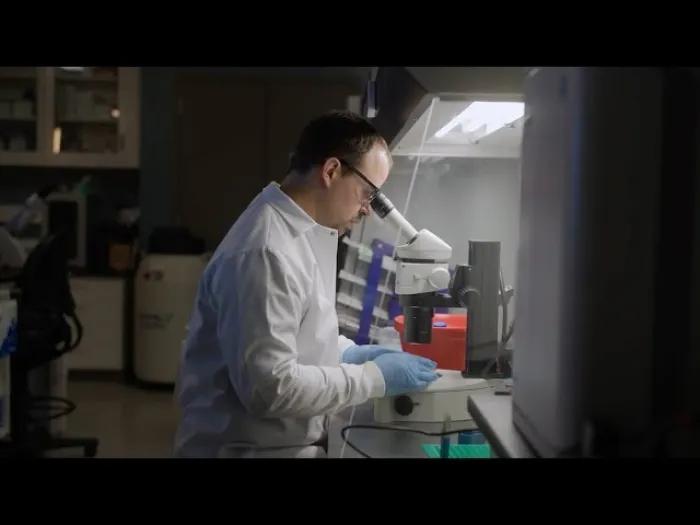
Research Scout Scholar: Joshua Welch, PhD
Meet Dr. Joshua Welch, a Great Minds Research Scouts scholar at the U-M Medical School.

Department News
Thomas Chen, M.S.: From U-M to Harvard/MIT
Thomas Chen, M.S., graduated in Spring 2025 from the Gilbert S. Omenn Department of Computational Medicine and Bioinformatics (DCMB) with a Master's in Science degree. He started his bioinformatics studies at U-M as a senior student majoring in Microbiology, and attended DCMB’s Accelerated MS program. In June 2025, he will pursue his training to become a scientist-physician at the Harvard/MIT MD-PhD Program.
