
Marschall S Runge
1301 Catherine Street
Ann Arbor, MI 48109-5624
Manage Your Profile
About
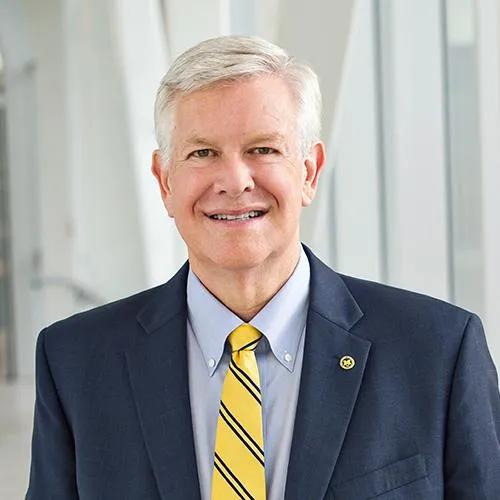
Marschall Runge, MD, PhD, holds the Frank D. and Agnes C. McKay Professorship at the University of Michigan and currently serves as Special Advisor to the Michigan Medicine Executive Vice President for Medical Affairs. He previously served as CEO of Michigan Medicine (2015–2025) and Dean of the University of Michigan Medical School (2016–2025).
Before joining the University of Michigan, he was executive dean for the University of North Carolina School of Medicine, the Charles Addison and Elizabeth Ann Sanders distinguished professor of medicine at UNC-Chapel Hill, chair of the UNC-CH Department of Medicine, and principal investigator and director of the NIH-funded North Carolina Translational and Clinical Sciences Institute, one of 55 medical research institutions working together as a national consortium to improve the way biomedical research is conducted across the country.
An honors graduate of Vanderbilt University with a bachelor of arts degree in biology and a Ph.D. in molecular biology, he earned his M.D. from the Johns Hopkins School of Medicine, where he was an intern and resident in internal medicine. He completed a cardiology fellowship at Harvard’s Massachusetts General Hospital and was a faculty member there prior to moving to Emory University as an associate professor of medicine in 1989. Before joining the UNC faculty in 2000, he held the John Sealy Distinguished Centennial Chair in Internal Medicine and was director of the Division of Cardiology and the Sealy Center for Molecular Cardiology at the University of Texas Medical Branch at Galveston.
He holds five patents and is a past president of the American Heart Association, Galveston Island Division, and the Paul Dudley White Society at Massachusetts General Hospital.
Links
Michigan Biology of Cardiovascular Aging (M-BoCA) linkedin
Qualifications
-
Clinical Cardiology FellowMassachusetts General Hospital, Cardiac Unit, Boston, United States
1985 - 1989
Clinical Fellowship
-
Research Cardiology FellowMassachusetts General Hospital, Cardiac Unit, Boston, United States
1985 - 1989
Other
-
ResidentJohns Hopkins Hospital, Internal Medicine, Baltimore, United States
1984 - 1985
Residency
-
InternJohns Hopkins Hospital, Internal Medicine, Baltimore, United States
1983 - 1984
Internship
-
NIH Postdoctoral FellowVanderbilt University, Nashville, United States
1979 - 1980
Postdoctoral Fellowship
-
Postdoctoral FellowJohns Hopkins Medicine, Cell Biology and Anatomy, Baltimore, United States
1980 - 1980
Postdoctoral Fellowship
-
NIH Predoctoral FellowVanderbilt University, Cellular and Molecular Biology, Nashville, United States
1978 - 1979
Predoctoral Fellowship
Center Memberships
-
Center MemberSamuel and Jean Frankel Cardiovascular Center
-
Center MemberMM-PKUHSC Joint Institute
Research Overview
One of the major focuses of my research has been studying the role of mitochondrial oxidative stress in the pathogenesis of cardiovascular disease. Our lab was one of the first to provide experimental evidence that mitochondrial DNA damage is not only correlated with atherosclerotic lesions in human aortic tissue and aortas from Apoe-/- mice but also preceded atherogenesis in young Apoe-/- mice. Apoe-/- mice deficient in mitochondrial antioxidant enzyme Sod2 (Apoe-/- /Sod2+/-) exhibit early increases in mitochondrial DNA damage and a phenotype of accelerated atherogenesis at the arterial branch point. Furthermore, we showed that Sod2 deficiency increases endothelial dysfunction in Apoe-/- mice, and that atherosclerosis risk factors, such as cigarette smoke and hypercholesterolemia, increase mitochondrial damage in cardiovascular tissue. Follow-up studies in our lab showed that increased mitochondrial oxidative stress under hyperlipidemic conditions in aging induces atherosclerotic plaque instability in part by increasing smooth muscle cell apoptosis, necrotic core expansion, and matrix degradation. We demonstrated that targeting mitochondrial reactive oxygen species with MitoTEMPO attenuates features of atherosclerotic plaque vulnerability in middle-aged Apoe-/-/Sod2+/- mice by lowering expression of calpain-2, caspase-3, and matrix metalloproteinase-2 and decreasing smooth muscle cell apoptosis and matrix degradation.
Recent Publications
-
Madamanchi C, Alhosaini H, Sumida A, Runge MS. Int J Cardiol, 2026 Jun 15; 453: 134427Journal ArticleCorrigendum to 'Obesity and natriuretic peptides, BNP and NT-proBNP: Mechanisms and diagnostic implications for heart failure' [Int J Cardiol. 2014, 176(3):611-7].
DOI:10.1016/j.ijcard.2026.134427 PMID: 41865605 -
Lozhkin A, Vendrov AE, Pan H, Wickline SA, Madamanchi NR, Runge MS. J Mol Cell Cardiol, 2026 Mar 21; 214: 44Journal ArticleCorrigendum to 'NADPH oxidase 4 regulates vascular inflammation in aging and atherosclerosis' [Journal of Molecular and Cellular Cardiology 102 (2017) 10-21].
DOI:10.1016/j.yjmcc.2026.03.004 PMID: 41865670 -
Vendrov AE, Sumida A, Canugovi C, Lozhkin A, Hayami T, Madamanchi NR, Runge MS. Redox Biol, 2026 Jan 20; 104033Journal ArticleCorrigendum to: "NOXA1-dependent NADPH oxidase regulates redox signaling and phenotype of vascular smooth muscle cell during atherogenesis" [Red. Biol. 71 (2019) 101063].
DOI:10.1016/j.redox.2026.104033 PMID: 41565511 -
Vendrov AE, Lozhkin A, Hayami T, Levin J, Chamon JSF, Abdel-Latif A, Runge MS, Madamanchi NR. Frontiers in Immunology, 2024 Jul 9; 15: 1410832 - 1410832.Journal ArticleMitochondrial dysfunction and metabolic reprogramming induce macrophage pro-inflammatory phenotype switch and atherosclerosis progression in aging
DOI:10.3389/fimmu.2024.1410832 -
Vendrov AE, Xiao H, Lozhkin A, Hayami T, Hu G, Brody MJ, Sadoshima J, Zhang YY, Runge MS, Madamanchi NR. Redox Biology, 2024 Jul 9; 67: 102937 - 102937.Journal ArticleCardiomyocyte NOX4 regulates resident macrophage-mediated inflammation and diastolic dysfunction in stress cardiomyopathy
DOI:10.1016/j.redox.2023.102937 -
Vendrov A, Silveira Fernandes Chamon J, Levin J, Hayami T, Runge M, Madamanchi N. Circulation, 2023 Nov 11; 148 (Suppl_1): A16902 - A16902.Proceeding / Abstract / PosterMolecular Basis of the Vascular Cell Phenotypic Switch and Wall Remodeling in Abdominal Aortic Aneurysm: NOX4 NADPH Oxidase-Derived Mitochondrial Oxidative Stress and DNA Damage
DOI:10.1161/circ.148.suppl_1.16902 -
Vendrov A, Lozhkin A, Hayami T, Levin J, Silveira Fernandes Chamon J, Runge M, Madamanchi N. 2023 Oct 3;Proceeding / Abstract / PosterMitochondrial Oxidative Stress Mediates Macrophage Pro-inflammatory Metabolic Switch in Atherosclerotic Vascular Disease in Aging
-
Ramos-Mondragón R, Lozhkin A, Vendrov AE, Runge MS, Isom LL, Madamanchi NR. Antioxidants, 2023 Oct 1; 12 (10):Journal ArticleNADPH Oxidases and Oxidative Stress in the Pathogenesis of Atrial Fibrillation
DOI:10.3390/antiox12101833
