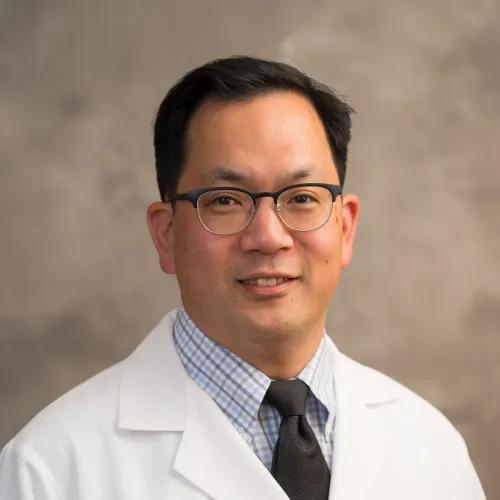
Richard S Kwon, MD, MS, FASGE
Department of Internal Medicine, Division of Gastroenterology
3912 Taubman Center, SPC 5362
Ann Arbor, MI 48109
Manage Your Profile
About
Dr. Kwon joined the Division of Gastroenterology in 2005 and is currently a Clinical Associate Professor. He received his bachelor's degree from Amherst College and his medical degree from UCLA Medical School. He completed his internal medicine residency at Cedars-Sinai Medical Center and his gastroenterology fellowship at Brigham and Women's Hospital (BWH). He also completed his advanced endoscopy fellowship at the combined BWH and Massachusetts General Hospital program. He earned his Master of Science in Clinical Research Design and Statistical Analysis at the University of Michigan.
Dr. Kwon is currently the Director of Advanced Endoscopy, Program Director for the Advanced Endoscopy fellowship, and Co-director of the Comprehensive Pancreas Program. He also serves as the Medical Director of the Michigan Chapter of the National Pancreas Foundation. He is a principal investigator in several independently funded research studies and has been an author on over 100 publications, including multiple research studies, national guidelines, and book chapters. He is a sought-after speaker, having served as invited faculty at multiple regional, national and international courses.
Center Memberships
-
Center MemberAI and Digital Health Innovation
Research Overview
Biomarker discovery for pancreatic cystic neoplasms, quantitative imaging analysis for pancreatic cysts and cancer, early detection of pancreatic cancer, prevention of post-ERCP pancreatitis, outcomes of endoscopic therapy for pancreatic disease (pseudocysts, and pancreatic necrosis) and luminal disease (Zenker's diverticulum, Barrett's esophagus, early esophageal cancer, early gastric cancer, early colon cancer, large polyps, esophageal strictures), advanced endoscopic imaging.
Recent Publications
-
Worthington C, Raitses-Gurevich M, Innamorati G, Hart PA, Wilkie TM, Tau N, Brin D, Yablecovitch D, Laish I, Keith D, Giles K, Permuth JB, Simeone DM, Zogopoulos G, Brand RE, Graff JJ, Earl J, PRECEDE Consortium . Int J Cancer, 2026 Jun 15;Journal ArticlePancreatic Cancer Early Detection Biomarkers for High-Risk Individuals: Insights From the PRECEDE Consortium.
DOI:10.1002/ijc.70592 PMID: 42298760 -
Henstridge A, Sahai V, Peterson N, Machicado JD, Kwon R, Schulman AR, Wamsteker E-J, Philips GM, Menees SB, Xia JY, Hogenson T, Shi J, Frankel T, Bednar F, Di Magliano MP, Lyssiotis CA, Truty MJ, Fernandez-Zapico ME, Carpenter E. Gastrointestinal Endoscopy, 2026 May 3; 103 (5): s - 2850.Proceeding / Abstract / Poster296b LONGITUDINAL ANALYSIS OF MATCHED PATIENT BIOSPECIMENS REVEALS NEURAL REPROGRAMMING OF CANCER-ASSOCIATED FIBROBLASTS FOLLOWING CHEMOTHERAPY IN PANCREATIC DUCTAL ADENOCARCINOMA
DOI:10.1016/s0016-5107(26)06672-1 -
Henstridge A, Sahai V, Peterson N, Machicado JD, Kwon R, Schulman AR, Wamsteker E-J, Philips GM, Menees SB, Xia JY, Hogenson T, Shi J, Frankel T, Bednar F, Di Magliano MP, Lyssiotis CA, Truty MJ, Fernandez-Zapico ME, Carpenter E. Gastroenterology, 2026 May 7; 170 (6): s - 2850.Proceeding / Abstract / Poster296b LONGITUDINAL ANALYSIS OF MATCHED PATIENT BIOSPECIMENS REVEALS NEURAL REPROGRAMMING OF CANCER-ASSOCIATED FIBROBLASTS FOLLOWING CHEMOTHERAPY IN PANCREATIC DUCTAL ADENOCARCINOMA
DOI:10.1016/s0016-5085(26)06741-7 -
Tanner S, Chiang M, Chen A, Min S, Kwon R, Machicado JD, Philips GM, Wamsteker E-J, Schulman AR. Gastrointestinal Endoscopy, 2026 May 6; 103 (5): s-124-s-125Journal ArticleTu1944 ENDOSCOPIC TRANSPAPILLARY GALLBLADDER DRAINAGE IN PATIENTS WITH GALLBLADDER-RELATED DISEASE: AN ELEVEN YEAR EXPERIENCE OF 326 PATIENTS
DOI:10.1016/s0016-5107(26)00569-9 -
Tanner S, Chiang M, Chen A, Min S, Kwon R, Machicado JD, Philips GM, Wamsteker E-J, Schulman AR. Gastroenterology, 2026 May 6; 170 (6): s-124-s-125Proceeding / Abstract / PosterTu1944 ENDOSCOPIC TRANSPAPILLARY GALLBLADDER DRAINAGE IN PATIENTS WITH GALLBLADDER-RELATED DISEASE: AN ELEVEN YEAR EXPERIENCE OF 326 PATIENTS
DOI:10.1016/s0016-5085(26)00638-4 -
Consul N, Machicado J, Kwon R, Zacur G, Chahine R, Hussain H. 2026 Mar 15;Proceeding / Abstract / PosterMRI for the Identification of Atypical Etiologies and Unexpected Sequelae of Pancreatitis
-
Li J, Branch G, Macchia J, Elhossiny AM, Arya N, Liang J, Kadiyala P, Peterson N, Kwon R, Machicado JD, Wamsteker EJ, Schulman A, Philips G, Menees S, Xia J, Singhi AD, Sahai V, Fang JM, Frankel TL, Bednar F, Pasca di Magliano M, Shi J, Carpenter ES. Cellular and Molecular Gastroenterology and Hepatology, 2026 Jan 1; 20 (6):Journal ArticleSpatial Analysis of Intraductal Papillary Mucinous Neoplasms Defines a Paradoxical Keratin 17-positive, Low-grade Epithelial Population Harboring Malignant Features
DOI:10.1016/j.jcmgh.2026.101749 PMID: 41638478 -
Tavakkoli A, Kapinos KA, Kwon RS, Singal AG, Elmunzer BJ. Clin Transl Gastroenterol, 2025 Dec 18;Journal ArticleVariations in Incidence and Financial Burdens of Non-Pancreatic Post-ERCP Adverse Events.
DOI:10.14309/ctg.0000000000000966 PMID: 41410317
Featured News & Stories