Family that overcame Crohn’s supports research for future patients
Grateful for donor-funded research that helped transform their daughter’s life, Kripke family makes gift to support future patients and families.
Author |
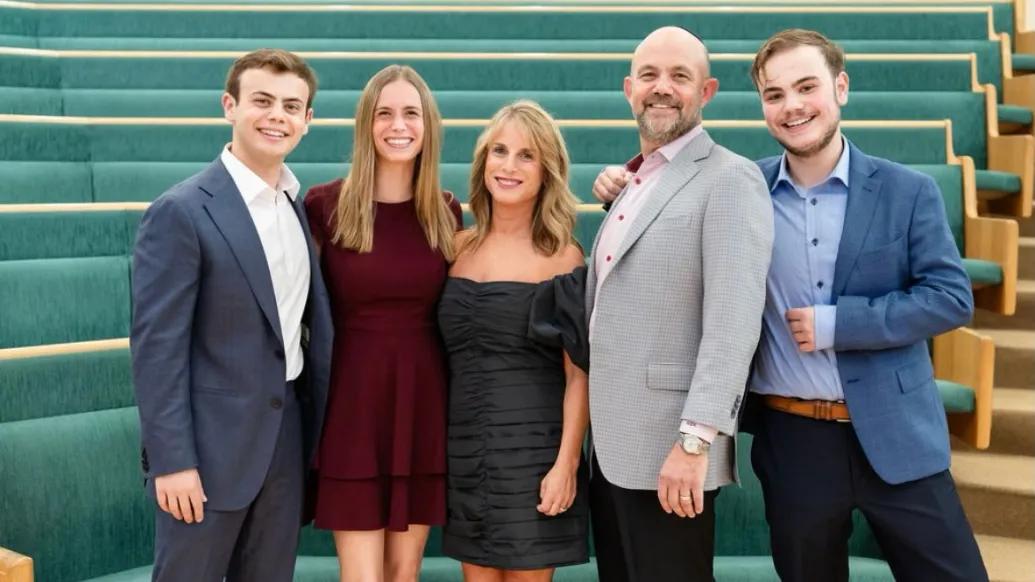
As their daughter, Sari, struggled with worsening abdominal pain, Matt and Jill Kripke were determined to find the right answers. After a diagnosis of Crohn’s disease and a difficult stay at their local hospital, they turned to Michigan Medicine, where she finally received the care she needed to return to a normal life.
In gratitude, the Kripkes have made a gift to support the Crohn’s disease research of Jeremy Adler, M.D., M.Sc., professor of pediatrics and interim director of pediatric gastroenterology at Michigan Medicine, to help ensure that future patients and families can also receive the care they need.
A struggle for answers
Jill remembers the severity of Sari’s illness when she was first diagnosed with Crohn’s disease in her early teens.
“She was very, very sick,” Jill says. “It got to the point where she couldn’t walk at school and was hunched over.”
Sari spent three days in the hospital, where her care team expressed alarm over her condition and recommended that she undergo surgery. Matt and Jill did not feel reassured and were not comfortable with what they were hearing.
“My thought was that there was no way we could just go through with this surgery,” Jill says. “We had to go to Michigan for a second opinion.”
In the best hands
At Michigan Medicine, the family was referred to Adler, who specializes in caring for children who have pediatric inflammatory bowel diseases.
“We were very lucky to be placed with Jeremy Adler,” Matt says. “We felt like we were getting the expert in pediatric Crohn’s, and it gave us a lot of comfort to know that we were in not just good hands but what felt like the best hands in the country.”
Not only was Adler able to successfully treat Sari without surgery, but his attentive, unrushed, and supportive care made a big impression on the Kripkes.
“We never felt like any question was too small, and we never felt like we were rushed out,” Matt says. “It was a bit of an effort to drive the 50 minutes to Michigan from our house, but we never felt like it wasn’t worth the time.”
Adler’s calm and reassuring approach also helped ease the family’s anxiety after the confusion and fear they had experienced during her hospitalization.
“Any time your child is diagnosed with something you don’t know about, ‘scary’ is really understating what it feels like,” Matt says. “You feel hopeless, lost, and confused, and all you want as a parent is for someone to say, ‘Hey, don't worry, I’ve got this; I'm going to get you to the other side of this; everything is going to be ok.’”
Sari’s condition improved greatly, and she remained under Adler’s care for several years. During this time, he invited the family to participate in some of his research studies, and they were happy to help.
“Sari was the one doing the work,” Matt says. “She would have to record how she was doing and feeling, and I think she was so willing to do it because Dr. Adler had made such an impact on her.”
The gift of giving back
The Kripkes worked with Brenda Wehrli, senior director of development in Michigan Medicine’s Office of Development, to make sure their gift would have the greatest possible impact on Adler’s work.
They hope their gift will help Adler continue to improve the standard of care for children with Crohn's disease and that other providers will learn from his work.
“We want the standard of care to improve throughout the country and the world,” Matt says, “so other parents don’t have to face that uncertainty and scariness we did. The way he takes care of these kids is very calming, and we are willing to help him find even better ways to help more.”
For Adler, the Kripkes’ gift comes at a pivotal time and gives him hope for the future of medical research and the families he cares for.
“Many of the important questions we focus on come from patients and families,” Adler says. “These are often the questions families and physicians want to know the answers to, but which may not be high priorities for federal funding agencies. Also, with the recent cutbacks in federal funding, donor funds have become even more important to support important research studies.”
Donor generosity provides critical direct support for research studies and also helps Adler and other doctors and scientists demonstrate the potential of their ideas and gather data that is needed to apply for grant funding from the NIH and other agencies.
For the Kripkes, their gift is both a way to give back to the physician who changed their daughter’s life and to build on the generosity of past donors whose support made her care possible — continuing a legacy of giving for future patients and families.
“The reason we were able to get this treatment is because someone who didn’t know us or our daughter decided to support medical research,” Matt says. “We all have a tendency to want to help people who are close to us, but the greatest gift is to be able to help someone you don’t even know.”
If you are interested in supporting the Division of Gastroenterology within the Department of Pediatrics, please visit the department’s giving page. To support Dr. Adler’s research, contact Brenda Wehrli at [email protected], or make a gift to the Shaevsky Family Research Fund for Crohn’s Disease, which directly supports Dr. Adler’s work.
About the Look to Michigan campaign
This gift is part of the Look to Michigan fundraising campaign, which aims to create transformative answers to health care’s biggest challenges for the benefit of people in our state and beyond. Building on 175 years of leadership in medicine and as part of the University of Michigan’s Vision 2034 strategic framework for impact, we are breaking new ground in patient care, research, medical and graduate education, health equity, and health care facilities. Together, we can improve and save lives. For more information, visit michiganmedicine.org/giving/look-to-michigan.
Philanthropy News
Discover how donors at Michigan Medicine drive advances in patient care, research, and education. See how philanthropy brings Michigan answers to patients and families.
In This Story

Jeremy Adler, MD, MSc
Clinical Professor
Brenda Wehrli
Senior Director of Development
Featured News & Stories

Kellogg care inspires gift to vision research

Rare cancer diagnosis inspires community of support
Identifying avoidant, restrictive food intake disorder in gastroenterology patients

Foundation gift inspires additional gifts to strengthen youth mental health care

As probiotic use surges, microbiome-supportive food consumption stagnates