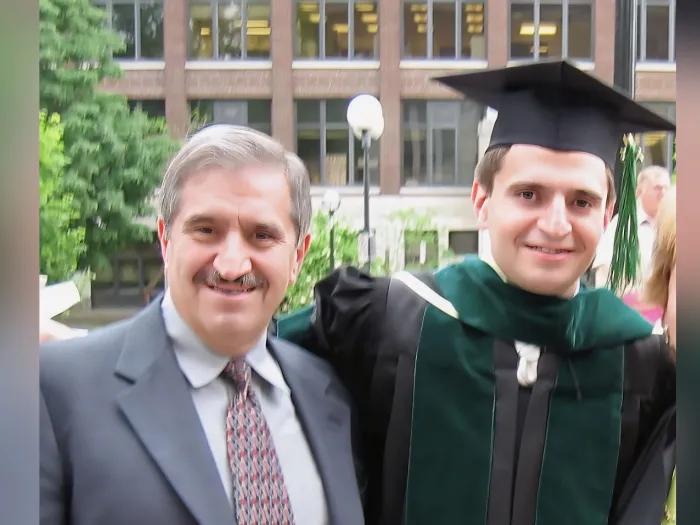
Joshua Pickard, Ph.D., developed computational methods and tools for biomarker discovery
He defended his Ph.D. thesis June 13, 2025
Author |
Data collection is the foundation for all biology research and clinical feedback. But measurements are limited by factors such as cost, quantity and availability.
In response to this challenge, observability theory and methods can be used to infer whether a limited set of data is good enough to accurately inform about an entire system.
For his doctoral dissertation, Dr. Pickard developed observability methods and algorithms for biological systems that change over time. On June 13, 2025, he defended his thesis titled “Observability and higher-order methods for biomarker discovery,” and his mentor was professor Indika Rajapakse.
“To me, the exciting part of this research is that the tools that I have developed can be applied to all types of data from systems that evolve over time, like imaging, transcriptomics, genes and proteins, or others.”—Joshua Pickard, Ph.D.
Ultimately, Pickard is interested in identifying new biomarkers of health which could have a great impact in clinical settings.
“Joshua is a creative and joyful scientist. He loves to solve bio mathematical problems and to find the roots of the solution. And he is generous in helping others.”—Gilbert S. Omenn, M.D., Ph.D., Harold T Shapiro Distinguished University Professor of Medicine, Professor of Computational Medicine and Bioinformatics and co-director of the Center for Computational Medicine and Bioinformatics
Starting in Fall 2025, Pickard will expand his scientific interests as a postdoctoral fellow at the Eric and Wendy Schmidt Center at the Broad Institute in Boston, MA. The Center is enabling a new field of interdisciplinary research at the intersection of machine learning and biology, aimed at improving human health.
For long-term plans, Pickard is considering a career in academic research and wants to carry in his own teaching the passion and enthusiasm that he experienced on a daily basis with his U-M mentors.
Pickard expresses great gratitude for the experience and training opportunities he has had at U-M.
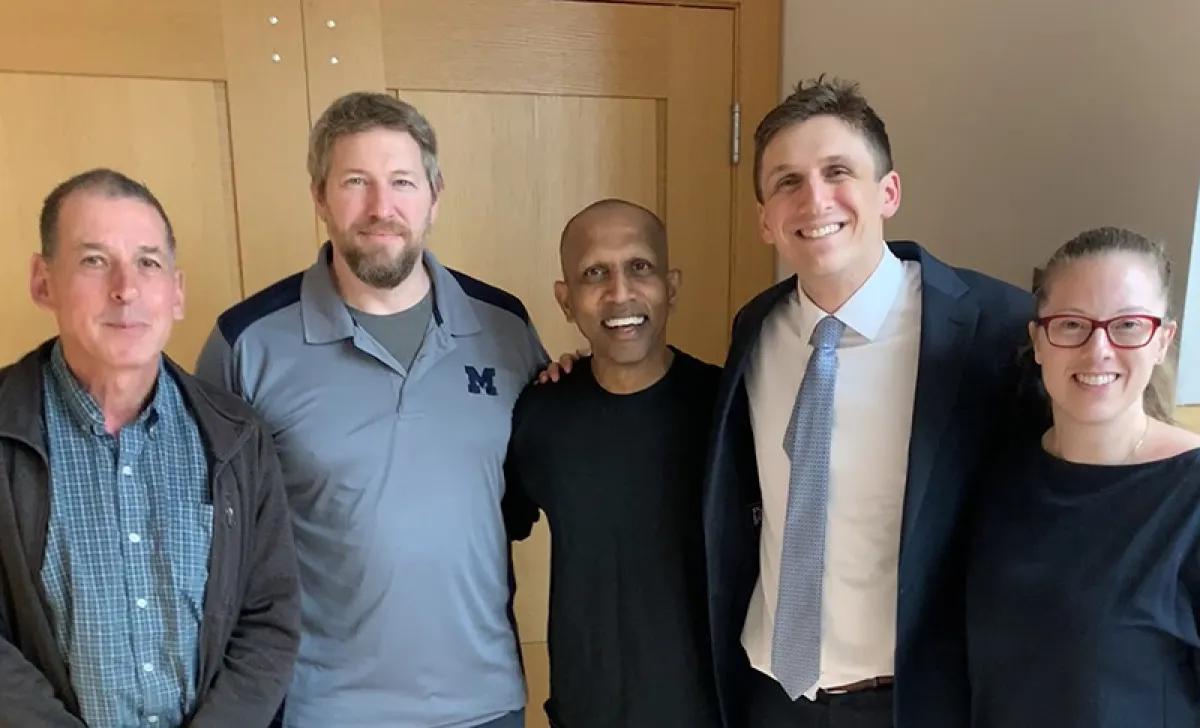
Dr. Pickard's thesis committee after his defense. (Left to right: Professors Anthony Bloch, Ryan Mills, Indika Rajapakse, Joshua Pickard, and Lindsey Muir; not pictured but from his committee is Dr. Amit Surana.
The science
A model is called “observable” when from a small amount of collected data one can confidently infer what happens within the complete system, over time. This is useful for determining aspects of a system that are not measured. Since measurements and data collection are expensive, observability is a very effective tool both for research and in clinical settings.
Modeling systems, Pickard built observability algorithms with the goal of identifying biomarkers. For his thesis, he developed and applied algorithms for observability to higher-order systems that consider the multiple relationships between various elements of a system and their many possibilities for interactions. When Pickard started his graduate studies, observability for large-scale higher-order systems was not very well characterized, and he used hypergraphs and tensor algebra to study these systems.
He further developed and applied these methods and tools to a wide range of data from cellular reprogramming, proliferation, and perturbation experiments. He expects that his algorithms can be applied more broadly to other systems and data sets.
“To consider ‘how good is the data?’ is a first step in many research projects, and observability theory offers a powerful framework for answering this question. That is what I am interested in studying,” he said.
The curriculum
Pickard joined the University of Michigan (U-M) as an undergraduate student in 2019, in the College of Engineering, initially studying computer science. As COVID-19 spread, he became interested in epidemiology and studied with Aaron King, Ph.D., Nelson G. Hairston Collegiate Professor of Ecology and Evolutionary Biology in the College of LSA. While taking a bioinformatics course, he realized that there are many applications for computational methods and tools, and that swayed him toward this field.
Pickard joined DCMB through the Accelerated Master’s Program (AMDP) and is very grateful for this program that helped him transition from undergraduate studies into the Master’s curriculum, and eventually into the Ph.D. program. =
“AMDP was very helpful to get into the Ph.D. program and meet professors in both the Department and the Center for Computational Medicine and Bioinformatics (CCMB), and learn about the exciting research done in bioinformatics.”
With AMDP, he appreciated how he could couple computational mathematical theory with applications for new experimental data. “With my thesis, I think that I have made progress toward finding ways to further develop computational methods to address the challenges of identifying new biomarkers,” he said.
“Joshua came to our accelerated bioinformatics master’s degree program (AMDP, also known as SGUS or SUGS) with a major in U-M Computer science and a minor in math, with significant prior biology knowledge as well. He already had a lot of knowledge in the areas on which bioinformatics is built. The AMDP program allows top undergrad students at the U-M to get a master’s degree in one year, and as Joshua showed, this can be a path into our highly competitive Ph.D. program. Josh chose some of the hardest statistics and computing classes available, and after taking an introductory biology class, also took a graduate class in physiology, above and beyond requirements. In addition to his Ph.D. in Bioinformatics, he pursued a certificate in Computational Discovery and Engineering.” Margit Burmeister, Ph.D., Associate Chair and Professor, Computational Medicine & Bioinformatics Director, Bioinformatics Graduate Program
In DCMB, Pickard first joined Dr. Najarian’s lab where he learned about tensors, machine learning and models.
“When Joshua was working in my lab, he often appeared very early in the morning before anyone else, and sometimes would still be working late into the evening after everyone else had left. While Joshua’s mathematical knowledge and his attention to technical details always impressed me, the first thing that comes to mind when I think of him is the constant smile on his face and his cheerful attitude that always brightened the room for everyone.”—Kayvan Najarian, Ph.D., Professor of Computational Medicine and Bioinformatics, Emergency Medicine and Electrical Engineering and Computer Science.
For his doctoral work, he studied with Dr. Rajapakse’s group where he could apply his mathematical skills and further develop his interest in system biology.
"Joshua is an amazing, kind person with strong character. He is incredibly industrious, as shown by his numerous projects and publications. He maintains high standards in his work and is a valuable contributor to our academic environment here at Michigan. I am extremely excited for Joshua’s future, and at the same time, I will miss him very much."—Indika Rajapakse, Ph.D., Professor of Computational Medicine and Bioinformatics
The teaching and awards
Pickard was a GSI for one year and remained involved in the courses he taught since then. “I really enjoy teaching and I can see myself making a career of it,” he said. His outstanding teaching was recognized with DCMB’s Teaching Nomination for the U-M OGPS Excellence in Teaching Award.
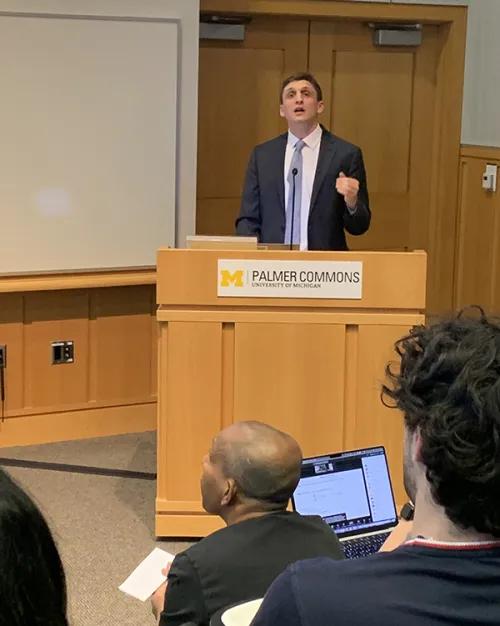
While at DCMB, Pickard was part of the Systems and Integrative Biology Training Program” (SIBTP, NIH T32) and received the Michigan Institute of Computational Discovery and Engineering (MICDE) fellowship.
Outside the laboratory
Pickard enjoys walking in U-M’s Arboretum prairie, hanging out with friends and family, and traveling. His next trip will take him and his brothers to Europe before he starts his postdoc.

Joshua Pcikard, PhD, travels in Vietnam after attending the IEEE Conference on Decision and Control in Singapore, in 2023
In This Story
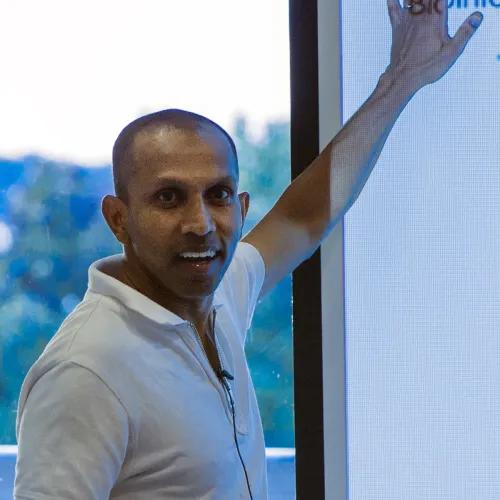
Indika Rajapakse, PhD
Professor
Lindsey A Muir, PhD
Research Assistant Professor

Ryan Mills, PhD
Professor
Kayvan Najarian, PhD
Professor
Featured News & Stories
Improving care for patients with brain injuries
Human connection takes center stage at Medical School Commencement
Alum reconnects to his roots through Doctors of Tomorrow scholarship fund
Advancing proteomics through computational innovation: Kai Li successfully defends dissertation
Scholarship honors love and gratitude