Green Anesthesia Initiative exceeds lofty goals for reduction in emissions
Michigan Medicine’s Department of Anesthesiology has taken Planet Blue at U-M Health’s mantra to heart: Healing patients and the planet. The Green Anesthesia Initiative (GAIA) was formed in 2022 to reduce greenhouse gas emissions by 80%. Now, that ambitious goal is reality.
The Department of Anesthesiology unveiled its results: GAIA -- an homage to the personification of Earth in Greek mythology -- which has been associated with an 88% reduction of inhaled anesthetic greenhouse gas emissions.
This was all done while preserving patient safety through a total team effort.
“What our GAIA team has accomplished is inspiring,” Department Chair George A. Mashour, M.D., Ph.D., said. “From the start, we aimed to minimize our carbon footprint. We have tremendous leadership on this project from our department, great partners in U-M Health, and a committed team of fantastic clinical colleagues. Thank you to everyone who truly makes it happen each and every day.”
Anesthesiology is a carbon-intensive specialty, including the common use of inhaled agents that can lead to significant greenhouse gas emissions and global warming over an extended period. GAIA’s aims are to implement environmentally sound health care practices while continuing to protect public health and provide excellence in patient care.
“Our anesthesiology team’s strategy and focus on such an important project demonstrates what we can achieve with creativity, persistence and teamwork,” said Tony Denton, senior vice president and chief environmental, social and governance officer at Michigan Medicine. “The collaboration across areas of our organization shows that we can find environmental sustainability solutions to save our planet while treating patients in a safe and highly reliable manner, a win-win.”
Surpassing its goal
GAIA’s original goal of 80% reduction in greenhouse gas emissions in three years from the baseline of fiscal year 2021 baseline was ambitious — but anesthesiology and U-M Health exceeded that threshold in under two years. And Mashour was first to credit the incredible team effort it took for it to happen.
Mashour and GAIA leads David Hovord, M.B.Ch.B., and Prabhat Koppera, M.D., formally introduced the initiative in March 2022 during a departmentwide virtual town hall. From there the team grew to include Robyn Rachel, MHSA, P.M.P., Tim Dubovoy, M.D., Paul Picton, M.D., Douglas Colquhoun, M.B.Ch.B, M.P.H. and many others providing support.
The team developed a three-phased approach. Phase One was to reduce or eliminate inhaled anesthetics with high global warming potential and replace them with anesthetics that have a smaller carbon footprint, such as sevoflurane. Desflurane, which is an inhaled ether with the worst carbon footprint, was a major target of intervention and the team also aimed to reduce the use of isoflurane and nitrous oxide.
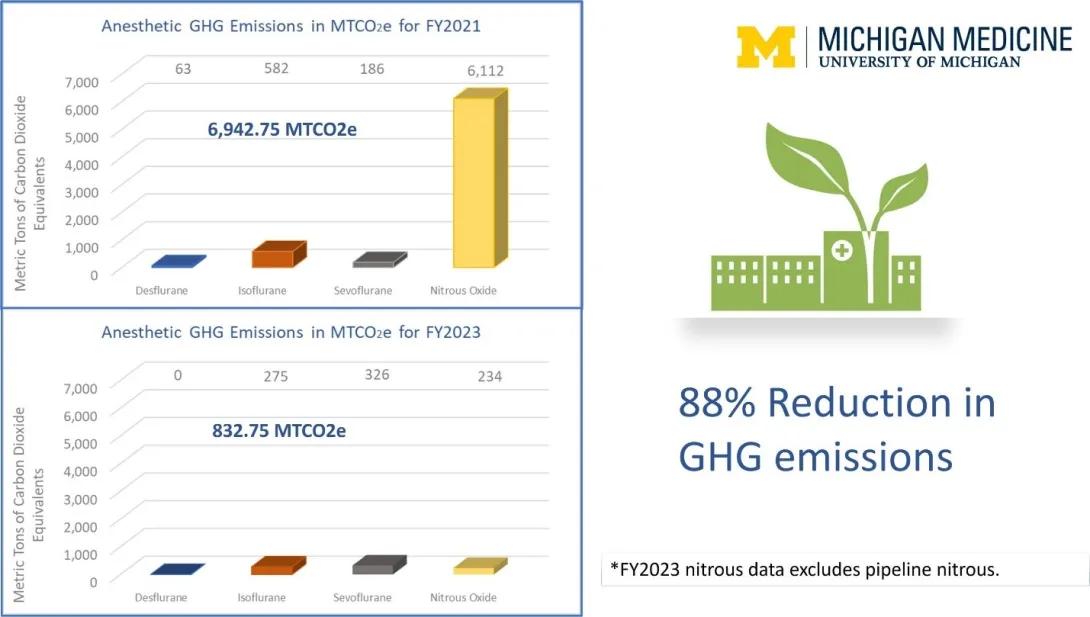
As the chart below illustrates, emissions were reduced from 6,942.75 metric tons of carbon dioxide in FY21 to 832.75 metric tons in FY23, an 88% reduction and clear investment towards saving our planet.
The 88% represents 6,110 metric tons of CO2 prevented from entering the atmosphere or the equivalent of 1,360 gasoline-powered passenger vehicles driven for a single year. This elimination was aided by U-M Health’s Pharmacy Services and Supply Chain teams.
The second phase of GAIA included low-flow practices to reduce current flows by 25%. This lowers the release of anesthetic in the environment and minimizes anesthesia delivery costs. This was done by updating anesthesia machines with increased technology to safely automate lower gas flows.
Additionally, the GAIA project team explored the feasibility of minimizing and/or eliminating the use of bulk N2O in the building pipelines in favor of more efficient cylinder usage. This proved to be an effective strategy.
The journey continues, however, as Phase Three looks to lower carbon gas emissions further. In this phase, the team seeks to broaden the initiative’s impact — both within the department and beyond — as leadership further commits to reducing the amount of anesthesia waste and diverting as much as possible from landfills.
Plans for this phase include:
- Creating anesthesia site-specific workgroups to develop additional solutions in support of GAIA’s carbon emissions reduction goals
- Developing a consortium with other health care systems to influence environmentally preferred purchasing practices
GAIA’s project team includes team members from across the department’s clinical sites, as well as staff from U-M Health representing pharmacy ordering, environmental sustainability, supply chain and safety.
In This Story

David G Hovord, MD
Clinical Assistant Professor

George A Mashour
VICE DEAN
Featured News & Stories
U-M Awards Strategic Initiative Fund Grant to Diabetes Reprogramming Initiative Led by Dr. Ganesh Palapattu
BREATHE-3 study offers lifeline to Michigan patients with severe emphysema

Specialized care helps patient navigate rare liposarcoma diagnosis
Medical School Honors Three Faculty Members with Endowed Professorships
Evolving causes, diagnosis of drug-induced liver injury