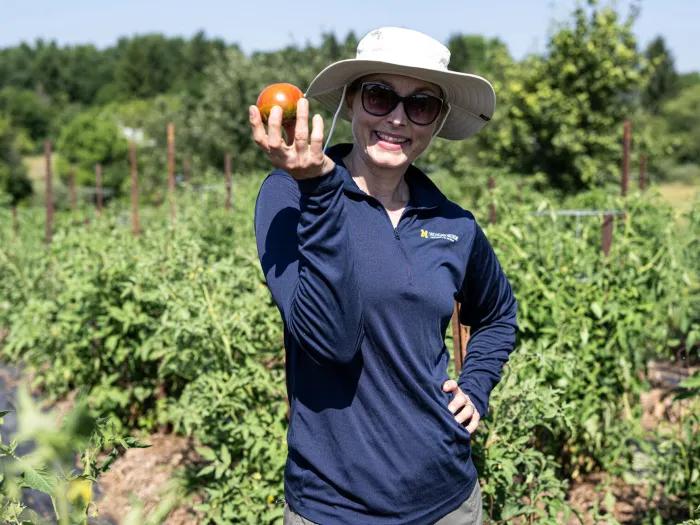
Two Microbiology & Immunology PhD students – Adam Hafner and Katy Krupinsky – are recipients of this year’s Rackham Predoctoral Fellowships.
This annual fellowship supports outstanding doctoral students with a stipend that covers a year of their studies. The awardees are graduate students who have achieved candidacy and are working on researching and writing their dissertation.
Adam Hafner
Hafner is a fifth year PhD student in Christiane Wobus’s lab.
“Adam is highly motivated and engaged in his research,” said Christiane Wobus, PhD. “He is not only the one performing the techniques, but importantly, is the intellectual driver of his project. He is great at multitasking and very productive. In short, he is the type of graduate student that any mentor dreams to have in their lab.”
His research centers around noroviruses, which causes gastroenteritis. When the virus gets into a host, it can manipulate the metabolism of the host.
“My research is centered around uncovering how noroviruses reprogram host metabolism, because by doing so, we can potentially identify therapeutic targets,” Hafner said.
In your body, metabolic pathways create resources that your cells need to live. But viruses can hijack these pathways to steal the resources, which they also require. If researchers can discover which resources the viruses are stealing and how they are stealing them, it will help us learn how to fight off these tiny bandits more efficiently.
Additionally, if researchers can determine which resources norovirus need to survive, they may be able to better replicate human norovirus in the lab.
"By uncovering the metabolic determinants that the virus requires, that might help with cultivation efforts, since we're historically not able to continuously grow human norovirus in the lab,” Hafner said.
For Hafner, receiving the Rackham Predoctoral Fellowship is validating. Last year, he experienced a setback when a diversity grant he applied for was cancelled.
“I'm grateful that Rackham has this internal fellowship for higher level graduate students,” Hafner said. “Since it is internal, we don't have to worry about if funding dries up. I've also been able to go to a lot of fun conferences because of Rackham travel grants.”
After graduation, Hafner’s goal is to use the skills he developed in the Wobus Lab to continue investigating viruses. He hopes to work at a pharmaceutical company evaluating antiviral compounds and to continue working with organoid models. His ultimate goal is to help deliver successful antiviral therapies which combat diseases caused by viruses.
Katy Krupinsky
Krupinsky is a fourth year PhD student, co-mentored by Denise Kirschner and Adam Lauring.
“Katy seamlessly integrates high-impact research with an exceptional and innovative teaching portfolio for a graduate student,” said Denise Kirschner, PhD. “She makes significant contributions to two research labs while excelling in mentoring and teaching roles, bringing a unique multidisciplinary perspective that bridges science and education in meaningful ways.”
Her dissertation uses computational and mathematical modeling to understand respiratory pathogens of high public health concern. Her work focuses on three infectious diseases: tuberculosis, influenza and COVID-19. Each disease has its own separate, yet related, project dedicated to it.
The tuberculosis project looks at reactivation, or when the symptoms of the disease return after a period of normalcy. Additionally, around half of TB cases have a concurrent lymph node infection, which is difficult to study in patients. By using computational models, Krupinsky expands our knowledge of the molecular mechanisms behind reactivation in the lymph nodes.
The tuberculosis project looks at lymph node infection, one of the most common secondary sites of TB infection. Lymph node infection is difficult to study in patients and of interest because it is hypothesized to play a key role in TB reactivation, or when symptoms of disease return after a period of normalcy. By using computational models, Krupinsky expands our knowledge of the molecular mechanisms behind infection in the lymph nodes.
For the second and third projects, Krupinsky studies how pathogens are passed from one person to another. When a sick person coughs, for example, some of the virus will be spread through the air, but not every virus will be transferred to a new host. This is known as the transmission bottleneck. Krupinsky uses computational methods to understand the transmission bottleneck in influenza and COVID-19.
“It’s been great to get recognition for the work that I've been doing, and kind of this fellowship shows that I am among the top of the university for final year PhD students,” Krupinsky said. “It’s validating to see that the work that I'm doing is not only valued by my direct peers, but also in the greater research conversation at Michigan.”
After graduation, Krupinsky’s goal is to teach and engage more in educational research. She has been involved in both aims, leading multiple courses and redesigning outdated curriculum.
“I'm really proud of my teaching work,” Krupinsky said. “It's been really fun to combine my passions and having the leeway to do this in addition to my technical dissertation work.”
In This Story

Adam Hafner
PhD Student | Wobus Lab
Katy Krupinsky
PhD Student | Lauring and Kirschner Labs
Christiane Wobus, PhD
Associate Professor

Denise E Kirschner, PhD
Professor

Adam Lauring, MD, PhD
Professor
Featured News & Stories

A tragedy and a trial shine a spotlight on new moms’ mental health

Beyond the White Coat: The Med Student Tradition Behind Michigan’s Smoker

Caregiver Resources: Reduce the Risk of Burnout
Why tendons heal so poorly and how researchers hope to fix them
Michigan Medicine leadership changes set for regents consideration