
More articles about: Stroke Treatment

Health Lab
Stroke survivors miss critical treatment, face greater disability due to systemic transfer delays
Problems with the United States stroke transfer system are drastically reducing survivors’ chances of receiving critical treatment and increasing the likelihood that they will leave the hospital with a disability, a study suggests.

Health Lab
Telestroke patients more likely to receive treatment, but with greater delays
Stroke patients evaluated using telemedicine (telestroke) have higher odds of receiving essential treatment, yet it takes longer for them to be treated — potentially limiting the benefits, finds a Michigan Medicine.

Health Lab
Ischemic stroke: what’s the right treatment?
Most strokes are ischemic, meaning blood flow to part of the brain is blocked by a clot. Here, a neurologist shares treatment options and how providers decide when time is short.

Health Lab
Drug candidate successfully treats atherosclerosis, fatty liver disease in large mammals
A compound that was previously found to treat severe fatty liver disease also reduces atherosclerosis, a primary driver of cardiovascular death, in non-human primates. The drug candidate was developed at the University of Michigan.
Health Lab
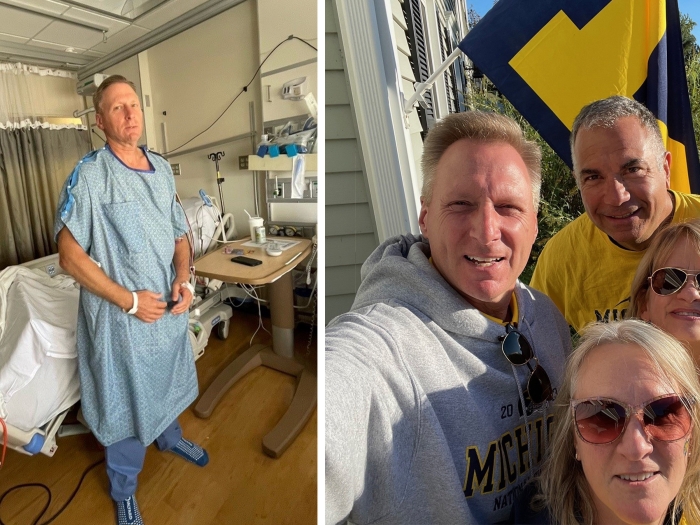
Michigan fan saved after wife recognizes stroke at football game
After a man suffered a stroke at a University of Michigan football game, his wife’s recognition of his symptoms helped him receive lifesaving treatment and make a full recovery.

Health Lab
Black stroke patients arrive later to hospitals, EMS less likely to notify
Research found that it took approximately 28 minutes longer for a Black patient to be brought in for emergency care after displaying symptoms of a stroke.

Health Lab
Timely response leads to complete recovery for young stroke survivor
For a Michigan man in his early 30s who never expected to have a stroke so young, the quick action of others allowed him to fully recover with no need for rehabilitation.

Health Lab
Michigan Medicine doctor gains new perspective as a stroke patient
Experience gave him a new appreciation for interprofessional patient care
Health Lab
Nearly 30% of caregivers for severe stroke survivors experience psychological distress
Post-traumatic stress worse among Mexican American caregivers compared to white caregivers.

Health Lab
Irregular heartbeat after valve surgery increases risk of stroke, death
Postoperative atrial fibrillation, commonly known as Afib, has traditionally been viewed as benign and limited. But a study led by researchers at the University of Michigan Health Frankel Cardiovascular Center finds that postoperative atrial fibrillation increases the risk of strokes and permanent Afib — and is linked to worse long term survival — after heart valve surgery.
Health Lab
Women stroke survivors believe they will receive worse care in the emergency room
National study examined health care perceptions of approximately 3,500 women, including those with and without a history of stroke

Health Lab
Research finds potential target for cardiovascular disease in diabetes
University of Michigan researchers found that the overproduction of neutrophil extracellular traps is an important contributing factor to vascular dysfunction in diabetes.

Health Lab
Nearly three-quarters of stroke patients requiring higher level of care wait over two hours for transfer
More than 70% of people experiencing a stroke who require a transfer wait longer than two hours to be transferred from the initial emergency department to hospitals with higher levels of care to receive time-sensitive care, a study finds.
Health Lab
Do you know what Moyamoya disease is?
Moyamoya disease is a rare condition that can cause blockage of the blood vessels in the brain and increase the risk of stroke. Learn more about this chronic disease from U-M Health’s neurologist and neurosurgeon as they explain more about how it is diagnosed and treated.
News Release
University of Michigan Health recognized by AHA for highest quality stroke care
University of Michigan Health has received the highest honor from the American Heart Association/American Stroke Association as a leader in stroke care in 2022, according to national guidelines and research. This marks the 9th consecutive year that the health system’s Comprehensive Stroke Center has earned the AHA’s Get With The Guidelines® - Stroke GoldPlus award.
