Stephen CJ Parker, PhD

Manage Your Profile
Center Memberships
-
Center MemberCaswell Diabetes Institute
-
Center MemberAI and Digital Health Innovation
Research Overview
We generate multiple high-throughput data sets on the genome, epigenome, and transcriptome across species and in disease-relevant tissues/cells at single-cell multi-omic resolution and use machine learning computational approaches to integrate and analyze this data. We aim to better understand the effects of genetic variation on chromatin architecture and transcriptional regulation at single-cell resolution. The major goal of the lab is to generate mechanistic knowledge about how disease susceptibility is encoded in the non-coding portion of the genome (from GWAS), with a focus on complex metabolic diseases including diabetes and related traits. We accomplish this through an interdisciplinary combination of molecular, cellular, and computational approaches.
Links
Parker Lab
Recent Publications
-
Moo KG, Orchard P, Varshney A, D’Oliveira Albanus R, Manickam N, Kinnunen L, Lakka TA, Saramies J, Laakso M, Tuomilehto J, Mohlke KL, Boehnke M, Scott L, Koistinen HA, Collins FS, Parker SCJ. 2026 Aug 27; bioRxiv,PreprintErosion of regenerative regulation: age-associated shifts in the skeletal muscle fiber epigenome and transcriptome
DOI:10.64898/2026.08.19.744884 -
Maddox A, Manickam N, Orchard P, Erdos MR, Narisu N, Stringham HM, Lakka TA, Saramies J, Laakso M, Tuomilehto J, Mohlke KL, Boehnke M, Scott LJ, Koistinen HA, Collins FS, Varshney A, Rao A, Parker SC. 2026 Aug 23; bioRxiv,PreprintIntegrated Analysis of Skeletal Muscle Transcriptional Networks Characterizes Dysregulation in Pathways and Trait-Associated Regulatory Regions in Type 2 Diabetes
DOI:10.64898/2026.08.17.745340 -
Orchard P, Blackwell TW, Kachuri L, Castaldi PJ, Cho MH, Christenson SA, Durda P, Gabriel S, Hersh CP, Huntsman S, Hwang S, Joehanes R, Johnson M, Li X, Lin H, Liu CT, Liu Y, Mak ACY, Manichaikul AW, Paik DT, Saferali A, Smith JD, Taylor KD, Tracy RP, Wang J, Wang M, Weinstock JS, Weiss J, Wheeler HE, Zhou Y, Zöllner S, Wu JC, Mestroni L, Graw S, Taylor MRG, Ortega VE, Johnson WC, Gan W, Abecasis G, Nickerson DA, Gupta N, Ardlie K, Woodruff PG, Bowler RP, Meyers DA, Reiner A, Kooperberg C, Ziv E, Vasan RS, Larson MG, Cupples LA, Silverman EK, Rich SS, Heard-Costa N, Tang H, Rotter JI, Smith AV, Levy D, Aguet F, Scott LJ, Raffield LM, Parker SCJ. Science, 2026 Jul 16; 393 (6808):Journal ArticleCross-cohort analysis of expression and splicing quantitative trait loci in TOPMed
DOI:10.1126/science.adx2989 PMID: 42462027 -
Narisu N, Li HX, Rathbun CJM, Varshney A, Swift AJ, Yan T, Sinha N, Currin KW, Xue D, Robertson CC, Taylor DL, Taylor HJ, Beck A, Lee BN, Wang L, Broadaway KA, Wilson EP, Stringham H, Saramies J, Lakka TA, Spracklen CN, Scott LJ, Stitzel ML, Tuomilehto J, Laakso M, Koistinen HA, Boehnke M, Arda HE, Chen S, Biesecker LG, Bonnycastle LL, Erdos MR, Mohlke KL, Parker SCJ, Collins FS. 2026 Jul 15;PreprintMulti-tissue analyses of allele-specific chromatin accessibility nominate likely functional variants for type 2 diabetes.
DOI:10.64898/2026.07.14.26358094 PMID: 42523508 -
Tovar A, Kyono Y, Nishino K, Bose M, Varshney A, Parker SCJ, Kitzman JO. Human Genetics and Genomics Advances, 2026 Jul 9; 7 (3):Journal ArticleUsing a modular massively parallel reporter assay to discover context-dependent regulatory activity in type 2 diabetes-linked noncoding regions
DOI:10.1016/j.xhgg.2026.100606 PMID: 41952336 -
Vu HTH, Sun H, Kudtarkar P, Sharp SA, Brusman L, Feng F, Bate T, Jurgens JA, Wang Y, Huang Y, Mao R, Corban S, Huber AK, Shilin A, Sun Y, Narayanaswamy S, Jang D, Robertson CC, Shrestha S, Nguyen T, Smadbeck P, Zhang L, Brandes M, PanKbase Consortium , Flannick J, Burtt N, Chen S, Liu J, Cartailler J-P, Voight BF, Stitzel ML, Brissova M, Gloyn AL, Gaulton KJ, Parker SCJ. 2026 Jul 7;PreprintPanKbase Integrated Single-Cell Map: A Comprehensive Atlas of Human Pancreatic Islets.
DOI:10.64898/2026.06.02.729719 PMID: 42327171 -
Parikh S, Strobl DC, Jiménez S, Beckmann JL, Arnoldt L, Roellin E, Vandenbempt V, Sterr M, Aije M, Vu HTH, Melton R, Liu J, Feng F, Cartailler J, Gaulton KJ, Parker SCJ, Ruland J, Conrad C, Brissova M, Carlotti F, Lickert H, Eils R, Balboa D, Luecken MD, Theis FJ. 2026 Jun 28; bioRxiv,PreprintThe Human Pancreas Cell Atlas defines a healthy reference framework for disease contextualization and translational benchmarking
DOI:10.64898/2026.06.22.733853 -
WANG Y, MAO R, FENG F, VU HT, HUANG Y, HAN Z, HUBER AK, CARTAILLER J-P, CHEN S, BRISSOVA M, PARKER S, LIU J. Diabetes, 2026 Jun 8; 75 (Supplement_1):Journal Article2395-P: PanKgraph: An Integrated Knowledge Graph for Type 1 Diabetes Research
DOI:10.2337/db26-2395-p
Featured News & Stories

Understanding human metabolic disease

How context shapes genetic disease risk
Highlighted Publications: January - May 2026
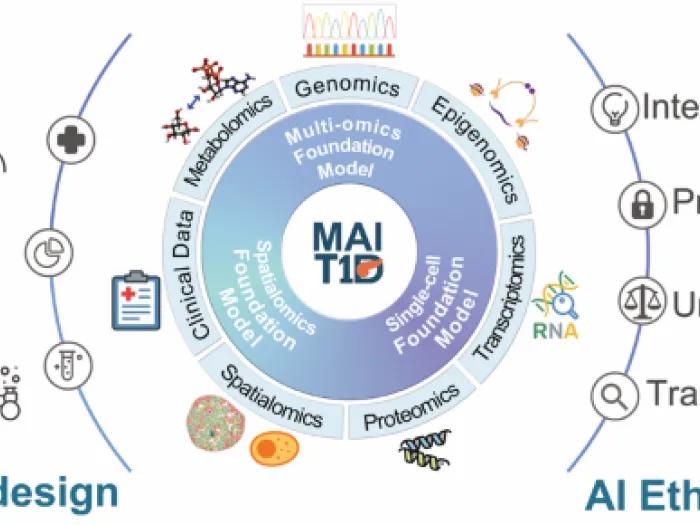
A New Collaborative to Better Predict, Prevent, and Treat Type 1 Diabetes
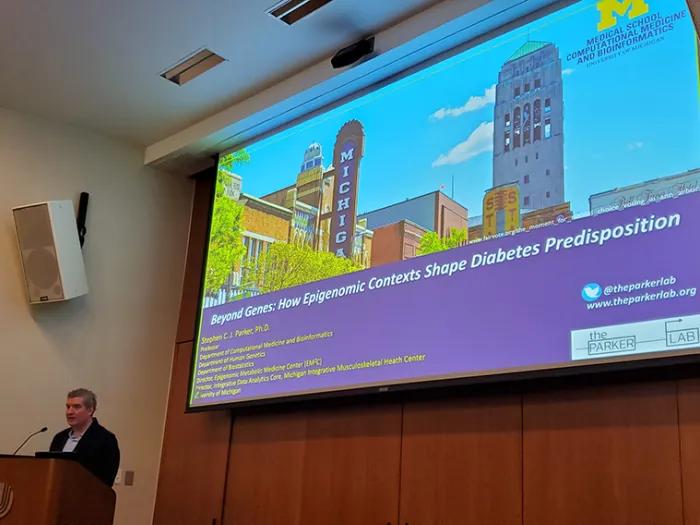
Stephen Parker gave the C. Ronald Kahn Distinguished Lecture at Harvard University