Modeling oral, heart health connections: Global REACH grant supports new partnership
The newest collaboration supported by Global REACH aims to explore connections between oral health and cardiovascular health among women.
Author |
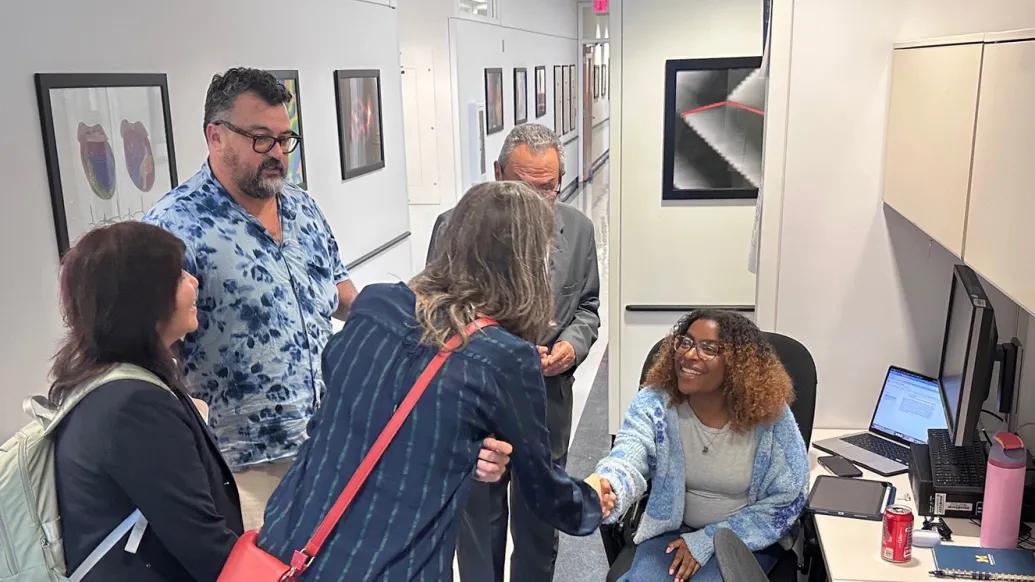
Research Assistant Professor of Internal Medicine Andre Monteiro Da Rocha has received a $10,000 Partnership Development Grant to collaborate with colleagues at the University of São Paulo (USP) in Brazil, combining ongoing research there with his expertise in creating human induced pluripotent stem cells (hiPSC) and organoids for disease modeling and basic science experiments.
“Currently, my collaborators’ project prospectively investigates the clinical ties between women’s oral and cardiovascular health using several different clinical research tools, including a large number of patient biopsy samples,” said Rocha, DVM, MSc, PhD. “When we incorporate hiPSC technologies into the project, we gain experimental freedom using human models that allow us to precisely test different conditions including hormones, energy source, oxygen levels and to manipulate the expression of candidate genes.”
Rocha also serves as director of the Michigan Medicine Cell Regeneration Core, which creates disease specific experimental models derived from hiPSCs. Produced by taking regular adult cells—like skin or blood cells—and reprogramming them to act like stem cells, hiPSCs can be transformed into almost any cell type in the body, making them an extremely versatile lab tool.
Offered twice annually, Partnership Development Grants are intended to help UMMS faculty develop new international collaborations. Rocha completed his PhD at USP before joining Michigan Medicine in 2011. While he has previously engaged with colleagues there, this will be his first time leading such a collaboration. His partners, Drs. Silvia Lourenço and José Antonio Franchini Ramires, plan to visit Michigan Medicine this fall, and Rocha expects to travel to São Paulo in spring 2026.
Lourenço and Ramires are studying the relationship between oral health and cardiovascular diseases throughout women’s lifespan, including menopause, a period in which many women experience xerostomia (dry mouth). Xerostomia is associated with oral health issues like tooth decay and gum disease, which in turn can increase the risk of certain cardiovascular conditions. By developing and using salivary gland organoids grown in Rocha’s lab, the team will be able to manipulate hormones and run experiments to study how different phases of reproductive life affect production of saliva.
In addition to advancing the science, Rocha hopes the collaboration will open the door to bilateral exchange and training opportunities for students and post-graduate learners. He plans to host a USP fellow in his lab next year to learn techniques for designing and running experiments using hiPSC-derived models. There may also be opportunities for UMMS learners to engage with training at USP’s Heart Institute (Instituto do Coracao – InCor) in São Paulo. The health system affiliated with USP is the largest in Latin America, and its Heart Institute alone has more than 500 beds, Rocha noted.
“The research potential is fantastic, but another benefit is the opportunity for residents and medical students to train there and gain experience with a high volume of clinical cases in a high-tech universal health care system,” he said. “It feels good to help establish a new partnership with my alma mater and potentially open new avenues of collaboration.”
Featured News & Stories

MyVoice poll finds youth have mixed perceptions of oral nicotine pouches
Inaugural RISE Prize Recognizes Innovation in Health Sciences Education

12-year-old shares journey with sickle cell anemia on Capitol Hill
LGBTQ+ Aging in America

Michigan’s aging brains need more protection, poll shows